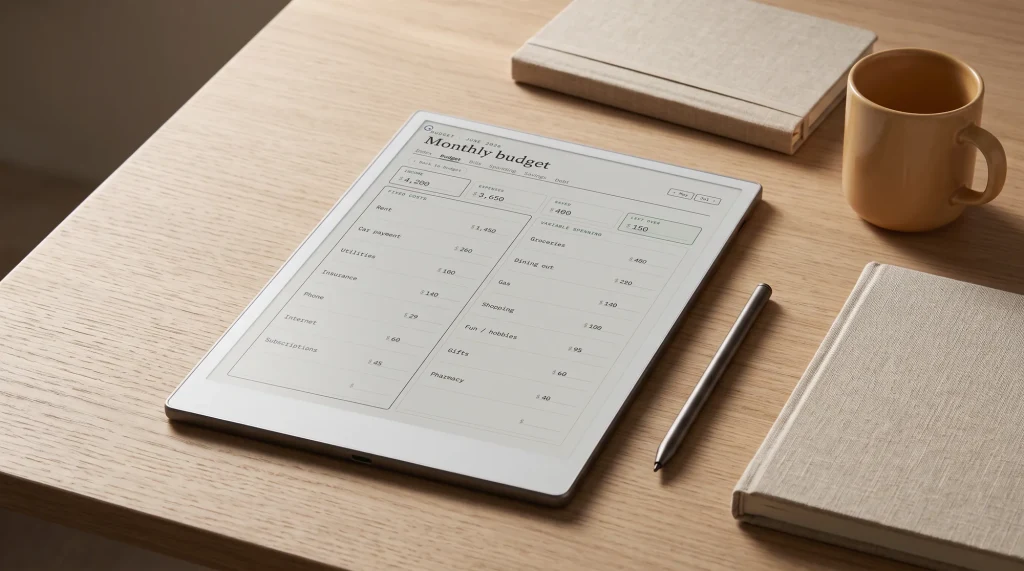
The idea
What a net worth tracker actually does
A net worth tracker records a single number each month: everything you own minus everything you owe. Cash, savings, investments, and the value of anything big you could sell go on one side; mortgages, loans, and card balances go on the other, and the difference is your net worth. A net worth tracker keeps that figure in one place, snapshotted month by month, so you stop reacting to a single day’s account balance and start watching the trend. It is the widest-angle view in personal finance, the one number that captures whether the whole plan is moving in the right direction.
The mechanism is plain arithmetic done on a schedule. Once a month you write down each asset and each debt, add up the two sides, and record the difference next to the date. Over a year that becomes a line, and the line is the point: it smooths out the noise of a good or bad week and shows the direction. A single balance can lie to you on any given day; a net worth line, tracked monthly, tells the truth about the trend.
Why e-ink
Why an e-ink tablet suits a monthly net-worth check
Checking net worth is a once-a-month job, not a daily one, and that is exactly the rhythm an e-ink tablet rewards. The screen does not glow, does not notify, and does not sit inside the same phone that shows you a market app blinking red and green all day. You open the tablet on the first of the month, update the figures, note the new number, and close it, and the calm of that ritual is part of why it lasts. A reMarkable, a Kindle Scribe, or a writing-capable Boox all handle it equally well, because the job is small: hold a table, take a few figures, keep them. Watching net worth daily is a recipe for anxiety; watching it monthly, by hand, on a page that does nothing else, is a recipe for perspective.
There is a fair trade to name. An app can link your accounts and update the number for you in real time; a hand-kept tracker asks you to write the figures in once a month. What you get for that is distance from the daily swings and a deliberate moment to actually look. People who check a live number constantly tend to feel worse and act rashly; people who log it once a month tend to see the trend and stay the course. The small effort of writing it down is what buys the calm.
The method
How to set up a net worth tracker
A net worth tracker fails when it is too fiddly to update or so detailed you dread the monthly count. The setup below keeps it to a few minutes a month, and it takes about twenty minutes once to build.
List what you own, in rough figures.
Cash, savings, investments, pensions, and the resale value of anything big like a car or home. Round to the nearest hundred; precision matters far less than tracking the same way each month.
List what you owe.
Mortgage, car loan, student loans, card balances, and any money you owe a person. These are the second side of the equation, and shrinking them lifts your net worth just as much as saving does.
Subtract, and log the number with the date.
Add up each side, take the difference, and write it next to the month. That one figure is your net worth; everything else on the page is just the working behind it.
Repeat on the same day each month.
Pick a date, the first of the month works well, and update it then, every month. Consistency is what turns a column of figures into a trend line you can actually read.
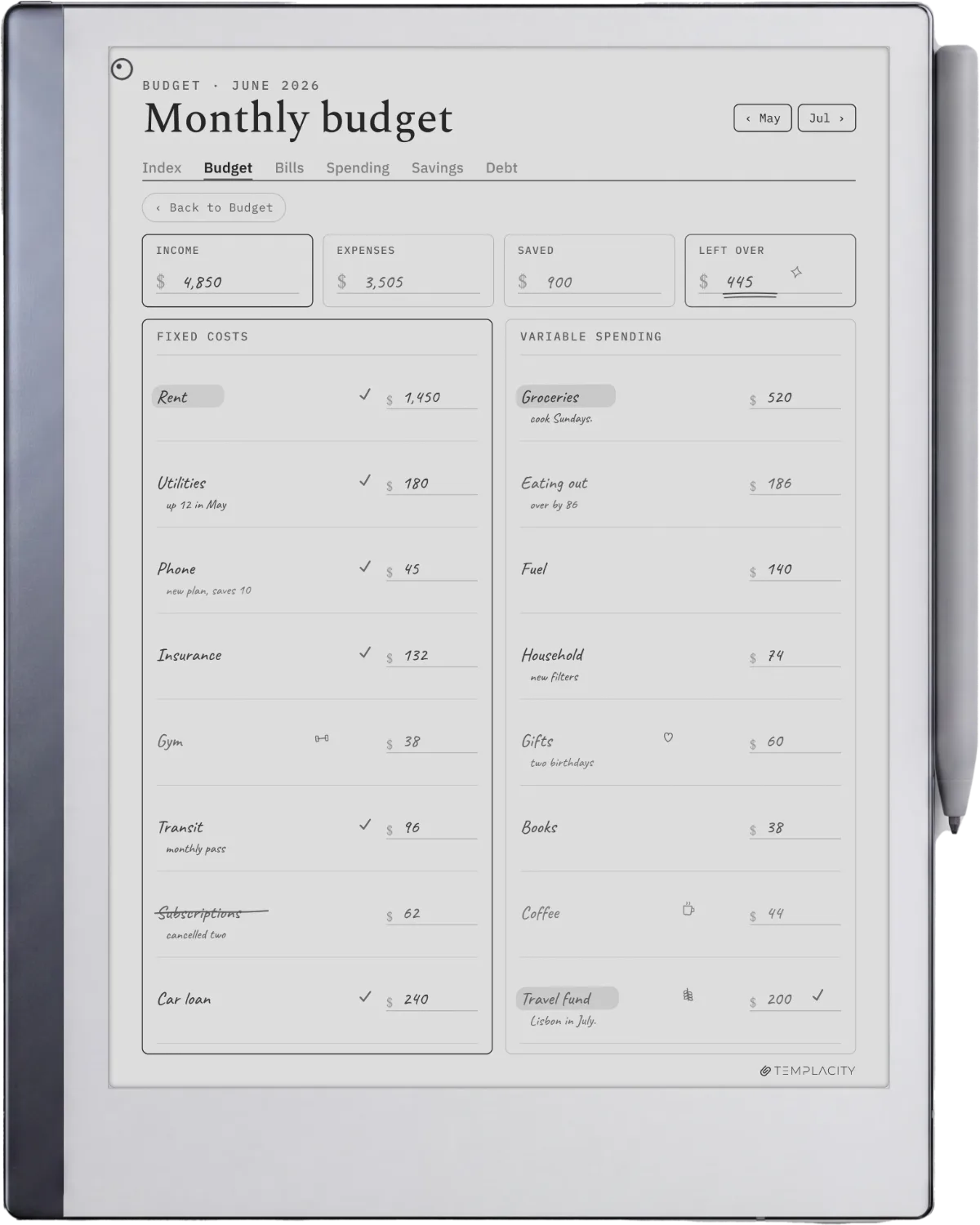
Keep the file dated rather than blank. A net worth tracker dated for 2026 and 2027 gives you a row per month already laid out, so you just drop the figure in and watch the line build. An undated grid makes you draw and date the timeline yourself, the small friction that ends most trackers by spring. Net worth is a multi-year story, and a dated file is the one that carries the line from one year into the next without a reset.
The two sides
What counts as an asset and a liability
Keep the definitions simple, because a net worth tracker is only useful if you count the same things the same way each month. An asset is anything you own that has real resale value: cash, savings, investments, pensions, a car, a home. A liability is anything you owe: a mortgage, loans, financing plans, card balances. Skip things you would never actually sell or that have no resale value, like furniture or clothes, because padding the number just fools you. The honest version counts only what you could turn into money and everything you genuinely owe.
Skip things you would never actually sell, because padding the number just fools you; count only what you could turn into money and everything you genuinely owe.On counting honestly
One judgment call comes up a lot: your home. If you own one, include its rough market value as an asset and the mortgage as a liability, which nets out to your equity. Some people prefer to leave the home out entirely and track only liquid net worth, the money they could actually reach. Either is fine, as long as you pick one and keep it consistent, because the trend only means something if the method does not change month to month.
The bigger picture
Where net worth fits with the rest of your money pages
Net worth is the scoreboard; the other pages are the game. A debt payoff tracker shrinks the liability side, a savings tracker grows the asset side, and every month both show up in the single net worth figure. That is the quiet satisfaction of tracking net worth: the small, dull habits on the other pages, the payments and the deposits, add up to a line that visibly climbs. When a month feels like it went nowhere, the net worth trend often shows it did.
If you want the wider view, our digital budget planner guide covers picking one for reMarkable, Kindle Scribe, and Boox, with the net worth page as the summary at the front of it. Keep it on the same tablet as your reMarkable planner or Kindle Scribe planner so the money pages sit beside the week they belong to.
How people define their net worth is personal, and one person counts the house while another tracks only what is liquid, so if you keep a net worth tracker, tell us in the comments what you include and how often you update it. The honest account of what people actually count is worth more to the next reader than any template, and it helps us build the page around the way people really measure progress.
FAQ
Common questions, answered briefly
What is a net worth tracker?
How often should I update my net worth?
Should I include my house in net worth?
What counts as an asset?
Can I keep a net worth tracker on a Kindle Scribe or Boox?
If yours isn’t above, drop the question in the comments and we’ll add it.
People also ask