The brief
What the best digital work planner has to do
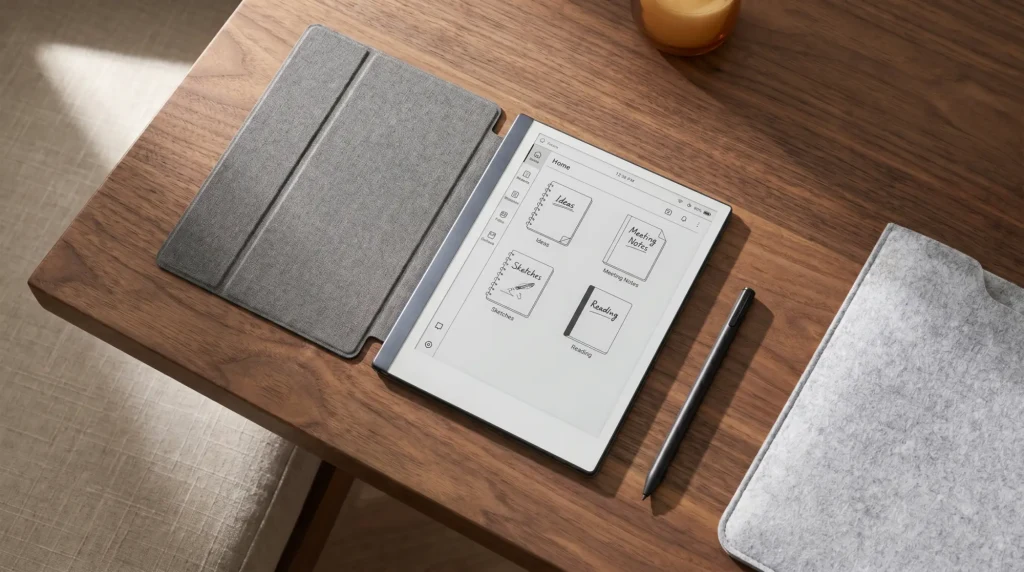
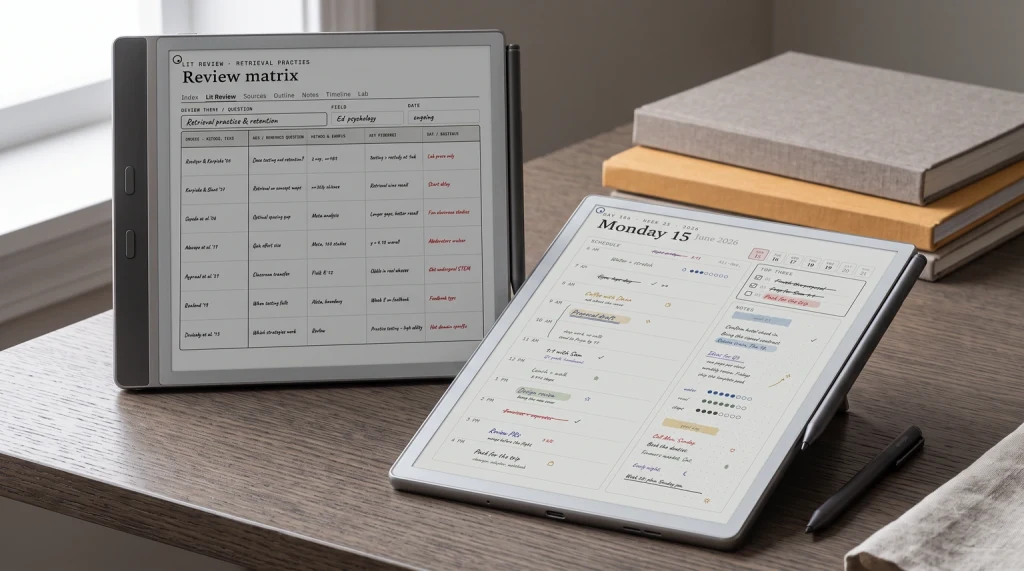
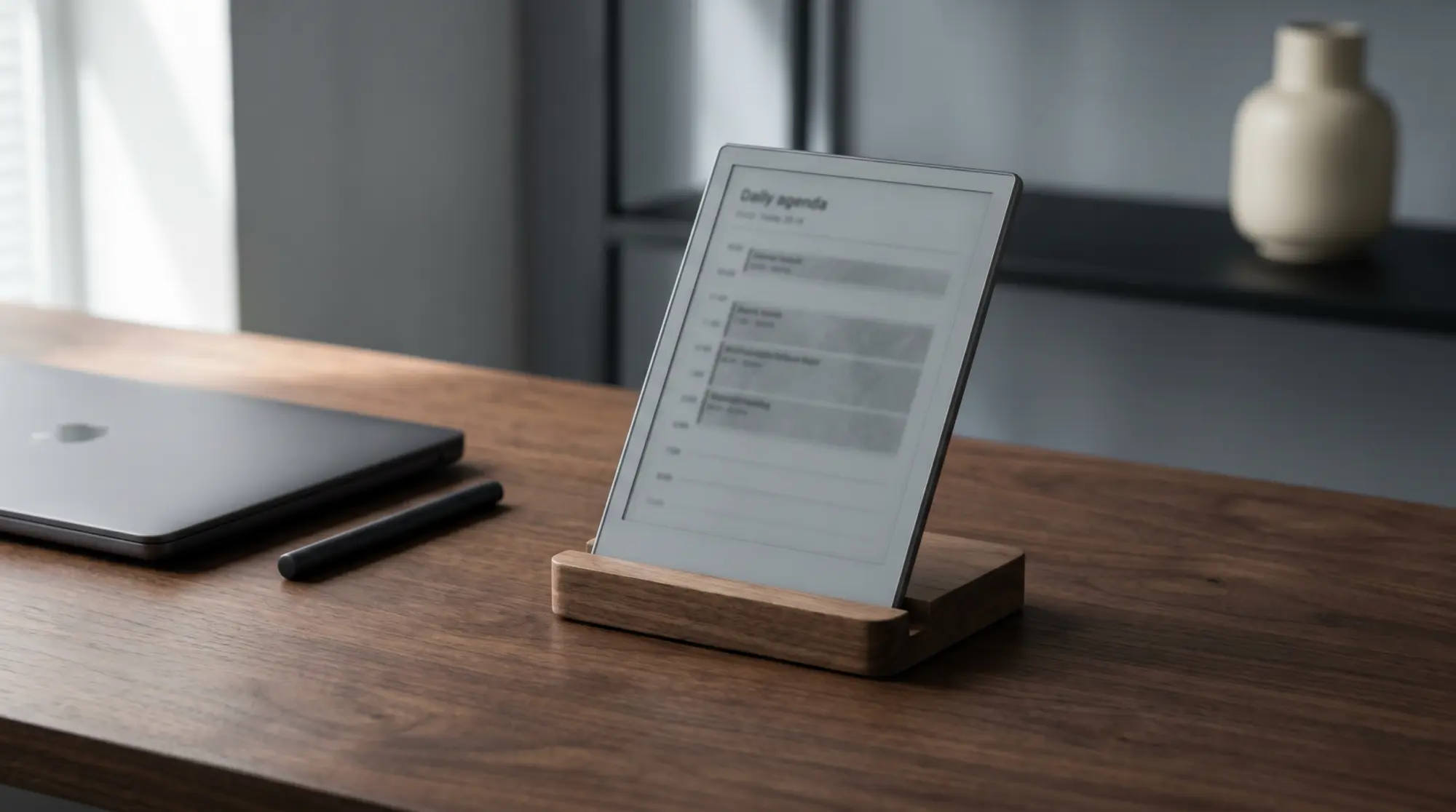
A digital work planner is a planner PDF, built with tappable links, that you load onto an e-ink tablet and write on by hand through the working day. The job it does is easy to state and easy to get wrong: it has to show today’s agenda, take you from the week to a single day or a single project in one tap, and give you somewhere to hold the to-dos, the meeting notes, and the next steps that otherwise scatter across a dozen tabs. A task app can hold some of that, but it pings you while you are trying to think, and a paper pad cannot link a deadline to the project it belongs to. The best digital work planner sits between the noisy app and the loose notebook, a quiet page you actually plan on, and the rest of this guide is how to choose one that fits your tablet and your week rather than one that looks productive in a screenshot and goes unused by the second sprint. If every planner you have tried has ended that way, the problem is more likely the layout than the effort, and our ADHD planner guide covers which layout choices decide it.
Three things separate a work planner you keep from one you abandon. It has to be hyperlinked, so moving from the week to today or to a live project is a tap and not a scroll. It has to be dated to a real year, so the weeks are built and recurring work lines up. And it has to carry the pages a working week actually needs, which is a shorter list than most productivity templates admit. Get those three right and the tablet becomes the one surface your week lives on.
- Hyperlinked: tap from the week to a day, to a project page, to meeting notes, without losing your place
- Dated: the year mapped for you, ideally two years so projects carry forward
- Pen-ready: agenda and task lines sized for fast handwriting, not fiddly typed entry
- Focused: a daily agenda, a weekly to-do list, project pages, and meeting notes, with little filler beyond that
Tablet first
Match the work planner to your tablet
The most common mistake is choosing a planner before checking it suits the tablet on your desk. A file built for a 10-inch writing surface can feel cramped on a 6-inch reader, and an agenda laid out for one pen can ignore the pressure and palm rejection of another. So start from the hardware. If you already own a reMarkable, a Kindle Scribe, or a writing-capable Boox, the work planner has to be made or sized for it, because the link spacing, column widths, and margins are all tuned to a screen. A planner sold per device exists for that reason, and a generic one that claims to fit everything usually fits none of them well by Thursday afternoon.
This is also where the calm of e-ink earns its place at work. A planner on a matte screen does not surface notifications while you are mapping the week, which is the quiet most knowledge work is missing. The short version is that all three brands write well on e-ink; the difference is software and ecosystem, not whether the work planner will run. Decide the device, then buy the planner built for it.
| Device | Best for | Daily planning | App flexibility |
|---|---|---|---|
| reMarkable | Deep, distraction-free work planning | Excellent, fast and quiet | Closed, focused |
| Kindle Scribe | Planning plus reading reports in one device | Strong on the writable PDF | Limited, reading-led |
| Boox | Planning plus the work apps you cannot drop | Good, with adjustable tools | Open Android |
The pages
The pages a work planner actually needs
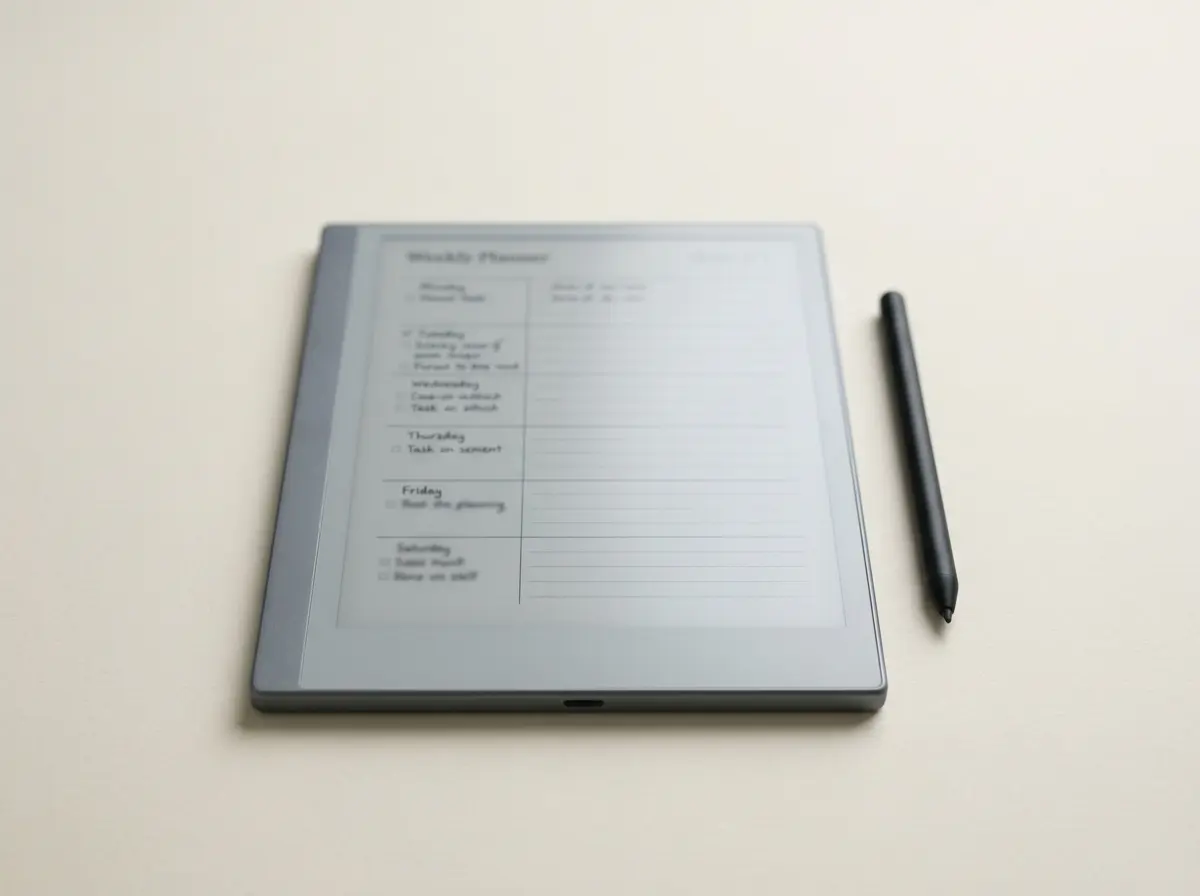
A work planner does not need fifty page types; it needs the few that carry a working week. The backbone is a daily agenda with time blocks, so meetings and focus work share one honest view of the day. Under that sit a weekly to-do list that survives across days, project pages so each workstream has a home with its own next step, and a meeting-notes section so decisions do not vanish into a chat thread. Recurring tasks deserve their own checklist. Almost everything past that is filler that looks productive and goes unfilled.
Most lost work is not a planning problem, it is a where-does-this-go problem, and the right page gives each kind of work a home. The matrix below maps the work pain you keep hitting to the single page that handles it, which is a quicker way to judge a planner than counting its tabs.
| If the week keeps slipping on | The page that handles it | Why it works |
|---|---|---|
| Days lost to back-to-back meetings | Daily agenda with time blocks | Focus work gets booked like a meeting, not squeezed into the gaps |
| To-dos scattered across apps | Weekly to-do list | One list that carries across days beats five half-tracked ones |
| Projects with no clear next step | A project page per workstream | Each project holds its own next action, so nothing stalls unseen |
| Decisions lost in chat threads | Meeting notes section | The outcome and the owner are written down where you will find them |
| The same tasks slipping every week | Recurring checklist | Routine work is a checkbox, not a thing you re-remember |
One honest note on naming, since the search results blur it. A work planner is for running your week; a “business planner” in the search box often means business-plan software for starting a company, which is a different tool entirely. If you want to map your weeks, projects, and meetings by hand, that is the planner this guide is about. If you want to write a funding document or a company plan, that lives in a word processor, not a hand-written agenda.
Device fit
reMarkable, Kindle Scribe, or Boox for work
All three write well on e-ink, so the choice comes down to how each fits your working day. If you want deep focus and nothing pulling at your attention while you plan, reMarkable is the calm pick, and a planner pairs with it the way our reMarkable planner guide lays out. If you read reports and documents as much as you plan and want one device for both, Kindle Scribe writes on the same screen you read on, which our Kindle planner guide covers. If your work depends on a specific app, a writing-capable Boox gives you open Android beside the planner. None is wrong; they suit different jobs.
Work and money sit close together for anyone running their own time, so a work planner often pairs with a budget. If you also track invoices, expenses, or a freelance income, our digital budget planner guide covers the money side on the same tablet, so the week you plan and the income it earns live one tap apart rather than in two separate tools.
Dated or not
Why a dated work planner beats an undated one
Work runs on a calendar whether you like it or not, and a dated file is what keeps your planning honest against it. A work planner dated 2026 and 2027 lays the weeks out for you, numbers them, and opens to today, so you start planning rather than ruling up a grid first. An undated planner asks you to date every page yourself before the first deadline, which is busywork you will abandon the first busy week. The dated file does the opposite: it carries a quarter or a project from one year into the next, so the work you scoped in autumn is right there when it lands in the new year.
That two-year span matters for work because projects rarely respect a single calendar year. A planner that covers 2026 and 2027 follows a long initiative from kickoff to close without a second purchase, and lets you look back across a full year of weeks to see where your time actually went. It is the difference between a tool for your work and a blank book you have to set up before any of the real planning starts.
An undated planner asks you to date every page yourself before the first deadline, which is busywork you will abandon the first busy week.Why dated wins
In practice
Getting the most out of a digital work planner
Once the planner is loaded, a few habits decide whether it survives a real quarter. Plan the week in one short sitting, blocking focus time before the meetings fill the day, so the agenda reflects your priorities and not just other people’s. Keep every project on its own page with a visible next step, so nothing stalls quietly while you stare at a long list. Run a five-minute review at the end of each day to roll unfinished tasks forward, which is what stops a to-do list from becoming a graveyard. Back the file up to cloud storage, because a work planner is a single PDF and a lost tablet should never mean a lost quarter. And resist collecting page types you will not open; a digital work planner works because it is one focused file, and every extra tab is one more thing between you and the agenda you came to write.
A work planner only proves itself across a real quarter, so if you have run one through a project or two, tell us in the comments which pages you open every day and which you never touched. The honest list of what working people actually use is worth more to the next reader than any feature count, and it helps us shape the Professional pages around how a real week runs.
FAQ
Common questions, answered briefly
What is a digital work planner?
Which tablet is best for a digital work planner?
What is the difference between a work planner and a business planner?
Should a work planner be dated or undated?
Can I use a digital work planner on a Kindle Scribe?
If yours isn’t above, drop the question in the comments and we’ll add it.
People also ask