The idea
What sinking funds are, and what the tracker does
A sinking fund is money you save a little at a time for a cost you know is coming but that does not arrive every month: car insurance, a service, the holidays, an annual subscription, a dentist visit. A sinking funds tracker is the page where those funds live, one column per fund, topped up on payday and drawn down when the bill lands. The idea is old and simple, and it fixes the single most common way a budget blows up: a large, predictable charge that still somehow arrives as a surprise. Save a twelfth of it each month and the surprise disappears, because the money is already there.
The mechanism is plain. Each fund has a name, a target, the month it is needed, and the monthly amount that gets it there, plus a shaded balance you update as you go. A figure for the combined balance across every fund tells you how much of your savings is already spoken for, which is the number that stops you spending money that is really earmarked for the car. That is the whole tool, and it turns the scariest part of a year, the irregular bills, into a calm grid you have already handled.
Why categories
Why categorized funds beat one big pot
You could save for all of it in a single savings account, and many people do, right up until two big bills land in the same month and they cannot tell whether the money was for the car or the holiday. Sinking funds fix that by keeping each cost in its own labelled column, so the balance you see against “car” is genuinely for the car and nothing else. The separation is the point: it stops you raiding one goal to cover another and then wondering, in October, why the money you thought you had saved is gone. An e-ink tablet holds this beautifully, because a grid of labelled funds is exactly the kind of calm, always-there page it does best.
There is a fair trade to name. More columns mean more to top up each payday, and a wall of twenty funds is as abandonable as any over-built tracker. The fix is to run only the funds that matter, four to eight of them, and fold the tiny costs into a single “miscellaneous” line. Keep it to the irregular bills that actually wreck a month, and the tracker stays quick enough to keep.
The method
How to set up a sinking funds tracker
A sinking funds tracker fails when it has too many columns or no fixed moment to top them up. The setup below is quick to keep and clear to read, and it takes about twenty minutes once, before the first payday.
List the irregular costs that wreck a month.
Go through a year and write down the bills that do not come monthly: insurance, car service and registration, holidays, gifts, home repairs, annual subscriptions. These are your funds; the small stuff folds into one miscellaneous line.
Divide each by the months until it is due.
An eight hundred dollar insurance bill ten months away is eighty a month. Writing the monthly slice beside each fund turns a scary yearly number into a payday-sized one you can actually set aside.
Give every fund its own column.
One labelled column per fund with a target, a due month, and a shaded balance. The separation is what keeps each cost honest, so you never spend the holiday money on the car by accident.
Top them up on payday, then leave them alone.
Move each monthly slice the day money lands and shade the balances up. When a bill arrives, draw only from its own fund. A tracker topped up on payday works; one fed by leftovers does not.
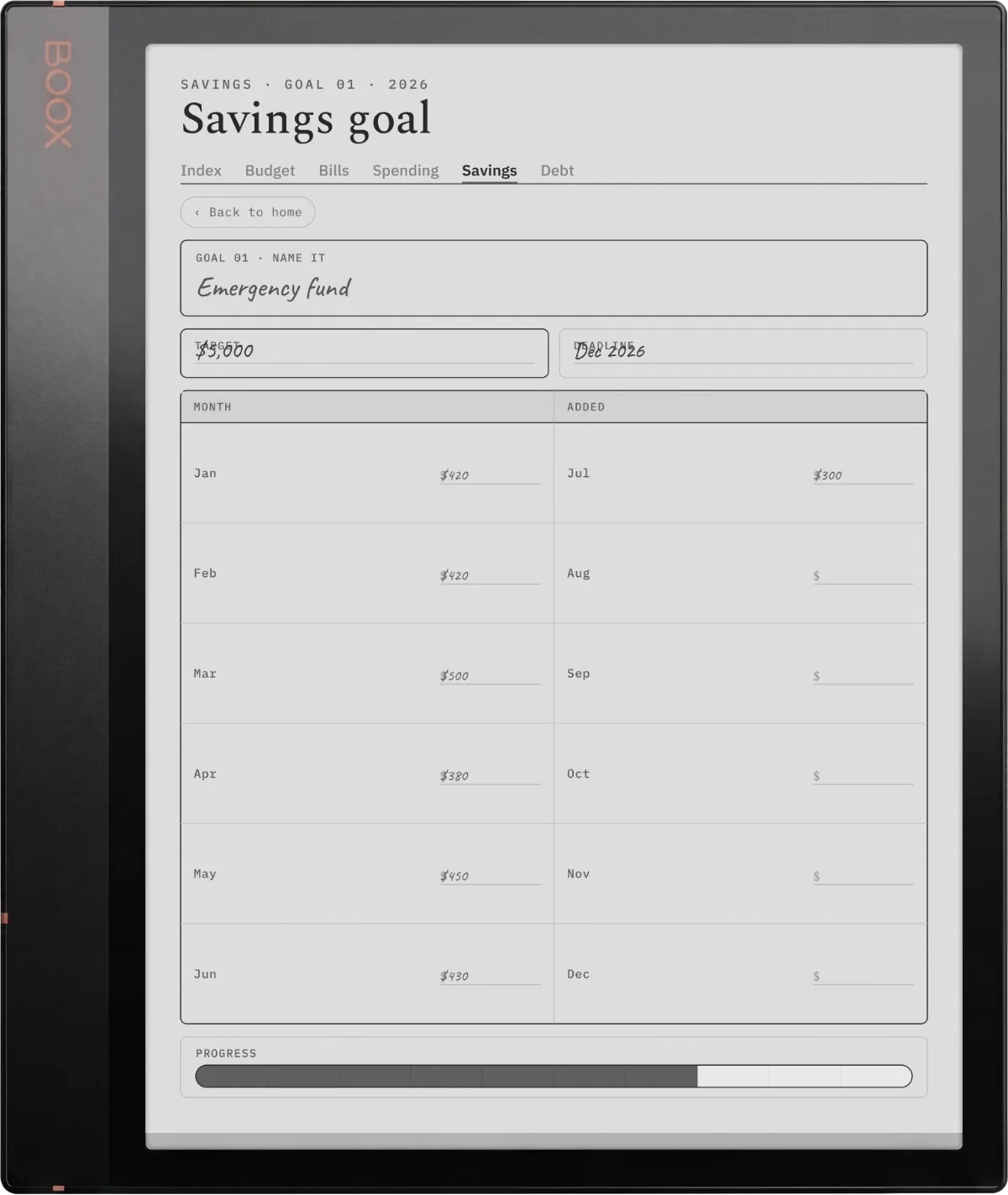
Keep the file dated rather than blank. A sinking funds tracker dated for 2026 and 2027 lines each fund up against the month it is due, so you can see at a glance whether the car fund will be full in time or needs a bigger monthly slice. An undated grid makes you map the calendar yourself, the small friction that ends most trackers by spring. Irregular bills are a year-round problem, and a dated file is the one that carries every fund across it.
Which funds
The sinking funds most people need
Most households need the same handful, and starting there beats inventing a long list you will not keep. A car fund covers insurance, servicing, tyres, and registration, the classic ambush bills. A holidays-and-gifts fund smooths the end of the year, which is where a lot of budgets quietly break. A home fund covers repairs and appliances that fail without asking. An annual-subscriptions fund catches the renewals that hit once a year. And a medical or dental fund covers the visits insurance does not. Five funds like these handle the bulk of what surprises people, and you can always add one when a new irregular cost shows up.
A holidays-and-gifts fund smooths the end of the year, which is where a lot of budgets quietly break.On which funds to keep
These funds sit right beside your regular bills, which is why the two pages work best together. The recurring monthly costs live on your digital bill tracker, and the sinking funds cover the ones that only come once or twice a year, so between them nothing predictable ever catches you short.
The bigger picture
Where sinking funds fit with bills, savings, and a budget
Sinking funds sit in the gap between a bill tracker and a savings tracker. A bill tracker watches what leaves your account every month; a savings tracker watches a goal you are building toward; sinking funds cover the known costs in between, the ones that are neither monthly nor optional. Kept together, the three mean the only things that can surprise your budget are the genuinely unexpected, which is what an emergency fund is for. Everything predictable already has a column.
If you want the wider view, our digital budget planner guide covers picking one for reMarkable, Kindle Scribe, and Boox, with the sinking funds page as one part of it. Keep it on the same tablet as your reMarkable planner or Kindle Scribe planner so the money pages sit beside the week they belong to.
Sinking funds are personal, and the columns one household needs look like clutter to another, so if you keep a sinking funds tracker, tell us in the comments which funds earned a column and which you dropped. The honest list of what people actually save for month to month is worth more to the next reader than any template, and it helps us build the grid around the bills that really ambush people.
FAQ
Common questions, answered briefly
What is a sinking funds tracker?
How are sinking funds different from a savings account?
What sinking funds should I start with?
How much should I put in each sinking fund?
Can I keep a sinking funds tracker on a Kindle Scribe or Boox?
If yours isn’t above, drop the question in the comments and we’ll add it.
People also ask