The shape of it
What a commonplace book is, and what it is not
A commonplace book is a notebook where you copy down the things you read that you want to keep: a sentence from a novel, a fact from a paper, a line overheard, a recipe, a proof. The entries are filed under subject headings rather than by date, and the heading is the point. You are not recording what happened to you today; you are building a private reference book out of everything you have read, arranged so that you can find a given thought again when you need it years later.
That single rule, headings rather than dates, is what separates it from three things it is often confused with. A diary or journal is chronological and looks inward; the day is the unit and you are the subject. A reading journal is organised by book; the volume is the unit and your reaction to it is the content. A commonplace book is organised by idea; the topic is the unit and other people’s words are most of the content. Locke put it plainly enough in the seventeenth century, and the definition has not moved since: you find a proper head for the passage, and you file it there.
It is also not a Zettelkasten, though the two get lumped together as personal knowledge systems. A Zettelkasten wants your own thinking, one idea per card, in your own words, linked to other cards. A commonplace book wants the original sentence, verbatim, with its source, filed once. The Zettelkasten is a machine for producing writing; the commonplace book is a larder. You can run both, and plenty of writers do, but they answer different questions. One asks what you think. The other asks what is worth keeping.
Where it came from
Twelve centuries of people copying out the good bits
The habit is older than the name. By the eighth century, monastic scholars were compiling extracts from scripture and the Church Fathers into collections called florilegia, literally gatherings of flowers, and by the thirteenth century those gatherings were being arranged by theme so a preacher could find every passage on, say, humility in one place. That is the whole mechanism already: excerpt, heading, retrieval. In fifteenth-century Italy the vernacular version was the zibaldone, which Giovanni Rucellai called a salad of many herbs, a small book of devotional, technical and literary scraps in no particular order. Erasmus then gave the practice a method in De Copia, arguing that a student should collect examples under organised heads, and he travelled with a chest of such notes that became the raw material for his Adagia.
The name we use came out of that Renaissance schoolroom, where the loci communes, the common places, were the standard headings under which a rhetoric student stored material for future arguments. What turned it from a schoolroom exercise into a lifelong personal instrument was John Locke. He worked out his own filing system over twenty-five years of note-taking, published it in French in 1685 as Méthode nouvelle de dresser des recueils, and it appeared in English in 1706, after his death, as A New Method of Making Common-Place-Books. Publishers went on to print blank notebooks pre-ruled to his design, which is the first commonplace book template in the modern sense.
After Locke the roll call is long and not especially surprising. Milton kept one with page references for the tracts and poems he was building toward. Jefferson kept two, one literary and one legal. Emerson and Thoreau both taught the practice at Harvard, and their own books survive in print. Hardy kept his in the formal Renaissance manner; Coleridge, Twain and Woolf kept theirs in a mess. W. H. Auden published his as A Certain World in 1970. The point of the list is not that clever people did it. It is that the practice survived the printing press, the typewriter, the card index and the search engine without changing shape, which usually means the shape is doing something the tools cannot.
The failure
Why most commonplace books are write-only
Ask anyone who started one and stopped, and the story is the same. The first month was a pleasure: a beautiful notebook, a good pen, a dozen pages of sentences worth keeping. Then one evening they wanted a particular line, something about grief or compound interest or the sea, and they could not find it. They flipped, they skimmed, they gave up, they searched the web for it instead and found it in four seconds. The notebook went back on the shelf and the entries slowed, because some part of them had learned that writing things in it did not make them retrievable. The book had become write-only.
This is not a failure of discipline, and it is worth being clear about that, because most advice online treats it as one. It is a failure of design. A notebook filled front to back in the order you happened to read things is a diary of your reading, and a diary is retrieved by date. But you never want a quotation by the date you copied it. You want it by what it is about. The medium and the retrieval key disagree, and the retrieval key loses every time.
A notebook you cannot find anything in is not a commonplace book. It is a very slow way of forgetting.On the write-only failure
The apps do not fix this so much as move it. Highlight-sync tools will pull every marked passage out of every book you read into one long feed, and the feed grows faster than anyone reads it. Ten thousand highlights with no headings is the write-only failure at scale, with the added cost that you never even copied them out, so nothing about the passage went through your hand. The keepers who last, on paper or on a screen, all do two things the feed does not: they choose a small fraction of what they marked, and they file each choice under a head they picked themselves. Selection and heading. Everything else is stationery.
The fix, from 1685
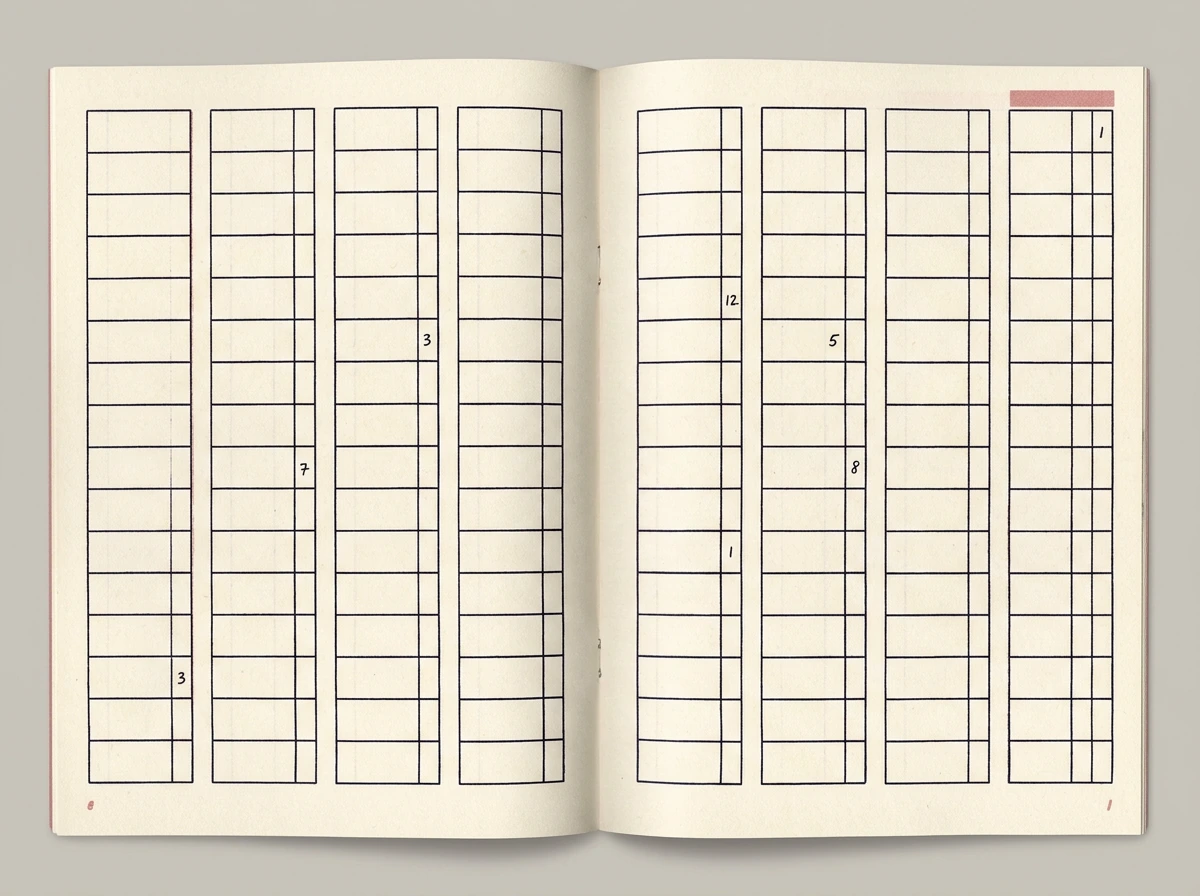
Locke’s index, explained in one page
Locke’s problem was the one above, with an extra constraint: paper was expensive and a notebook had a fixed number of pages. He could not give every subject its own section in advance, because he did not know which subjects would come up or how much room each would need. And he could not simply alphabetise, because a full alphabetical index of headings would itself run to many pages and need constant rewriting. His solution fits on the first two facing pages of the notebook and needs no planning at all.
Rule the double page into a grid. Down the side, every letter of the alphabet. Across each letter’s row, the five vowels: a, e, i, o, u. That gives roughly a hundred small cells, one for each combination of a heading’s first letter and the first vowel that follows it. Locke’s own example was the heading Epistola: first letter E, next vowel i, so it lives in the cell E.i. Where no combination is possible in Latin, the cell is left out, which is why Q gets only Q.u. The cells start empty. So do all the pages of the notebook after the index.
Now you read something worth keeping. You decide its head, say Epistola. You look at cell E.i. If it is empty, you turn to the first blank page of the notebook, write Epistola at the top, copy the passage under it, and write that page number into E.i. If the cell already holds a page number, you turn to that page and add the new passage below the old ones, or on the next blank page if the old one is full, adding the second number to the cell. That is the entire system. Headings are created the moment they are first needed, pages are allocated in the order they are first needed, and any heading can be found in two steps from the front of the book: first letter, next vowel, page number.
The reason this matters three centuries later is not nostalgia. It is that the second-vowel trick is exactly the kind of retrieval structure a search box makes you think you no longer need, and then you find yourself unable to search for a line whose words you have forgotten. Search finds strings. An index finds subjects. This method has always been about the second thing, and a page of headings you wrote yourself, in the order your reading produced them, is a map of your own mind that no full-text search reproduces. Locke used the same layout for twenty-five years before he thought it worth publishing. Whatever medium you settle on below, keep the index.
What goes in
What an entry needs, and what does not belong
An entry in a commonplace book is short and it is exact. The passage is copied as written, not paraphrased; paraphrase is what the Zettelkasten is for, and mixing the two in one book means you can never be sure later which words were the author’s. Under or beside the passage go three small things that cost ten seconds and save an hour later: the source with a page number, the date you copied it, and one line in your own hand about why it earned the page. That last line is optional in every guide and indispensable in practice. Five years on, the passage is still good but the reason you kept it has gone, and the one line is what brings it back.
| Entry | Reads as | The rule | How it goes wrong |
|---|---|---|---|
| A quotation | A sentence you would want to say again | Verbatim, with author, title and page | Copied loosely, then quoted back to someone as the author’s words |
| A fact or figure | Something checkable you want at hand | Include the year and the source, because figures rot | A number with no date, repeated a decade later as current |
| A method | A recipe, a proof, a set of steps | Enough to perform it without the book it came from | Half the steps, and the book has gone back to the library |
| A question | Something the reading raised and did not answer | One line, dated, under its subject head | Written in the margin of the book instead, and lost with it |
| A sketch or diagram | A shape worth more than its caption | Redraw it, do not paste it; the redrawing is the reading | A photo of the page, filed nowhere, on a phone |
| Your own day | What happened, how it felt | Does not belong here. That is a diary, and it wants a different book | The two get mixed, the headings stop working, and both books die |
The hardest discipline is the first one in the table, and it is worth saying why. The temptation with a long passage is to trim it, and trimming while copying is how a book slowly fills with sentences that are almost what the author wrote. Copy less, but copy it exactly. If a paragraph is too long to copy, the honest move is to take one sentence of it and write the page number, so that you can go back for the rest. A commonplace book of short exact things is more useful than one of long approximate things, and it is also, not by coincidence, one you will keep writing in.
What about your own thoughts? They are allowed, and every historical keeper included some, but they go in under a subject head like everything else, marked so you can tell them from the quotations. A line of your own about grief, filed under grief, next to Montaigne on grief, is exactly what the book is for. A page about how your Tuesday went is not. If the thinking starts to outgrow the quoting, that is the signal to start a second system, and the atomic notes approach is the natural next step: one idea per note, in your own words, linked to the last one.
The medium
Paper, app, or e-ink tablet, and the template question
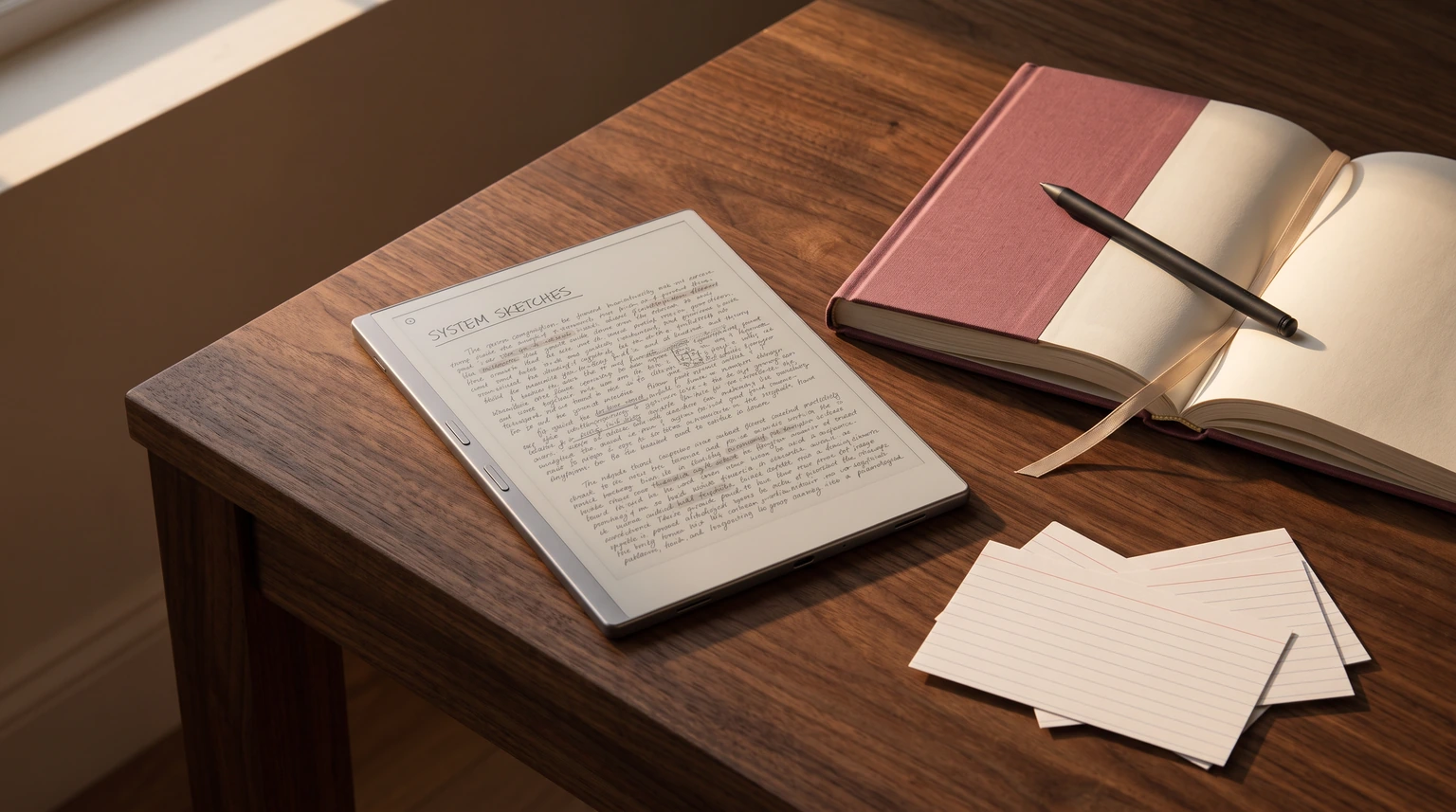
The people who have kept a commonplace book longest mostly keep it by hand, and they are unusually consistent about the reason. Ryan Holiday, whose post on the subject is the one most people find first, keeps his on 4×6 ruled index cards, a method he says he learned from Robert Greene, stored in photo boxes with dividers, one box per project. His categories were not planned; they emerged, and he tells new keepers not to worry about organisation at first. He also builds in a delay: finish the book, put it down for a week, then go back through the marked passages and transfer only the ones that survived the wait. And on the question of typing versus writing he is direct: when it costs you energy to put the words down, you are more inclined to make them count.
Cards have one enormous advantage over a bound book, which is that they can be re-sorted; the heading is a divider rather than a page, so a card can move when your categories change. They have one enormous disadvantage, which is that they are loose, and a box of loose cards is not something most people carry. A bound notebook is portable and permanent and cannot be re-sorted, which is precisely why Locke needed the index. Choose between them on that axis and nothing else. Both work. What does not work, for the reasons in the section above, is a notebook with no index or a box with no dividers.
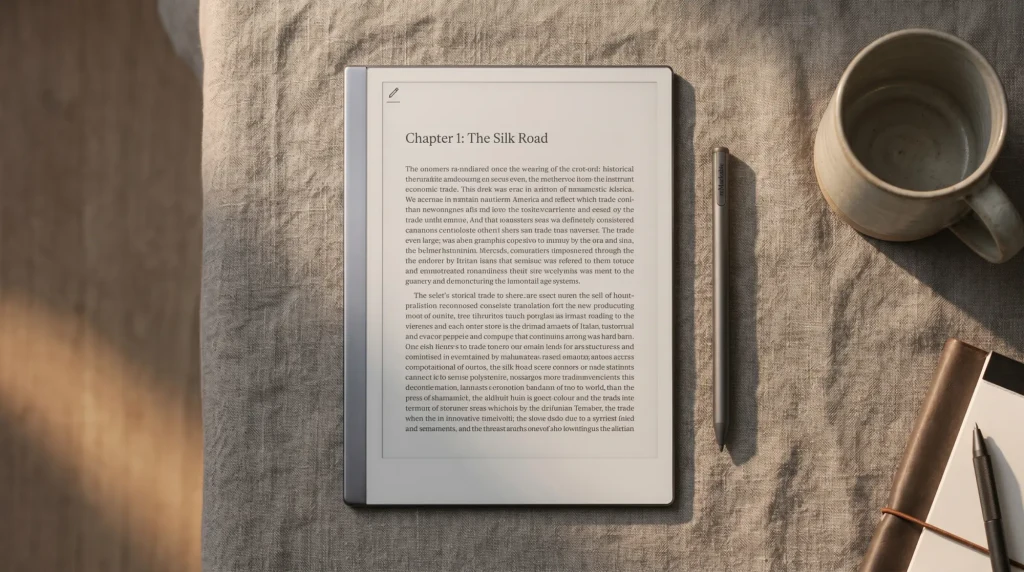
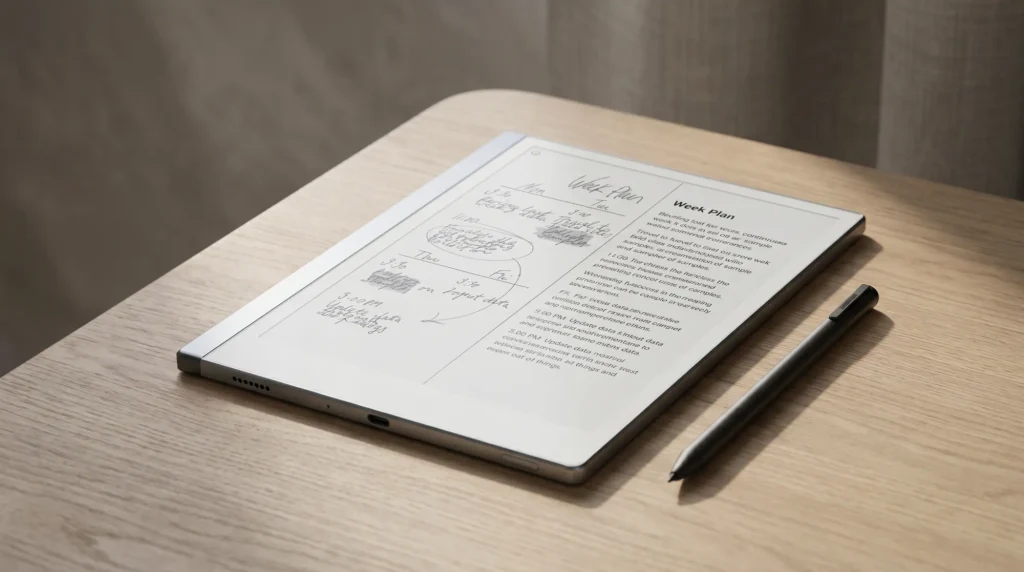
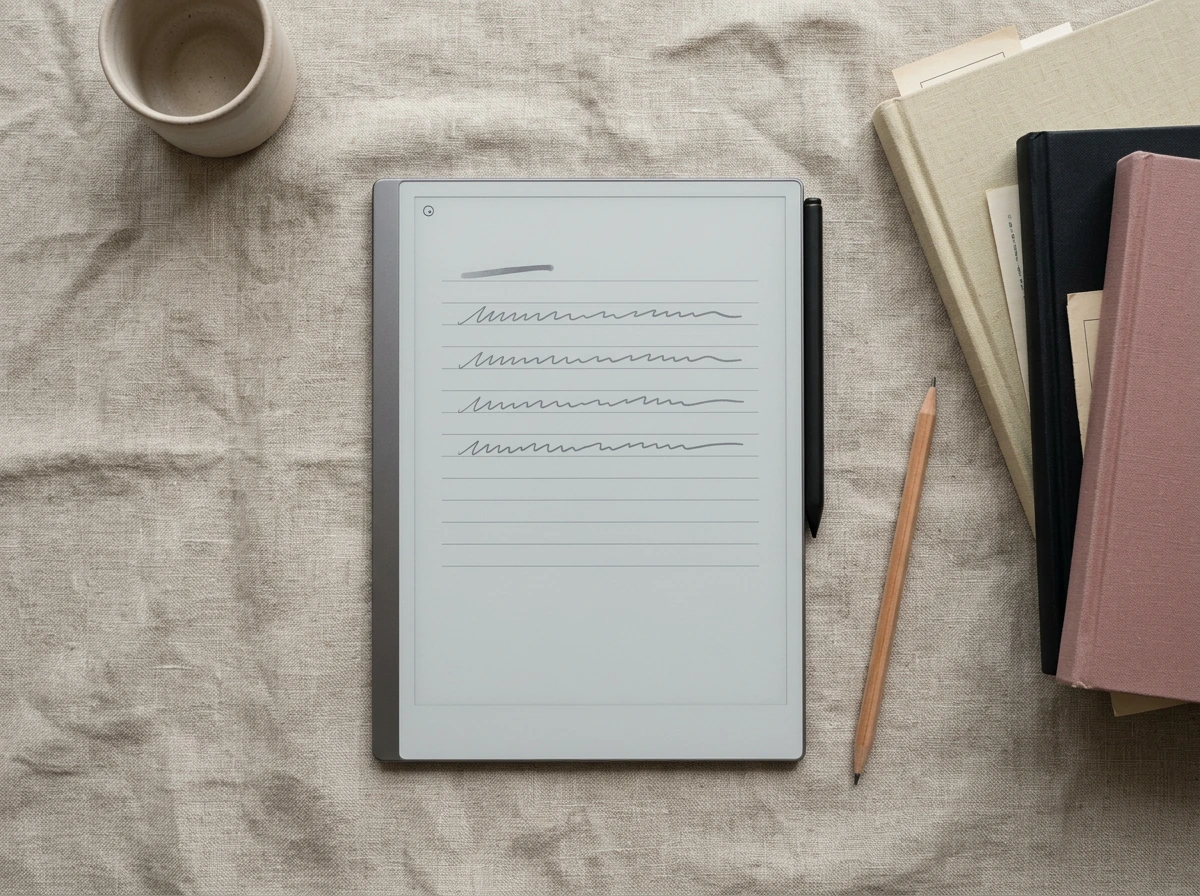
An e-ink tablet sits in an odd and rather useful position between the two. The writing is still by hand, so the energy cost that Holiday values is intact and nothing is pasted. But the notebook is no longer fixed: pages can be moved, a heading can be given its own notebook when it outgrows a page, and retrieval gets a second route alongside the index. reMarkable’s own guide to keeping a commonplace book on the device recommends exactly that route: attach tags to the book, their examples being things like Baseball, Meditation and Seabirds, so that entries can be filtered rather than flipped for, give the book a cover page, and pin it to Favorites so it is one tap away. Tags are Locke’s headings with the two-page grid done for you. We would still rule the grid on the first page, because a list of your own headings in your own order is worth having even when a filter exists, but the tablet removes the one chore paper cannot: re-copying an entry when a heading splits in two.
That last point is worth a sentence more, because commonplace book template is one of the things people search for and the answer is less exciting than the search implies. There is no format to get right. Locke’s printed notebooks were blank pages with a ruled index at the front, and that is still the whole specification. Our own free reMarkable templates page and the templates overview cover what a ruled page and a grid page look like on the device and how files get onto it; this is the least demanding thing you will ever ask of either. Spend the effort on the headings, not the layout.
If your reading already lives inside a notes app, the same principles hold and the trap is the same: the app will happily become a feed. The Obsidian Zettelkasten piece covers how to keep a linked-notes tool from swallowing the first month in plugins, and most of it transfers. On a Kindle Scribe the constraint is different again, and the note-taking guide for that device covers what its notebooks can and cannot do.
Starting
How to start a commonplace book in one sitting
Do the setup once, in about half an hour, with two or three books you have already read and marked. Starting with a blank notebook and a resolution is how it becomes write-only by week three; starting it with a backlog gives it twenty entries and a working index on day one, and after that it is only maintenance.
-
1
Rule the index before you write anything
First double page. Letters down the side, five vowels across. Leave the impossible cells out. Number the rest of the notebook’s pages in the corner now, while it is still empty, because you will not do it later.
-
2
Go back through a finished book, not the one you are reading
Holiday’s week of delay is the right instinct. Take a book you finished a month ago, open it at the first marked passage, and ask whether you still want it. Most of them you will not. Keep the survivors.
-
3
Name the head before you copy the passage
Decide what the passage is about in one word or two, look up its cell, and only then turn to the page. Copying first and filing later is the write-only habit in miniature.
-
4
Copy exactly, then add source, date and one line
The author’s words, the page number, today’s date, and a single line on why. Short entries. If a passage is too long, one sentence of it and the page reference.
-
5
Read the index once a week, not the book
The index is the part you reread. Two pages, thirty seconds, and it tells you what you have been thinking about lately better than any journal would, which is why the bullet journal method puts a two-page index at the front too. When a cell holds four page numbers, that heading has earned a notebook of its own.
After the first sitting the running cost is small: a marked passage or two per reading session, transferred in a batch when the book is done. What keeps the habit alive is the weekly look at the index, because that is the moment the book gives something back. A keeper who reads their index sees their own preoccupations laid out as a list of headings, notices that Attention has five page numbers and Money has one, and goes looking for what they want to read next accordingly. That is the loop the write-only notebook never closes, and it is the whole reason the method has lasted.
Headings
Commonplace book ideas: headings that earn their page
The one piece of advice every experienced keeper agrees on is not to plan the headings. Holiday’s list, Life, Death, Writing, Strategy, Narrative Fallacy, Article Ideas, Misc, grew out of what he read rather than what he intended to read, and a heading that arrives that way is one you will use. But a blank index on day one is intimidating, and it helps to know the shapes headings tend to take. These are not prescriptions. They are the kinds of head that keep filling up in the books that last.
- The big nouns. Grief, Attention, Money, Work, Sleep, Friendship, Luck. Broad on purpose; the passages under them will disagree with each other, and that is the value.
- Craft. Sentences about the thing you make, whether that is code, bread, arguments or furniture. Filed by the craft, not the author.
- Definitions. A word you met and had to look up, with the sentence it came in. This heading fills faster than any other and is the one people are most glad of later.
- Numbers worth keeping. The figure, the year, the source. A single page of these, kept honestly, is worth more than a folder of bookmarks, provided every one carries its date.
- Openings and endings. First and last lines of books. Writers keep this one obsessively; readers find it teaches them what an ending is.
- Things people said. Overheard, in a meeting, from a child. Verbatim, with who and when. The only heading where you are the primary source.
- Questions. Not answers. A page of open questions, dated, under its own head, is the closest the book gets to a to-do list, and rereading it is how the next book gets chosen.
- Against. Passages you disagree with, kept because the disagreement is useful. Marked so you never mistake them for endorsements.
- Method. How to do a thing: a proof, a recipe, a checklist, a rule of thumb. The Eisenhower matrix and the Cornell layout both started life as an entry under a heading like this in somebody’s notebook.
Nine is plenty to start and too many to keep. Within a month three or four of them will have most of the page numbers and the rest will be nearly empty, and that lopsidedness is information rather than failure. The book is telling you what you actually read for, which is rarely what you would have written down if asked. Let the headings you do not use stay empty; there is no cost to an unused cell. Let the ones you do use split when they get crowded. And keep the index the only part of the book that has to be tidy.
We are curious how other people close the loop. If you keep a commonplace book, on paper, cards or a screen, and you have a way of rereading it that actually gets used, describe it in the comments, index and all. The retrieval half of this method is the under-written half, and the good answers are mostly still in people’s notebooks.
FAQ
Common questions, answered briefly
What is a commonplace book in simple terms?
What is the difference between a commonplace book and a journal?
How do you index a commonplace book?
Do you need a commonplace book template?
Is a commonplace book the same as a Zettelkasten?
If your question is not up there, leave it in the comments and we will add it. The one we most want to hear about is how people handle a heading that outgrows its pages, because Locke’s answer was another page and a tablet’s answer is another notebook, and neither feels quite finished.
People also ask