The SQ3R method is a way of reading a textbook so that you remember it. The letters stand for Survey, Question, Read, Recite and Review, and the idea is to stop reading as if the chapter were a novel and start reading it as a set of answers to questions you asked first. It was published in 1946 by the Ohio State educational psychologist Francis P. Robinson, and it is still the reading strategy you will find in most college study-skills handouts.
Below: the five steps the way Robinson actually wrote them, the three details most guides leave out, one textbook section run through SQ3R from start to finish, what the evidence says now, how it compares with SQ4R, PQ4R and the other methods it gets mixed up with, and how to set the notes up on paper or an e-ink tablet.
The method
What is the SQ3R method?
Most students read a chapter once from top to bottom, feel that they followed it, and find a week later that very little stayed. Robinson opened his chapter on the method with exactly that student: the one who checks how thick the assignment is, reads every line, and closes the book with “a nebulous feeling that there was much he had understood but it now is jumbled.”
He then put numbers on it. In the studies he cites, several thousand high-school students averaged 53 per cent on a quiz taken straight after reading a passage, and two weeks later they could recall only about a fifth of what they had known on the day. Reading the passage again in the same sitting barely moved the score. Understanding something while you read it and being able to produce it later are two different things, and ordinary reading only trains the first.
The SQ3R method is built to close that gap. The survey and the question give the reading a target. The recite step forces you to produce the answer without the book, which is the moment you find out whether you learned it. The review fixes the whole chapter as one structure instead of thirty pages of separate sentences. It works on anything with headings: textbooks, long reports, journal articles, manuals. It suits novels badly, which have no headings and are not meant to be studied this way.
Step by step
The five steps of SQ3R, as Robinson wrote them
Here are the steps with Robinson’s own instructions put back in. The quoted lines are from the 1946 text; the timings are his, not ours.
-
S
Survey: one minute on the headings
Glance over the headings and the final summary, if the chapter has one. Robinson: the survey “should not take more than a minute and will show the three to six core ideas around which the rest of the discussion will cluster.” You are not reading yet, only learning the shape.
-
Q
Question: turn the first heading into a question
“Encoding” becomes “What is encoding, and what makes it stick?” The question has to be asked on purpose, as you reach the heading, so you know what you are reading for. One heading at a time, not a list for the whole chapter.
-
R1
Read: to the end of that section only
Read to answer the question, and stop where the section ends. Robinson calls it “an active search for the answer,” as opposed to “passive plowing along each line.” Do not write anything yet.
-
R2
Recite: look away and answer from memory
“Look away from the book and try briefly to recite the answer to your question. Use your own words and name an example.” Then jot a few cue phrases. If you cannot answer, glance back at the section and try again. Now repeat Question, Read and Recite for the next heading, and the next, to the end of the chapter.
-
R3
Review: five minutes, notes covered
Look over your cue phrases to see how the points fit together, then cover them and recall the main points; uncover each one and recall what sits under it. Robinson puts this at “probably not more than five minutes,” far faster than rereading, and adds that later reviews pay off because of forgetting.
So the real shape of the SQ3R method is not five equal steps in a row. It is a one-minute survey, then a loop of question, read and recite that runs once per heading, then a short review. A chapter with six headings means six questions, six short reads and six recitals, which is why the method feels slow the first few times and fast once it is a habit.
Done properly
Three things most SQ3R guides get wrong
Put the original next to the handouts and summaries that rank for SQ3R and three differences show up again and again. Each one weakens the method in the same direction: it moves the effort from producing the answer back to reading.
The survey grows. Robinson’s survey is a minute on the headings. Many modern versions ask you to read the introduction, the summary, the captions and the questions at the end, and set aside five or ten minutes. A long survey is a first read in disguise, and it eats the curiosity the question step depends on.
The loop disappears. Laid out as five numbered steps, SQ3R reads as: survey the chapter, write all your questions, read the whole chapter, recite, review. That version recites once, at the end, about thirty pages. The original recites after every headed section, while the section is still small enough to hold. Robinson is explicit, in capitals in the original: repeat steps two, three and four on each succeeding headed section.
The notes get copied. Robinson spends more space on notes than on any other step, because it was where his students went wrong. His three rules: no notes until the whole section is read; notes written from memory, not from the book; notes in your own words, “little more than a word or phrase.” He describes students who copy a sentence into their notes “without ever having read it (for meaning)” because it was in italics. Copying from the open book feels like reciting and is not.
Worked example
An SQ3R method example: one textbook section, start to finish
For a real example we used section 8.1 of OpenStax’s free Psychology 2e textbook, “How Memory Functions.” It is a fair test: an ordinary college textbook section, and it happens to be about the thing SQ3R is trying to improve.
Survey, about a minute. The page has three main headings: Encoding, Storage and Retrieval, with Storage split into sensory, short-term and long-term memory. That is the whole skeleton. Before reading a word of the body you already know the section’s claim: memory is a process with three stages, and the middle stage has three parts.
First loop: Encoding. Question: “What is encoding, and what makes it work?” Read to the end of the Encoding section, then look away. The cue phrases written from memory came out as: input into memory; automatic (what you had for lunch) vs effortful (test material); meaning makes it stick, the bagpipe sentences; semantic, visual, acoustic. Each phrase is a prompt, not a sentence, and each one could be expanded aloud.
Second loop: Storage. Question: “What are the stages of storage, and whose model is it?” Read, look away, recite: sensory, then short-term, then long-term; Atkinson and Shiffrin, 1968; working memory as an alternative, Baddeley and Hitch. Here the recital stalled on the dates, which is the point of reciting: a glance back at the page fixed it, and the gap was found on the day instead of in the exam.
Third loop: Retrieval. Question: “How do we get a memory back out?” Recite: recall, no cues, an essay question; recognition, comparing, multiple choice; relearning.
Review, five minutes. Cover the cue phrases. Say the three stages. Uncover Encoding and recall its three kinds; uncover Storage and recall its three parts and the two models; uncover Retrieval and recall the three ways. Whatever does not come back is what you study next.
Notice what the chapter itself says about the result. Recognition, it explains, is what a multiple-choice test asks of you; recall is what an essay asks, with no cues to lean on. Rereading trains recognition, because the page is always in front of you. Reciting trains recall. That is the SQ3R method’s whole argument, in the textbook’s own terms.
Rereading trains recognition, because the page is always in front of you. Reciting trains recall.Worked example
The evidence
Does the SQ3R method work? What the research shows
Robinson built the method from the experiments of his day, and the one that most clearly explains it is about rereading. In a study he cites, readers took an easy test after reading a passage once, then after reading it two, three and four times in a row.
Score after reading the same passage again in one sitting (per cent right)
Three extra readings bought five points, and the fourth bought nothing. Robinson’s own trials of the SQ3R method were small and would not pass a modern review: after a few days’ practice, one how-to-study class moved from the 34th to the 56th percentile on reading speed and from the 43rd to the 53rd on comprehension, and a group that learned to predict quiz questions dropped from 15 errors to 6 on a quiz of equal difficulty. There was no control group, and he leaned as much on students telling him “I predicted 15 of the 20 questions he asked.”
The stronger evidence is newer and does not test SQ3R by name. In 2013 a team of psychologists led by John Dunlosky reviewed ten common study techniques for Psychological Science in the Public Interest. Practice testing and distributed practice came out with the highest rating. Rereading, highlighting and summarizing came out low. SQ3R was not one of the ten, but its parts map straight onto that verdict: reciting with the book closed is a form of practice testing, and a later review spread over days is distributed practice. The steps that matter in SQ3R are the ones the research backs, and the habits it replaces are the ones the research marks down.
Since then, a run of small classroom studies, several of them with school students reading in a second language, have compared SQ3R with ordinary reading lessons and mostly found it helps. They are useful as a sign that the method transfers to classrooms, not as proof of how much it helps, because most are single-school studies with short follow-up.
Where it comes from
Where SQ3R came from: Survey Q3R, 1946
Robinson taught how-to-study courses at Ohio State University, and the method first appears in his book Effective Study, published by Harper & Brothers in 1946. He did not call it SQ3R. The chapter is titled “Survey Q3R Method of Studying,” and he explains the name with a shrug at the era: the title “is abbreviated in the current fashion to make it easier to remember.” In a footnote he credits the armed-services manual writers of the time with showing how much short numbered points and boldface headings help a reader.
Many pages, Wikipedia’s among them, date the method to 1941. The 1946 book’s own preface points the other way. It says the material was first presented in an earlier book, Diagnostic and Remedial Techniques for Effective Study (1941), which dealt with skill problems and the worries that distract students, and that Part One of the 1946 book “introduces a new and important idea in how-to-study.” Part One is where Survey Q3R lives. The scan of the 1946 edition is free to read on the Internet Archive.
Reading the original is worth twenty minutes for anyone who teaches the method. Robinson treats SQ3R as a skill like golf or swimming that “may seem awkward and ineffective when it is first tried,” has students practise it on set passages first and on their real courses after, and tracks three things over the weeks: reading speed, the quality of the cue-phrase notes, and how many quiz questions the student predicted.
Compared
SQ3R vs SQ4R, PQ4R and other study methods
SQ3R has picked up variants, and they disagree with each other more than their names suggest. The University of Calgary’s SQ4R adds Relate, connecting the material to what you already know. American University’s SQ4R adds Record instead, a note-taking step before reciting. PQ4R, from a 1972 teachers’ sourcebook by Ellen Lamar Thomas and H. Alan Robinson, a different Robinson, renames Survey as Preview and adds Reflect. None of them changes the core: aim the reading with a question, then answer it without looking.
| Built forwhat it trains | You end withon the page | Weak atwhere it fails | |
|---|---|---|---|
| SQ3R | Learning a textbook chapter | Cue phrases under each heading | Texts without headings |
| SQ4R and PQ4R | The same, plus linking ideas | Notes plus your own connections | Time: one more step per section |
| Cornell notes | Capturing a lecture or chapter | Notes, cue questions, a summary | Testing what you captured |
| Feynman technique | Understanding one concept | A plain explanation, plus gaps | Covering a whole chapter |
| Flashcards | Remembering facts and terms | A deck reviewed on a schedule | Ideas with a why inside them |
They work best in combination, because each covers a different moment. SQ3R is for the first serious pass through a chapter. Its cue phrases drop straight into the left-hand column of a Cornell notes page, which is close to what Robinson was drawing anyway. The concept that would not recite cleanly is the one to run through the Feynman technique that evening. Bare facts the review keeps missing go on flashcards, and anything worth keeping past the exam becomes a permanent note in a Zettelkasten.
On the page
Setting up SQ3R notes on paper or an e-ink tablet
SQ3R needs very little: the book, and somewhere to write cue phrases that you can cover up later. A sheet folded lengthways works, questions on the left, cue phrases on the right, so the review is a matter of folding the right side under. Handwriting suits the method better than typing, because typing is fast enough to tempt you into copying whole sentences, the exact habit Robinson spent pages trying to break.
On an e-ink tablet the same layout lives in one notebook per course, and every chapter’s questions and cue phrases stay findable before the exam. If you read the textbook as a PDF on the same device, keep it in a separate document so that the notes page never shows the text you are meant to recall.
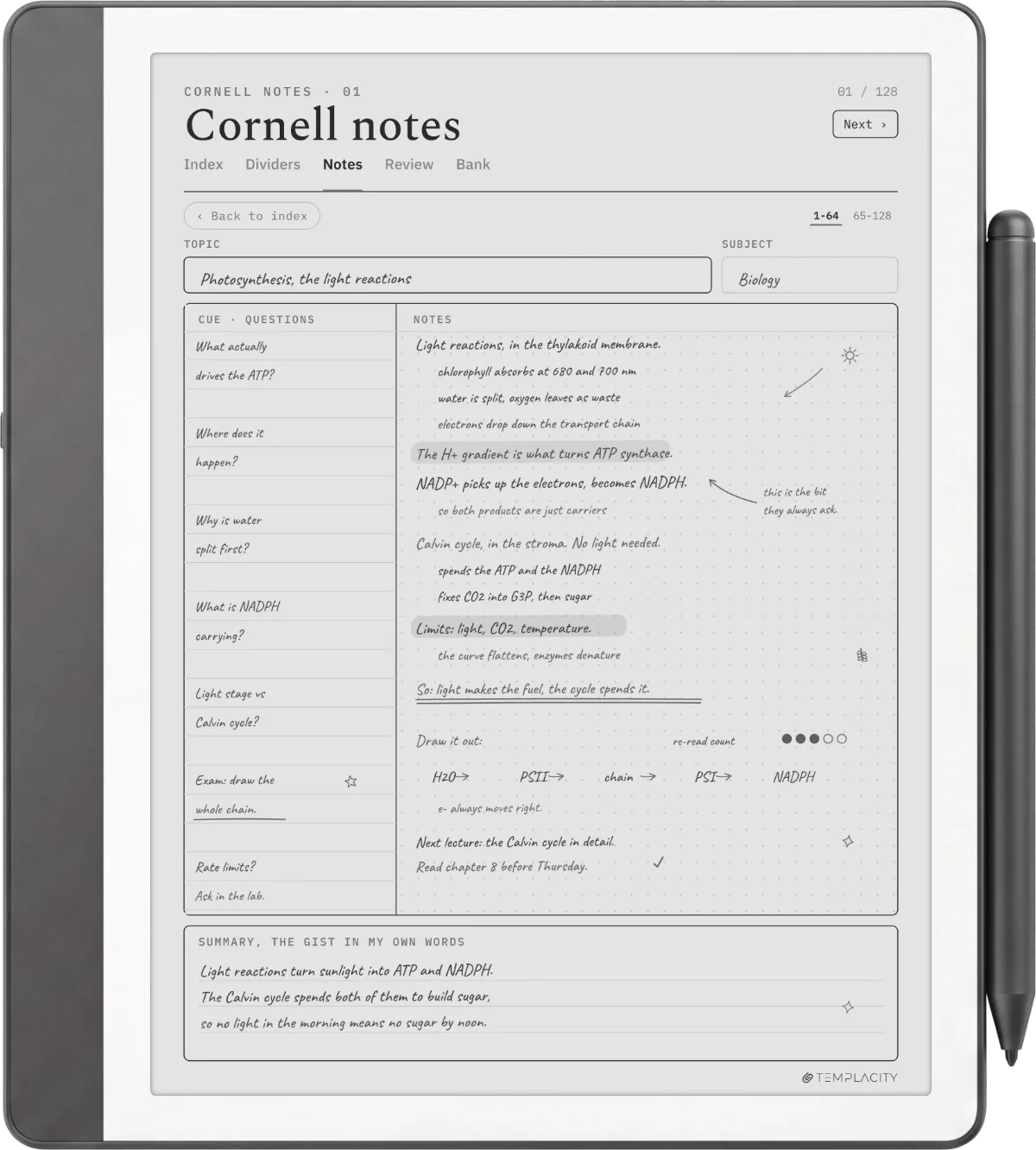
Our Cornell notes pages are laid out for this. The narrow left column is headed “Cue · Questions,” which is where each heading-turned-question goes; the wide field takes the cue phrases you write after looking away; and the strip at the bottom, “Summary, the gist in my own words,” is a ready-made place for the five-minute review. Cover the notes field with your hand, read the question in the cue column, and recite. For more on running a course from a tablet, see our guide to the best digital notebook tablet for students.
Making it stick
Making the SQ3R reading strategy a habit
The first chapter you study this way will take longer than reading it straight through. Robinson warned about exactly this and asked his students to time themselves anyway, with notes and without, so they could watch the gap close. A few things make the early weeks easier.
Practise the survey on its own. His suggestion: take an article on a subject you already know, look only at the headings, guess what each section will say, then check. It trains the one-minute survey without the pressure of a real assignment.
Write the recital, do not just think it. Robinson preferred written recital because “a mental review may often fool a reader into believing that a vague feeling of comprehension represents mastery.” A cue phrase on the page either came back to you or it did not.
Keep the cue phrases short. If a cue phrase runs to a full sentence, it was probably copied. A word or a short phrase is enough to prove you know the point and to prompt the explanation in the review.
Book the later reviews. The five-minute review on the day is only the first. A second look a few days later, and another before the exam, is the distributed practice the research rates so highly. A digital student planner is a sensible place to put those slots next to the reading itself. And if you also read for pleasure, keep that separate: a novel wants a reading journal, not a cue column. More study methods set up for e-ink tablets live on our reMarkable hub.
FAQ
Common questions, answered briefly
What are the 5 steps of the SQ3R method?
Who created the SQ3R method?
Is the SQ3R method effective?
What is the difference between SQ3R and SQ4R?
How long does the SQ3R method take?
If yours isn’t above, drop the question in the comments and we’ll add it.
People also ask
Other questions, briefly answered
Try one loop on the next chapter you have to read, and tell us in the comments which heading refused to recite. Those are usually the sections the exam asks about.