The short answer
Which OneNote app should you run on Windows 11?
Run the desktop app, plainly called OneNote, which you install free from the Microsoft Store and which also arrives with Microsoft 365. If you are searching for OneNote for Windows 11 because two OneNote icons appeared on your machine, or because the app you have suddenly refuses to let you type, that is the fix. Microsoft retired the other one. As of 14 October 2025, OneNote for Windows 10 reached end of support and moved into read-only mode, which means you can still open and view existing notes, but creating, editing and syncing content is no longer supported.
The naming is the whole problem, and it is worth spelling out because Microsoft’s own pages use several forms. There is OneNote, the desktop app, which Microsoft also refers to as “OneNote on Windows”; that is the survivor and it runs on both Windows 10 and Windows 11. There was OneNote for Windows 10, a separate Store app with a different codebase, now frozen. And there is OneNote for the web, which runs in a browser and is a smaller thing again. Three names, one of them dead, all of them containing the word Windows. No wonder the search results are a mess.
What changed
What happened to OneNote for Windows 10
Microsoft ended support for it on 14 October 2025, the same week Windows 10 itself stopped receiving updates. The app did not vanish and it was not uninstalled from anyone’s machine, which is exactly why the change catches people out months later. It still launches. Your notebooks still appear. The moment you try to add a line, you find out it has become a viewer. Microsoft’s wording is that the app transitions into read-only mode, and that no further bug fixes, security updates or technical support are coming.
The practical risk is not losing notes, it is quietly writing into a dead end. Someone who does not notice the change keeps a notebook open on a machine that cannot sync, and every note added elsewhere fails to arrive while every note they think they are adding fails to leave. If you have not consciously switched apps since autumn 2025, check which one you are in before you trust it with anything. Moving to OneNote for Windows 11 takes a few minutes and is covered below. The next section shows how to tell which app you have in about ten seconds.
Identify it
How to tell which OneNote you are running
Look at the top of the window. The desktop app carries the full Office ribbon, the wide banded toolbar with File, Home, Insert, Draw, View and the rest laid out in tabs, and it shows your notebooks in a panel you can dock down the left. The retired Windows 10 app has a slimmer, flatter toolbar and a navigation pane that slides out from the left edge, closer in feel to a phone app than to Word. If you have the ribbon, you are already on the right one.
The other tell is in Windows itself. Open Settings, go to Apps, then Installed apps, and search for OneNote. If a listing named “OneNote for Windows 10” appears, that is the retired app and you can uninstall it once you have confirmed your notebooks are safely in the desktop version. Plain “OneNote” or “Microsoft OneNote” is the one to keep, and that is what OneNote for Windows 11 means in practice: there is no separately branded Windows 11 edition, just the desktop app that runs on both versions of Windows. Do not uninstall anything until after the migration below, because the read-only app is still the only place any unsynced local notes exist.
Migration
Moving your notebooks across without losing anything
Start with the part that can actually cost you notes, because most guides bury it under reassurance. Microsoft is explicit that any notes not synced to the cloud will not show up in OneNote on Windows. The migration is not a file copy. It is a sign-in: the new app looks at your OneDrive or SharePoint account and pulls down whatever is there. Anything that only ever existed on your hard drive is invisible to that process. So the first move is to open the old app, right-click each notebook, choose to sync it, and resolve any sync errors before you go near the new one.
Once everything is genuinely synced, the rest is undramatic. Microsoft’s guidance is to make sure you sync your OneNote content before you switch, then install OneNote for Windows 11 from the Microsoft Store and sign in with the same work, school or personal account. Your notebooks appear on their own. Microsoft states that no data is lost in the migration and that cloud-saved notebooks, sections, pages, notes, tags, ink and attachments all carry over. Then do the boring verification step that people skip: open every notebook you had open in the old app and confirm the contents actually arrived. If sign-in is where you get stuck, our guide to signing in to OneNote covers the account tangles, and OneNote synchronisation issues covers what to do when a notebook refuses to sync at all.
The migration is not a file copy. It is a sign-in, and anything that only ever existed on your hard drive is invisible to it.On moving notebooks
Side by side
OneNote for Windows 11 vs the retired Windows 10 app
For anyone deciding whether the switch is worth doing today rather than eventually, the comparison is short and one-sided.
| Feature | OneNote (desktop) | OneNote for Windows 10 |
|---|---|---|
| Supported | Yes | No, ended 14 Oct 2025 |
| Create and edit notes | Yes | No, read-only |
| Syncing | Yes | No |
| Security updates | Yes | No |
| Local notebooks on your own drive | Yes | No |
| Price | Free | Free |
There is no column where staying put wins. The only reason to keep the old app installed at all is as a temporary holding pen for notes you have not yet managed to sync upward, and once those are safely across it can go. Everything the retired app did, the desktop app does, plus the things it never could.
The Windows advantage
Local notebooks, the one thing only Windows can do
The desktop app has a capability worth knowing about, because it is genuinely exclusive. Microsoft states that this is the only version of OneNote that supports local notebook storage on your PC’s hard drive, in addition to cloud storage. Not the Mac app, not the browser version, not the mobile apps. If you need a notebook that never touches consumer cloud storage, whether for a workplace policy, a confidentiality reason or simple preference, a Windows PC running the desktop app is the only way to have one.
The trade is that a local notebook is local in every sense, and choosing one is a decision only OneNote for Windows 11 lets you make. It does not appear on your phone, it does not open in a browser, and it is only as safe as your own backups. That asymmetry is also the thing to bear in mind before switching machines: someone moving from Windows to a Mac loses the option entirely, which we cover in our guide to OneNote for Mac, and the same constraint applies on phones and tablets, covered in OneNote for Android. On Windows you get to choose. Everywhere else the choice is made for you.
To check which of your notebooks are local and which live on OneDrive, and where the automatic backups go, see where OneNote files are stored.
Templates
Using templates in OneNote for Windows 11
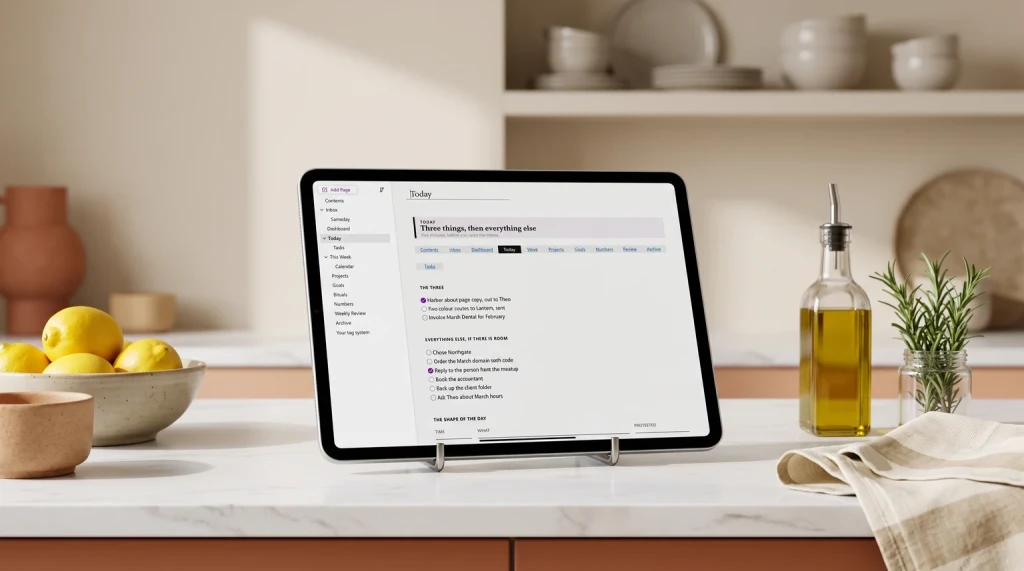
Once you are on the right app, the thing that decides whether the notebook survives past month two is whether pages start with a shape. A blank page invites a scribble, and a scribble is not something you go back to. A page that already has attendees, decisions and actions on it turns a meeting into a record. Same for a weekly plan, a project page, a call log. Our OneNote templates are built to load straight into the desktop app, and because the notebook syncs, a template set up once on the PC is available on every other device signed into the account.
The structure that holds up in OneNote for Windows 11 is one notebook, a section per area of work, and a template on every new page so nothing begins empty. Put a OneNote dashboard at the front as the page you open first each morning and the notebook stops being a place notes go to be forgotten. If you are still weighing OneNote against the alternatives before investing that effort, our comparison of the best note-taking app puts it against the field.
Who acts now
Who needs to act now
If you have opened OneNote on a Windows PC in the last few months and everything worked, you are already running OneNote for Windows 11 as Microsoft ships it, and there is nothing to do. If you are on a machine that has not been touched since 2024, or a work laptop that was set up years ago and left alone, check before you rely on it. The people most exposed are the ones who used the old app lightly enough not to notice it had stopped syncing, and who have a second device quietly diverging from it. Ten seconds in Installed apps settles it. The OneNote hub collects the setup, sync and template guides worth reading next.
If you have been through this switch, tell us in the comments what tripped you up, especially if you had local notebooks to rescue. That part of the process is where people actually lose work, and the fixes that worked for you will save someone else an afternoon.
FAQ
Common questions, answered briefly
Is OneNote free on Windows 11?
What is OneNote for Windows 10 and can I still use it?
Will I lose notes moving to OneNote on Windows?
How do I know which OneNote app I have?
Can OneNote on Windows store notebooks offline?
If yours isn’t above, drop the question in the comments and we’ll add it.
People also ask