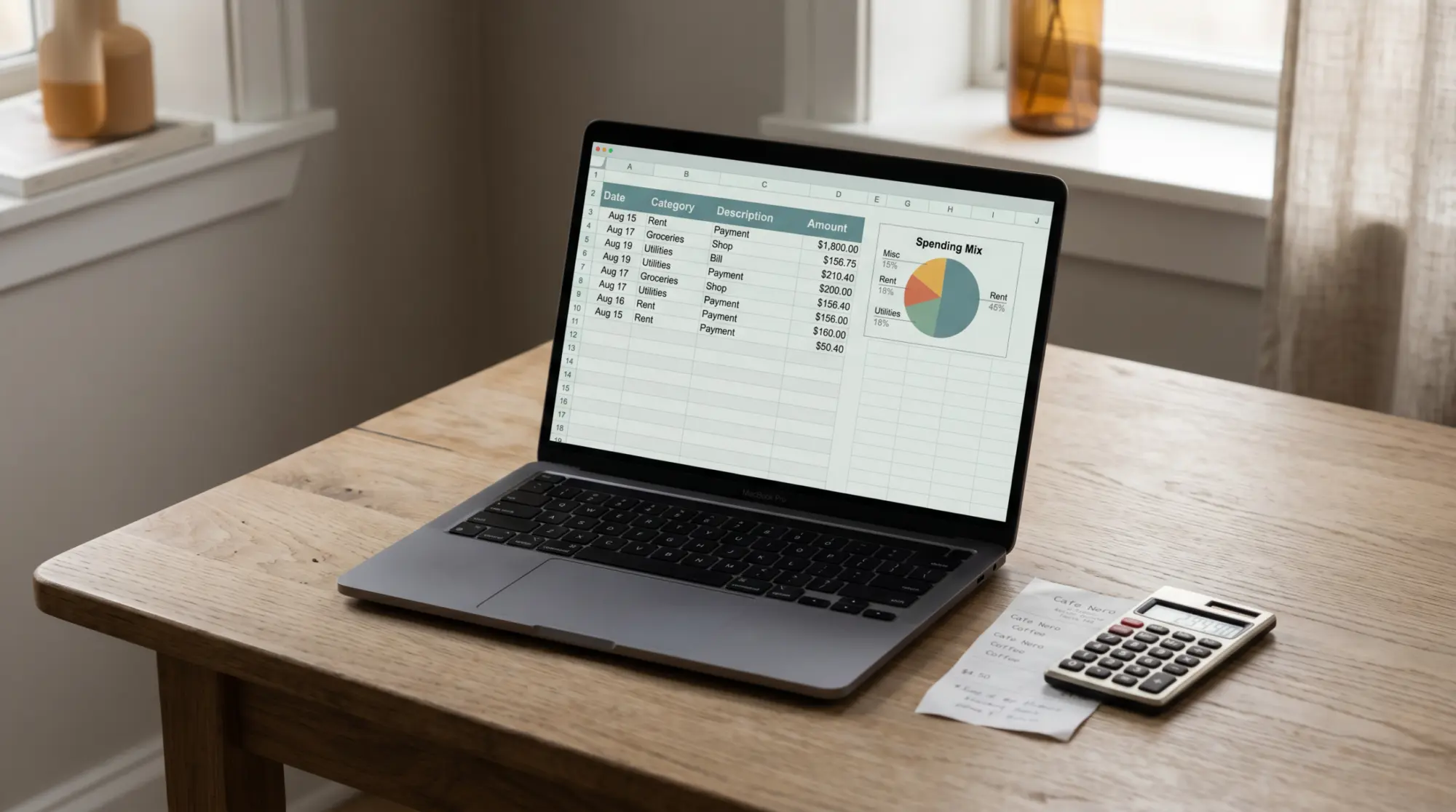
The frame
What an airbnb expenses spreadsheet is actually for
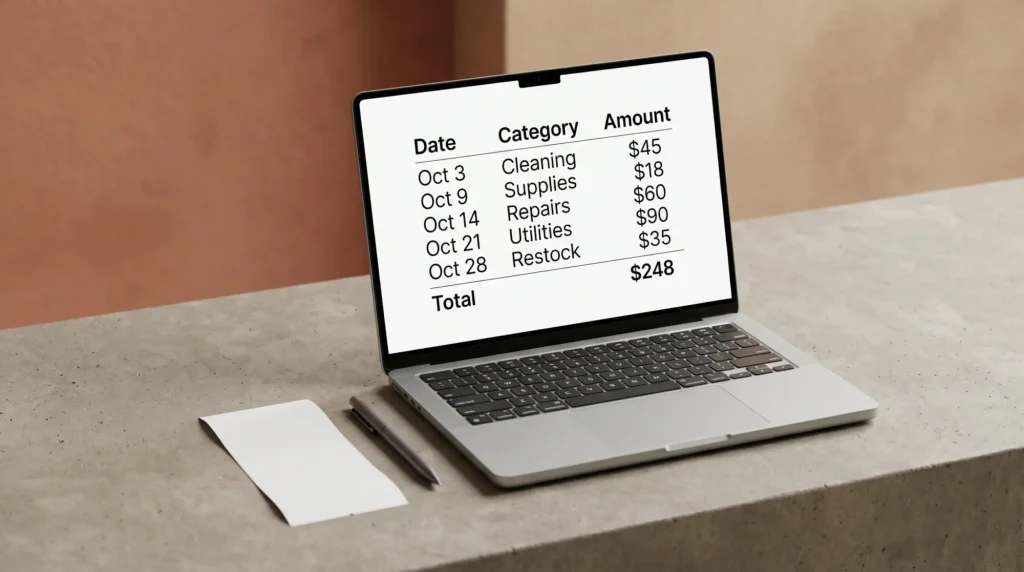
The airbnb expenses spreadsheet most hosts download is a tracking sheet. Date, vendor, amount, paid-by. That keeps you organized in the moment and produces a yearly sum that does not match any line on Schedule E. When the CPA asks for “advertising,” “cleaning and maintenance,” and “supplies” as separate buckets, the tracking sheet has to be re-categorized by hand. The work happens twice.
A spreadsheet that is built for the form does the categorization the moment you log the row. The label you pick is one of the Schedule E categories, period. That single discipline is what separates a sheet you use in April from a sheet you redo in April.
Reference
Schedule E, every expense line a host uses
All fifteen expense lines on the 2025 form, what belongs in each one, and the ones that do not go here at all.
i. Deduct in the year you pay it
ii. Deductible, but the figure comes from another document
iii. Not a Schedule E expense
15 expense lineslines 5 to 19 · 13 you enter, 2 carried from elsewhere
How to split the one that catches everyone: if the money kept the property at the standard it was already in, it is a repair and it goes on line 14 this year. If it made the property better, longer-lived, or newly able to do something, it is an improvement, and it belongs in depreciation instead. A dishwasher hose is a repair. A dishwasher is not.
Line numbers and labels read off the form itself, 2025 revision, checked 30 July 2026 at irs.gov The workbook that uses them
We keep books, we do not practise tax. Anything unusual, mixed use, a first year, short-term-rental rules that push you off Schedule E entirely, is worth ten minutes with your preparer.
Fifteen lines, and most host templates print eleven of them. The four that go missing are the expensive ones: management fees, mortgage interest, other interest, and depreciation. If you use a co-host or a property manager, line 11 is probably one of your largest deductions and it does not belong in “other”. The other trap is the pair that looks interchangeable in the moment: supplies and repairs against improvements. A new dishwasher is not a repair. A dishwasher hose is. Picking the right line at the point of entry is the whole discipline.
Setup
How to build the airbnb expenses spreadsheet
Start with the categories, not the columns.
Open a new sheet. Before you add a single transaction, build a one-column dropdown with the thirteen Schedule E categories you enter by hand, lines 5 through 17 and 19. Every row you enter must pick one. Leave lines 12 and 18 out of the dropdown; those two get carried in from your 1098 and your Form 4562 at year end rather than typed row by row. Without the dropdown, hosts re-invent category names mid-year and the labels stop matching.
Lock the seven core columns.
Date, vendor, description, amount, category (dropdown), property (if you host more than one), and receipt link. That is the entire row. Resist adding “tags” or “notes” columns; they always end up duplicating the category.
Build the year-end summary as a pivot, not a sum.
One pivot table grouped by category, summed by amount, filtered by year. That is the report your CPA wants. Hard-coded SUMIF formulas break the moment a row is inserted; a pivot survives a year of edits.
Tag mileage separately, monthly.
Auto and travel is the line hosts under-report most. Add a mileage log on a second tab, log it monthly while the trips are fresh, and reconcile to the IRS standard mileage rate at year end. Annual reconstruction from memory loses money every time.
Reconcile bank to sheet quarterly.
End of each quarter, pull the property bank-account statement and tick off each transaction in the sheet. Anything in the bank but not in the sheet is a missed deduction. Anything in the sheet but not in the bank is a duplicate. Do it four times a year, not once.
Categories
What goes in each airbnb expenses category
The category map below is the working version we use when setting up a host sheet. Edge cases are written into the notes column because that is where most disputes happen at tax time. If a transaction does not match a row here, it usually belongs in “Other,” not in the closest-looking category.
| Category | Line | Typical hosts entries | Edge-case note |
|---|---|---|---|
| Advertising | 5 | Listing photos, paid promotion, professional listing copy | Software for editing photos goes under supplies. |
| Auto and travel | 6 | Mileage to the property, supply runs, host check-ins | Track actual vs standard once, then commit for the year. |
| Cleaning and maintenance | 7 | Turnover cleaning, lawn, pool, pest, gutters | Cleaning fees you collect from guests still flow through income. |
| Commissions | 8 | Booking-platform host service fees | Guest service fees are not host commissions; the guest pays those. |
| Insurance | 9 | Property, liability, short-term-rental rider | AirCover is not a substitute for a real STR policy. |
| Legal and professional | 10 | CPA, attorney, permitting consultant | Software for bookkeeping itself goes under supplies. |
| Repairs | 14 | Fixing what already existed, replacing small items | Full appliance replacements are capitalized and depreciated, not expensed. |
| Supplies | 15 | Coffee, toiletries, paper goods, linens | Linens under a usable life of one year are supplies; over, capitalized. |
| Taxes | 16 | Occupancy tax remitted, business license | Property tax has its own line (16) but stays in the same bucket. |
| Utilities | 17 | Gas, electric, water, internet, streaming | Streaming counts when it is provided to guests as a listed amenity. |
| Other | 19 | Genuinely uncategorized, kept short | If “Other” tops 5 percent of the yearly sum, your category map needs a row. |
The notes column does most of the real work here. A host who logs every linen purchase to supplies but capitalizes a $1,200 sofa to depreciation is doing the same job two different ways, and the IRS expects it. That distinction lives in the notes, not in the line label.


Everything you hand a guest, matched and priced to move together.
Mistakes
The two mistakes that make hosts redo the sheet
The first is mixing personal-use expenses with rental expenses on the same row. If a property is rented 280 days and used personally for 30, the IRS prorates a long list of deductions, and a single mixed row breaks that proration cleanly. Two properties on one tab need a property column; two uses on one transaction need a split row.
The second is treating capital improvements as repairs. A new HVAC system is not a repair, even though it feels like one. The IRS expects items with a useful life over one year and over a de-minimis threshold to be capitalized and depreciated. A spreadsheet that puts those in “Repairs” overstates the current-year deduction and understates the basis. The audit risk is real.
If you would rather not rebuild the sheet from scratch, the curated host spreadsheets in our airbnb library start from this category map. The pre-built version of this template lives in the airbnb spreadsheet template, with the categories already wired into the dropdown.
For wider operational context, the airbnb resource shelf covers the welcome book, listing optimization, and cost projections that sit alongside an expense ledger.
FAQ
Common questions, answered briefly
What categories does an airbnb expenses spreadsheet need?
Should I keep one sheet per property or one combined sheet?
How do I handle cleaning fees that I collect from guests?
Is a furniture purchase a supply or a repair?
Does the spreadsheet replace bookkeeping software?
If your edge case isn’t above, drop it in the comments. We update this page when a host question reshapes the category map.
People also ask