The basics
What a gratitude journal is, and what it is not
A gratitude journal is a notebook, file or app where you write down things you are thankful for, on a regular schedule, in your own words. That is the whole idea. It is not a diary of everything that happened, and it is not a mood tracker. It is a narrow habit: look back over the day or the week, find something good, and put it on the page.
The writing is the part that does the work. Berkeley’s Greater Good in Action guide to the practice is blunt about it: the physical record is important, so do not just run through the list in your head. A thought slides past; a sentence you had to write makes you choose what to say about it, and that choosing is where the attention goes.
Most gratitude journals take one of three shapes. The first is the list: three or five good things, a line each. The second is the prompt: one question a night, answered properly. The third is the letter: a note of thanks to one person, sent or kept. The best journals mix them, and the rest of this guide shows how.
The research
Gratitude journal benefits: what the research actually found
The study most people mean when they say gratitude journaling works was run by Robert Emmons of UC Davis and Michael McCullough of the University of Miami. As Harvard Health Publishing describes it, participants wrote a few sentences each week. One group wrote about things they were grateful for, one about daily irritations, and one about events with no positive or negative slant. After ten weeks, the gratitude group was more optimistic and felt better about their lives. They also exercised more and had fewer visits to physicians than the group writing about irritations.
The second study worth knowing is about letters, not lists. Martin Seligman at the University of Pennsylvania tested several positive psychology exercises on 411 people. The one with the largest effect was writing and personally delivering a letter of thanks to someone who had never been properly thanked. Happiness scores rose immediately, more than for any other exercise in the study, and the lift lasted about a month.
Now the honest part. Harvard’s own summary adds that studies like these cannot prove cause and effect, only an association. And Greater Good’s long piece on keeping a journal opens its review of the research by admitting that gratitude journals do not always work: some studies show large benefits, others not much. The difference, it argues, lies in how people write, which is good news, because how you write is the part you control.
Tonight
How to start a gratitude journal in ten minutes
You do not need a special book to begin, and buying one is a popular way to put the habit off for another week. Start tonight with whatever you write on most easily, then upgrade the format once the habit has survived a month.
Pick one place and leave it where you will see it.
A notebook on the pillow, a PDF pinned in your notes app, a page on your tablet. The best gratitude journal is the one you can open in ten seconds without looking for it.
Tie it to something you already do.
Right after brushing your teeth, or with the first coffee of Sunday. Greater Good’s three good things exercise notes that many people find writing before bed helps it become routine.
Write one thing, in detail.
What happened, who was there, how it felt then and how it feels now. Three sentences about one moment beat ten words about five.
Add why it happened.
The three good things practice asks you to explain what caused each good event. It turns “nice lunch” into “my colleague noticed I had skipped breakfast”, which is a different entry.
Keep a prompt list for flat nights.
Some evenings nothing comes. A list of narrower questions gets you past those nights, and our 50 gratitude journal prompts are grouped by the kind of night you are having.
That is enough to begin. Resist the urge to design a system on day one. Habits die from friction far more often than from the wrong layout, and you will know after two weeks what your journal actually needs.
Examples
Gratitude journal examples: flat entries and ones that work
The fastest way to see the difference is side by side. Each row below starts with the kind of entry most people write in week one and shows the same moment written so it keeps working. The research tips behind each rewrite come from Greater Good’s practice guide: be specific, go for depth, focus on people, try subtraction, and savor surprises.
| Flat entryweek one | Entry that workssame moment | Why it worksthe habit | |
|---|---|---|---|
| Family | Family. | Mom called just to read out a recipe she found, laughing at her own handwriting. | A person, a moment |
| Work | Good day at work. | Sam covered the 9am call so the dentist run fit, and never made it feel like a favor. | Names who and what |
| Health | Health. | Walked up the station stairs without stopping, which was not possible in March. | Subtraction: then vs now |
| Small things | Coffee. | The new café got the order wrong, and the mistake was better than the original. | A surprise |
| Home | Home. | The heating came back on before the cold snap; picture this week without it. | Imagines it gone |
Notice what the right column has in common. Every entry happened on a particular day, most involve another person, and none of them could be copied into tomorrow’s page unchanged. That last test is the useful one. If an entry would fit any day of your year, it is a category, not a moment.
If an entry would fit any day of your year, it is a category, not a moment.Examples
Frequency
Daily gratitude journal or weekly: how often to write
The guidance here genuinely disagrees, and it is worth knowing why. Greater Good in Action’s practice guide says to write regularly, whether daily or every other day, and to commit to a set time. Its three good things exercise runs every day for at least a week. But Greater Good’s article on journal research points to work by Sonja Lyubomirsky in which people who wrote once a week for six weeks felt happier, while people who wrote three times a week did not.
The way to square it is to look at what each version guards against. Writing daily protects the habit: it is easier to keep a thing you do every night than a thing you do on some nights. Writing less often protects the freshness: when you write every day, the entries start repeating and the practice turns into a chore. So choose by your own failure mode.
- If you tend to drop habits, write a short daily gratitude journal entry, three good things in a line each, and save the long entries for one night a week.
- If you tend to go stale, write two or three longer entries a week, on fixed nights, and skip the rest without guilt.
- If neither has happened yet, start daily for two weeks, then look back. If the last few entries read like the first few, cut down.
Three shapes
Lists, prompts and letters: three ways to keep the journal
The list is where almost everyone starts, because it is fast. Greater Good’s practice guide suggests up to five things, and its three good things version adds the step that makes a list worth keeping: a line on why each thing went well. Lists suit busy weeks and people who like to see the page fill up. Their weakness is repetition, and it shows within a month.
The prompt replaces “what am I grateful for?” with a narrower question: who made today easier, what went better than you feared, what would this week have been like without your home. Prompts are the cure for a stale list, because the question changes before the answers do. We keep fifty of them, grouped by the night you are having, and they are worth borrowing even if you mostly write lists.
The letter is the shape with the strongest single result in the research, the delivered thank-you letter in Seligman’s study. It is also the slowest. A letter a month, written to one person who mattered and not necessarily sent, gives a list journal the depth it lacks. Keep a page at the back for them so they do not get lost between the daily entries.
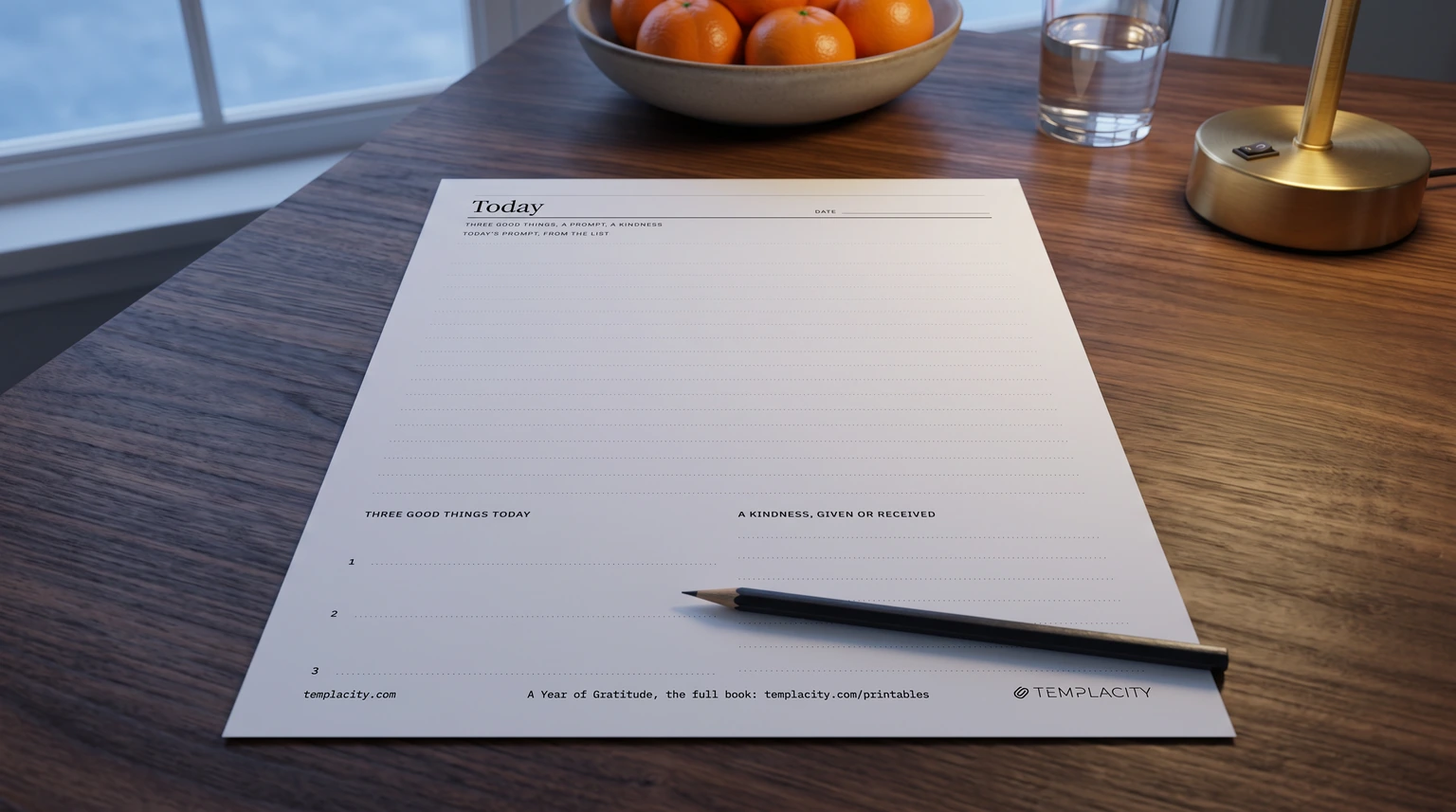
Many people end up with a mix: a short list most nights, a prompt when the list feels thin, a letter now and then. That is a good place to end up, and it is roughly how a day page in a guided gratitude journal is laid out, with the prompt on top and three good things underneath.
Paper or screen
Where to keep a gratitude journal: paper, app, iPad or e-ink
Greater Good’s guide lists a notebook, a phone notes app and a word processor as equally good homes, and that is fair: the format matters far less than whether you open it. What the format does change is how quickly you can start an entry and how likely you are to read the old ones, which is where much of the pleasure is.
- Paper notebook. No battery, no notifications, and it sits on the bedside table as a reminder. The cost is that it stays at home and old entries are hard to search.
- Printable pages. A structured page you print and keep in a binder or clipboard. Good when you want a layout without buying a book. Our printable journal pages guide covers what a good page holds.
- Phone notes or an app. Always with you, which helps the habit, but the phone is also the device that pulls you into something else before you have written a word.
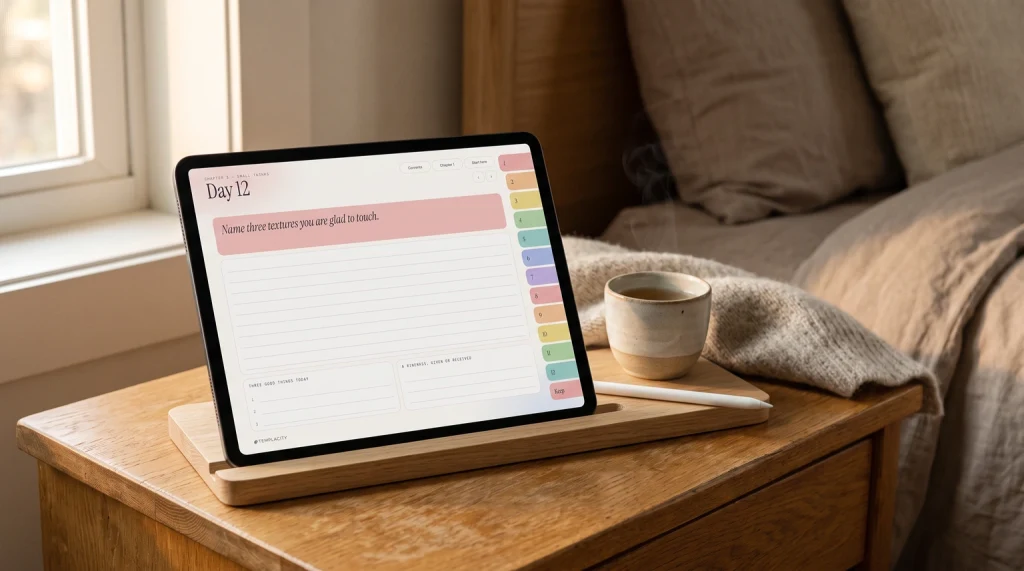
- iPad with a handwriting app. A journal PDF imported into Goodnotes or Notability gives you handwriting on a page that never runs out. Our Goodnotes journal template guide shows how to set one up.
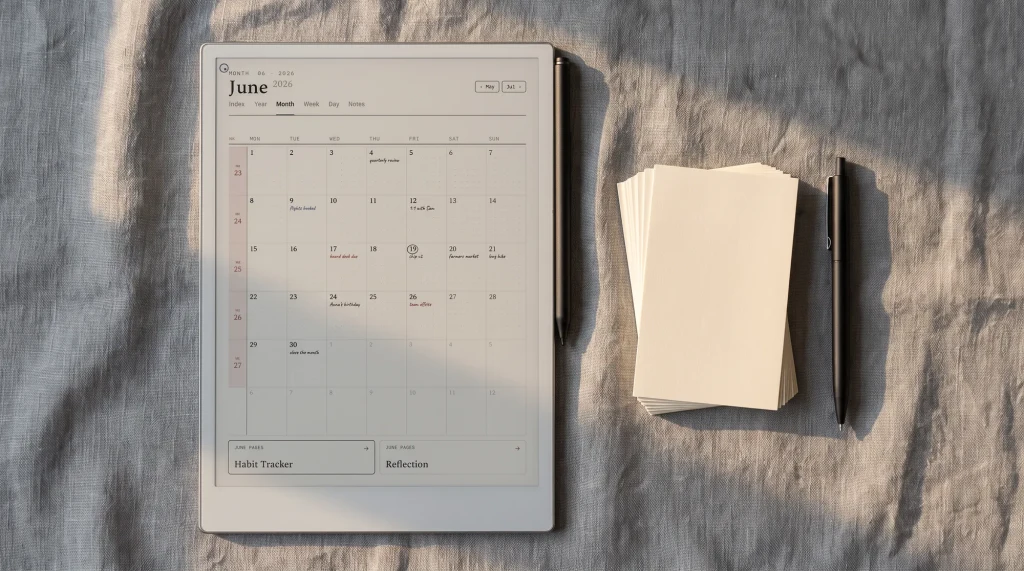
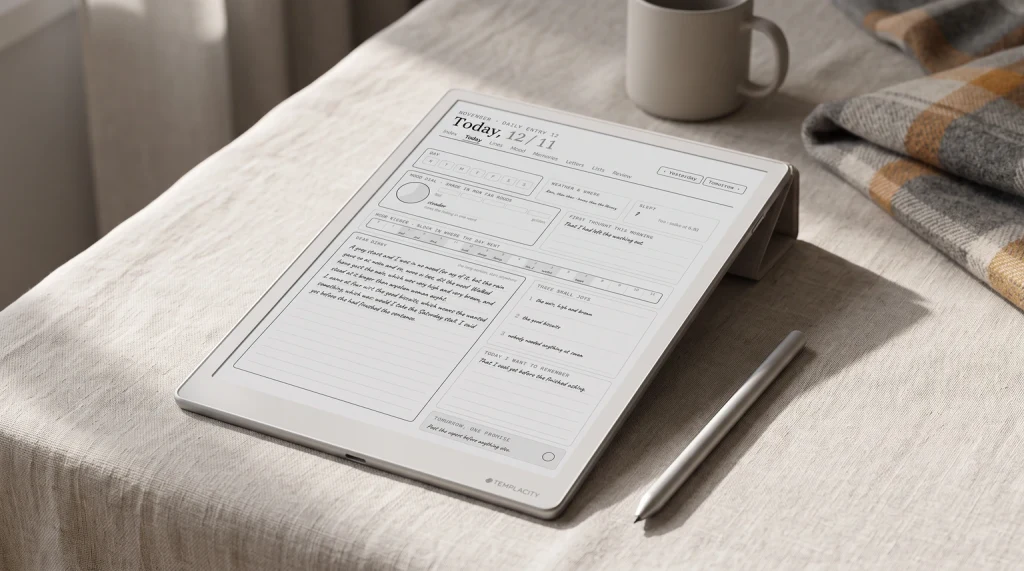
- E-ink tablet. A reMarkable, Kindle Scribe, Boox or Supernote writes like paper, does nothing else at bedtime, and keeps every entry in one file. Our digital journal template guide covers loading a journal onto one.
If you want to try a structured page tonight before choosing anything, our free printable gratitude pages are a 15-page PDF: thirty starter prompts, a day page with a prompt, three good things and a kindness, twelve single-prompt writing pages and a thank-you letter page. Download the US Letter, A4 or A5 version; each one also imports into Goodnotes or onto an e-ink tablet like any PDF.
Full disclosure: we also make two paid journals. A Year of Gratitude is the full book behind those free pages: 365 prompts in twelve themed chapters, three good things and a kindness each day, a look back at the end of every chapter, and six thank-you letters at the back. It is undated, so it starts the day you do, and one download carries the iPad, e-ink and printable editions. The Journal is a general daily journal with a small gratitude box on every day page, for people who want gratitude as one part of a wider entry. Neither is needed to start; a notebook does the job.
When it stalls
When gratitude journaling stops working
Almost every gratitude journal hits a wall around week three. The entries shrink, the same words come back, and writing starts to feel like homework. That is not failure; it is the point where the practice needs changing, and the fixes are small.
- The list repeats. Switch to one prompt a night for a fortnight. Greater Good’s guide says writing about the same people is fine, as long as you focus on a different detail each time.
- It feels forced. Write less often, not more. Two real entries a week beat seven hollow ones.
- You keep skipping. Make the entry smaller. One line on a hard night counts, and so does a single word you expand on Sunday.
- Nothing feels good at all. Gratitude is not a duty to feel fine. Write what held, however small: a warm bed, a friend who texted. If the weight does not lift for weeks, that is a conversation for a doctor or someone you trust, not a journal.
Some weeks you need to look at the hard feelings directly instead of around them. Gratitude and honest reflection are not rivals, and our shadow work prompts start gently for those weeks. If what you want is a fuller daily record with gratitude as one part of it, the bullet journal method makes room for a gratitude line inside a wider day.
Looking back
Read your gratitude journal back once a month
The step most guides skip is rereading. A month of entries, read in one sitting, shows you things a single night cannot: which people keep appearing, which small routines carry your weeks, which worries never came true. Set a date, the last Sunday of the month works, and read the month with a pen in hand.
Ask three questions as you read. Who showed up most, and have they heard that from you? What small thing turned up again and again, and could you have more of it? What did you worry about at the start of the month that turned out fine? The first question is often where a thank-you letter starts, which closes the loop between the list and the letter.
Gratitude journals are personal, and what keeps one going for a year bores another person in a week. If a habit, a prompt or a format has kept yours alive past the first month, tell us in the comments. The most useful advice we have collected came from readers who were already past week three.
FAQ
Common questions, answered briefly
What is a gratitude journal?
Do gratitude journals really work?
How do I start a gratitude journal?
Should I write in my gratitude journal every day?
Can I keep a gratitude journal on an iPad or e-ink tablet?
If yours isn’t above, drop the question in the comments and we’ll add it.
People also ask