What it is
What shadow work prompts are for
Shadow work prompts are questions that point you at the parts of yourself you usually look away from: the reactions that surprise you, the traits that irritate you in other people, the habits you defend a little too hard. The term comes from the psychologist Carl Jung, who used “the shadow” for the side of the personality that does not fit the picture we hold of ourselves. In his account we tend to push it out of view and then meet it again in other people, which is why so many of these prompts start with what annoys you in someone else.
The aim is not to dig up something dark for its own sake. It is to notice a pattern, name it, and decide what to do with it. Most of the value is in small, honest observations, written down often enough that you start to see them repeat.
The order
How to use shadow work journal prompts safely
Most prompt lists hand you fifty questions at once, with the heaviest ones about childhood mixed in beside the light ones. Order matters more than that. Start with reactions you had this week, which are fresh and low stakes. Move on to mirrors, what you notice in other people. Leave the older patterns until the habit is steady, and skip any prompt that does not feel right today.
- Keep it short. Ten to fifteen minutes, one prompt. Stop at the end of a thought, not in the middle of a feeling.
- Write facts first. What happened, what you did, what you felt in your body. The interpretation can come later.
- Be curious, not harsh. The goal is to understand a reaction, not to put yourself on trial for it.
- Close the page. End each session with one thing you will do differently, or one kind sentence to yourself.
Begin
Shadow work prompts for beginners
These first prompts are about how you see yourself. They are a warm-up: low risk, and useful for noticing the gap between the person you describe and the person you act as.
- Describe yourself in five words. Which word would a close friend disagree with?
- What compliment do you find hardest to accept, and why?
- What do you pretend not to care about?
- Which of your habits do you explain or justify most often?
- What part of your personality do you tone down at work?
- What would you do differently if nobody you know could see it?
- What are you proud of that you rarely mention?
Reactions
Shadow work prompts about your reactions
A reaction that is bigger than the moment called for is the clearest signal shadow work has. Use a recent one, while the details are still sharp.
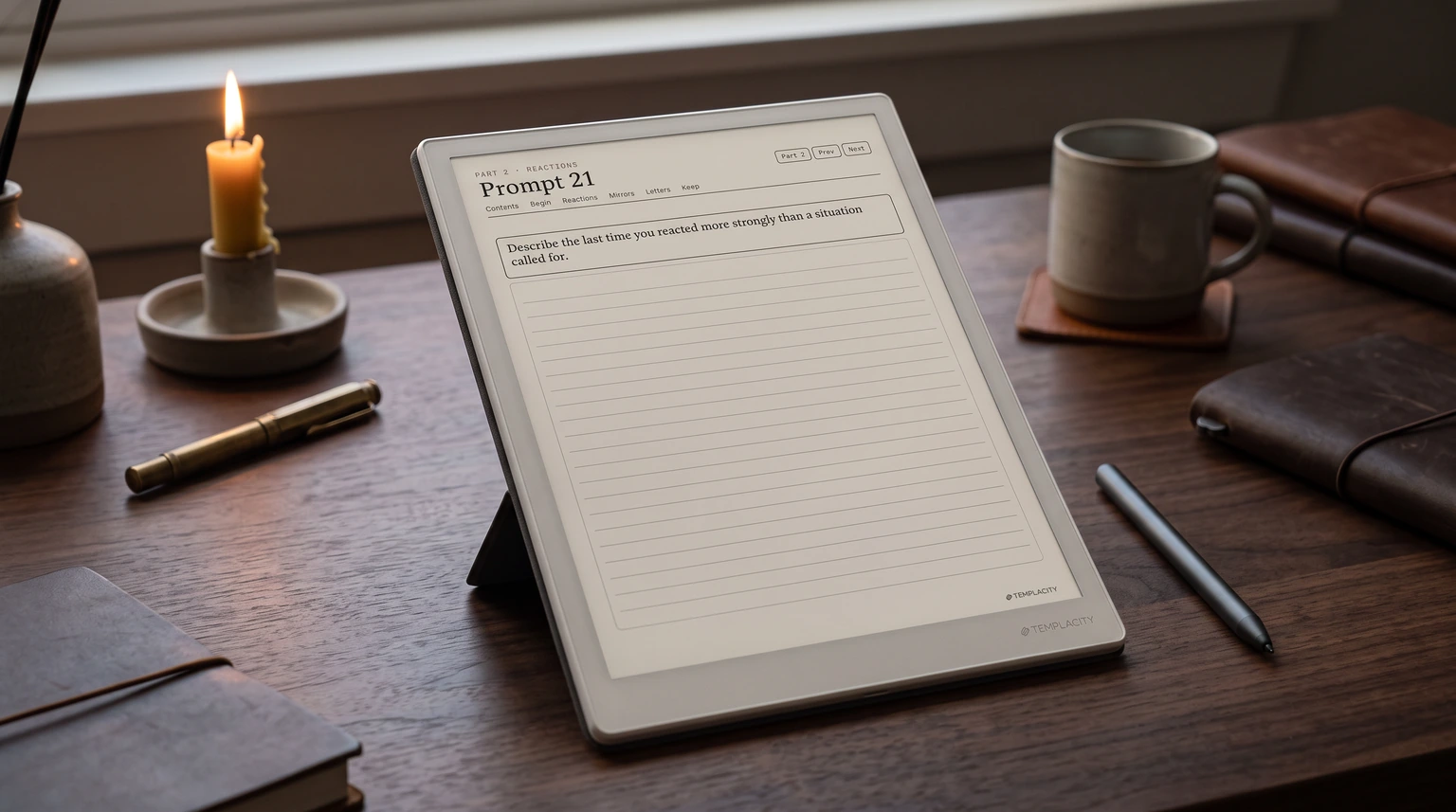
- Describe the last time you reacted more strongly than a situation called for.
- What were you protecting in that moment?
- What do you say when you are defensive? Write the exact words.
- Which kind of criticism stings for days, and which do you shrug off?
- When did you last feel jealous? What did the other person have?
- What makes you go quiet in an argument instead of speaking?
- What situation do you avoid, and what do you tell yourself about why?
A reaction that is bigger than the moment called for is the clearest signal shadow work has.Reactions
Mirrors
Prompts about what you notice in other people
Jung’s idea was that we often see our own disowned traits most clearly in someone else. These prompts start with other people and end with you. Write about the other person first, then turn the question round.
- Which trait in other people irritates you most? Where does a small version of it show up in you?
- Who do you judge quickly, and what do you assume about them?
- Whose success is hard to celebrate? What would it mean if you had it?
- What do you admire in someone that you would never allow yourself?
- Which complaint about others do you repeat most often?
- What did someone recently say about you that you rejected immediately? Is any part of it true?
- Who brings out a version of you that you do not like? What do they trigger?
Patterns
Shadow work journal prompts about older patterns
These reach further back, so save them for when the habit is steady and you have the time and energy to sit with the answer. If one touches something painful, stop there. You do not owe the page a full account.
- What were you praised for as a child? Do you still chase that praise?
- What was not allowed in your home growing up: anger, sadness, boasting, rest?
- Which family rule do you still follow without meaning to?
- What role did you play in your family, and where do you still play it?
- What did you learn to hide to fit in at school?
- Which fear has followed you from one decade of your life into the next?
- What story about yourself did you inherit rather than choose?
Hidden strengths
Prompts for the strengths you keep in the shadow
The shadow is not only faults. People hide strengths too, usually the ones that once got them into trouble or felt like showing off. These prompts are a lighter way to finish a session, and the letter prompts at the end are a good way to close a week.
- What talent do you downplay so you do not seem arrogant?
- When were you told you were “too much” of something? Is that quality useful now?
- What ambition have you never said out loud?
- What would you do if you trusted your own judgement fully?
- Which of your “flaws” has helped you at least once?
- What do the people who love you see in you that you do not?
- Write a letter to the version of you who first learned to hide something. What do they need to hear?
- Write a letter from your future self, one year on, about what changed.
- Write a short thank-you to a part of yourself you have been fighting.
- What did this week’s writing show you that you did not expect?
- What is one pattern you have now named? What will you watch for next time?
- What is one kind thing you can do for yourself before you close the journal?
Honesty
What shadow work is not
Shadow work is a journaling practice, not a treatment. It can help you notice patterns, but it cannot process trauma safely on its own, and some prompts, especially the ones about childhood, can bring up more than a notebook can hold. If writing leaves you shaken, distressed for days, or stuck on a memory you cannot put down, stop the practice and talk to a therapist or a doctor.
If you are in crisis or thinking about harming yourself, do not wait for an appointment. In the US you can call, text or chat with the 988 Suicide and Crisis Lifeline, which is free, confidential and open around the clock. Elsewhere, your local emergency number or a crisis line in your country will help.
For lighter days, a gratitude page makes a good counterweight to shadow work, and our list of gratitude journal prompts is built for exactly that. If you would rather keep these prompts in a journal file on an iPad or e-ink tablet, our guides to a digital journal template and a Goodnotes journal template cover the setup.
To try the practice on paper first, our free printable shadow work pages are a 15-page PDF: thirty starter prompts, twelve single-prompt writing pages, a go-gently page for why you are doing this and who supports you, and a reaction log for the moments that sting. US Letter, with A4 and A5 versions.
Full disclosure: we also make the full book. The Shadow Pages holds 160 prompts in eight parts, the reaction log, a mirror log and six letters, cut for iPad, reMarkable, Kindle Scribe, Boox and Supernote and to print. It is the same gentle practice as this list, just longer, and it carries the same limits: a journal, not a treatment.
Shadow work is personal, and the prompt that opens one person up does nothing for another. If a question on this list, or one of your own, has helped you see a pattern clearly, share it in the comments. Gently, and only what you are comfortable making public.
FAQ
Common questions, answered briefly
What is shadow work?
How do I start shadow work as a beginner?
How often should I do shadow work?
Is shadow work the same as therapy?
Can I keep a shadow work journal on a tablet?
If yours isn’t above, drop the question in the comments and we’ll add it.
People also ask