This page sits under our guide to how many weeks in a year on the Planning Hub, which explains why 52 is the everyday answer and 53 is the occasional one.
The list
The years with 53 weeks
Most years have 52 weeks. The years with 53 weeks are the exception, and they follow a fixed pattern rather than arriving at random. Here are the ones in the current era, using the ISO 8601 week-numbering system that businesses and most of the world follow:
- 2015 (started on a Thursday)
- 2020 (leap year that started on a Wednesday)
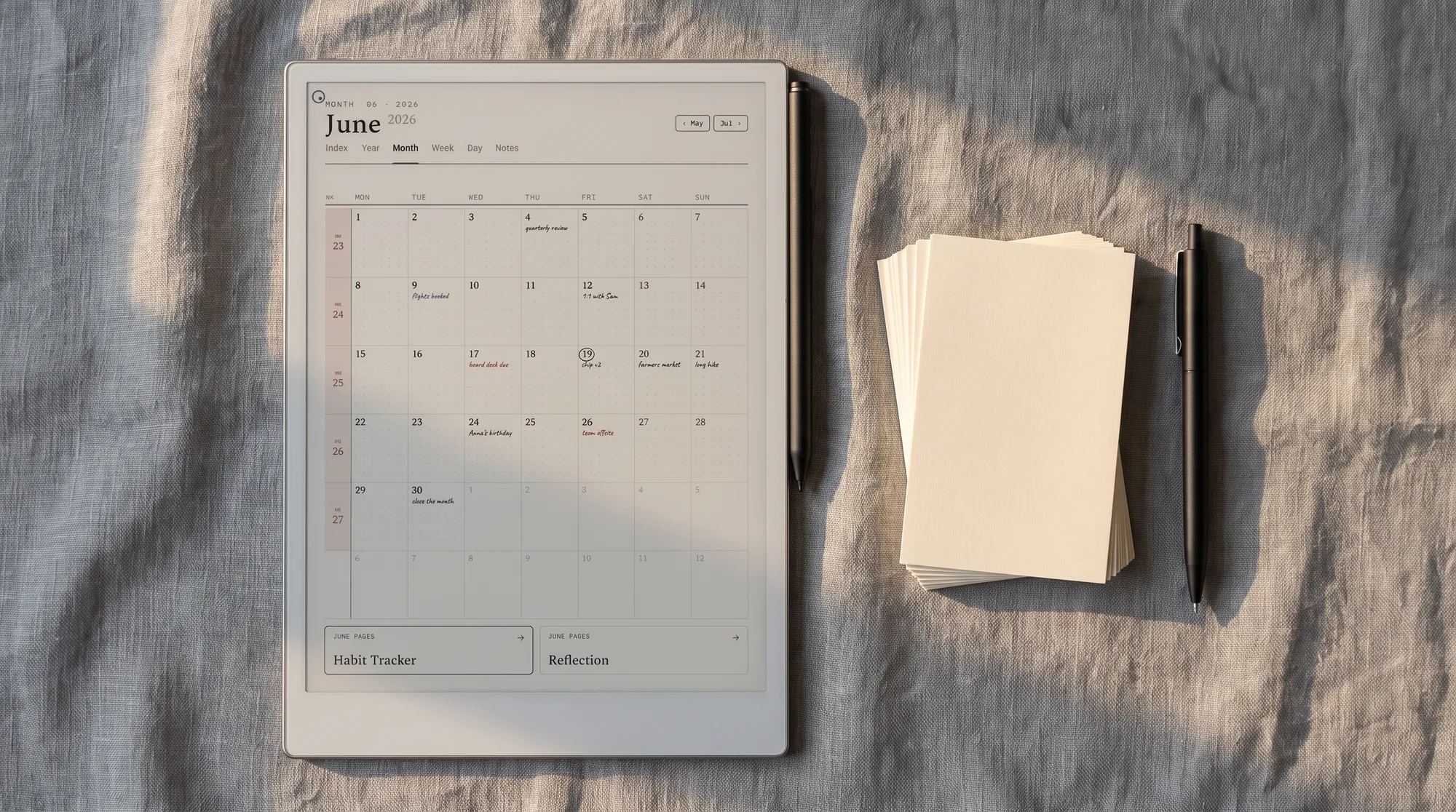
- 2026 (starts on a Thursday), the current one
- 2032 (leap year, starts on a Thursday)
- 2037 (starts on a Thursday)
- 2043 (starts on a Thursday)
- 2048 (leap year that starts on a Wednesday)
If your calendar’s week column reaches 53 this year, that is expected in one of these years and not a bug in your planner or spreadsheet. Between them, every year is a normal 52-week year.
The rule
The rule behind a 53-week year
Under ISO 8601, weeks start on Monday and week 1 is the week that holds the year’s first Thursday. Because of that, a year gains a 53rd week only when its days line up in one of two ways:
- The year starts on a Thursday (any year), or
- The year is a leap year that starts on a Wednesday.
There is an even quicker test that catches both cases: a year has 53 weeks if the 1st of January or the 31st of December falls on a Thursday. That is the tidiest way to check any year by hand once you know which weekday it opens on.
How often
How often a 53-week year happens
Across the full 400-year cycle that the Gregorian calendar repeats on, 71 years have 53 weeks and the other 329 have 52. That works out to about one 53-week year every 5.6 years on average, though the real spacing alternates between five and six years rather than being perfectly even. You can see that in the list above: 2020 to 2026 is six years, 2026 to 2032 is six, then 2032 to 2037 is five.
The unevenness comes from leap years nudging the starting weekday along by two some years and one in others, so the “starts on a Thursday” condition arrives on a slightly irregular beat. The long-run average, though, holds at roughly 71 in 400.
Why it matters
Why a 53-week year matters
For most people a 53-week year passes unnoticed. For anyone who runs anything on a weekly cadence, it shows up as one extra unit, and it is worth planning for:
- Payroll: weekly pay can mean 53 paycheques in a 53-week year instead of 52, and fortnightly pay occasionally lands 27 periods instead of 26. Budgets built on “52 times the weekly figure” come up short.
- Reporting and budgeting: retailers and finance teams that report on 4-4-5 week calendars add an extra week roughly every five to six years to resync, which is the same effect seen from the accounting side.
- Trackers and planners: a weekly habit tracker, invoice log, or content calendar with exactly 52 rows will be one row short. A layout that flexes to 53 avoids the scramble.
None of this is a problem if you know it is coming. It only bites when a system quietly assumes 52 and the 53rd week has nowhere to go. For how the numbering itself works, and how to read the current week number, see week numbers, explained; for whether the next year adds a leap day on top, see is 2027 a leap year.
If you keep a weekly system and want a version that already flexes between 52 and 53 weeks, tell us what you track in the comments. We keep this list current as the years roll on, so bookmark it and check back when your calendar hits week 53.
FAQ
Common questions, answered briefly
Which years have 53 weeks?
Is 2026 a 53-week year?
Why do some years have 53 weeks?
How often is there a 53-week year?
People also ask