The shape of it
What a zettelkasten actually is
The zettelkasten method is a way of keeping notes so that they accumulate into an argument instead of an archive. A zettelkasten, literally a slip box, is a container of short notes where each note holds one idea, carries a fixed address, and points at other notes. The word people reach for is filing system, and that is the one thing it is not. A filing system is built so you can put something away. This is built so things come back.
The distinction matters because it decides what you do on a Tuesday afternoon. In a filing system, the work is sorting: which folder, which tag, which project. In a slip box, the work is connecting: what does this new thought sit next to, and what does sitting next to it change. Sorting is finished when everything has a home. Connecting is never finished, which is why the box keeps producing.
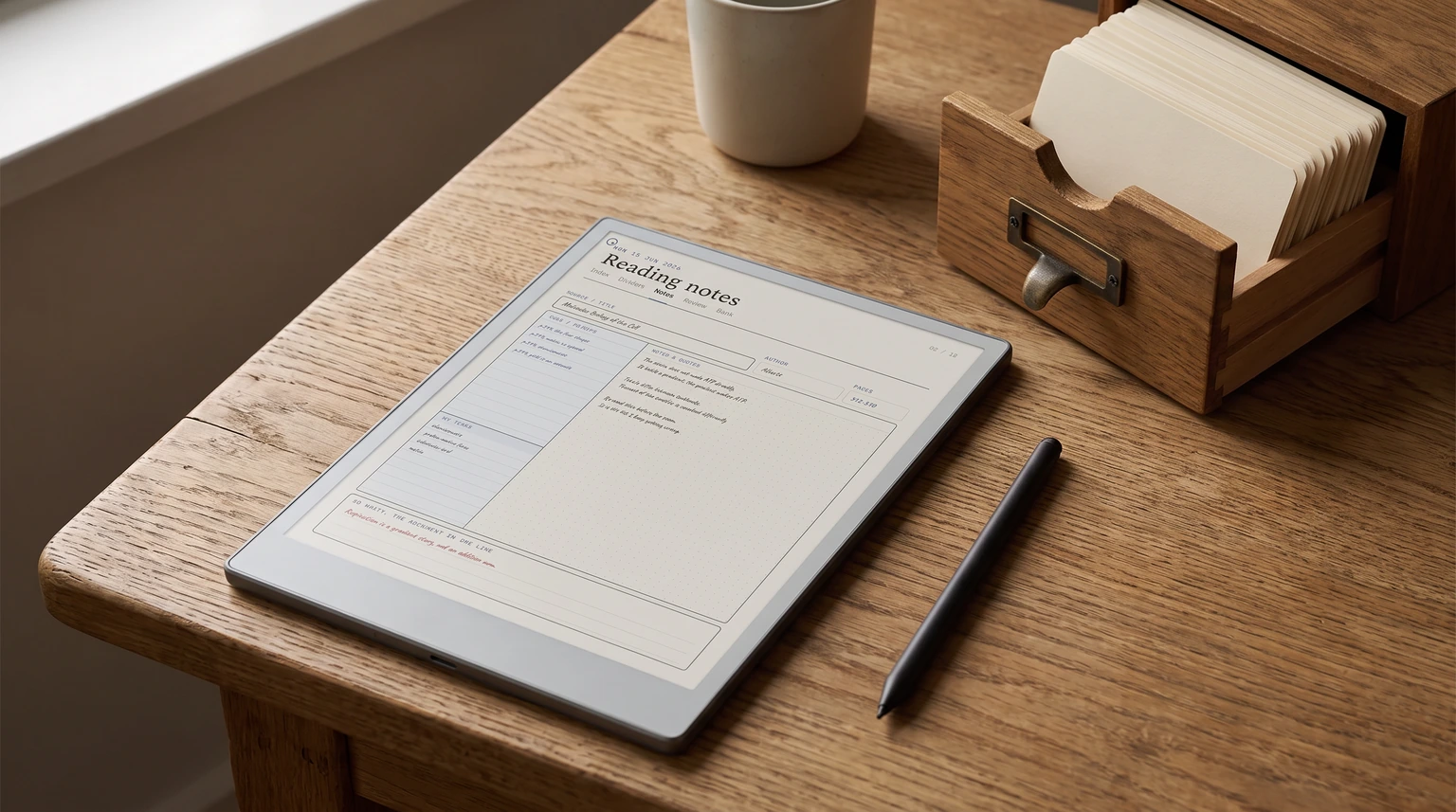
That is also why the method survives the medium. It began in wooden drawers, it works on paper cards today, it works on an e-ink tablet, and it works in a text editor. Nothing in the method requires software. A great deal of writing about it assumes otherwise, and that assumption is the single most expensive thing a beginner can inherit.
The version most English readers meet came through Sönke Ahrens and his book How to Take Smart Notes, which put the German academic practice in front of a general audience. The version before that came from a sociologist at Bielefeld who used it for forty-five years, and whose boxes are now a research object in their own right.
The rules
The four rules that make it work
Strip away the vocabulary and there are four rules. They are boring, they are not negotiable, and a box that follows them works whether it lives in a drawer or a folder of text files.
-
1
One idea per note
If a note contains two thoughts, it can only ever be filed next to one of them. Splitting feels wasteful and is the whole trick: two notes can sit in two different arguments, one note can sit in one.
-
2
Write it in your own words
Not a quote, not a highlight, not a screenshot. A sentence you had to build. The rewriting is the thinking; skipping it produces a box full of other people’s phrasing that you cannot use later because you never understood it.
-
3
Give it an address that never changes
Any stable identifier works: a running number, a date and time stamp, a branching number that lets a new note slot in beside an old one. What matters is that it is permanent, because every link you write is a promise that the address will still be there.
-
4
Link it to at least one note you already have
This is the rule people quietly drop, and dropping it is what turns a slip box back into a folder. A note with no link out is a note you will never meet again except by searching for it, which means you have to remember it exists.
Rule four does the work of the other three. Rules one to three are preparation: they make a note small enough, clear enough, and stable enough to be linked. If you follow the first three and skip the fourth, you have a tidy pile. If you follow all four, the box starts suggesting things, because the act of deciding where a new note belongs forces you to reread the neighbours.
The archive
Luhmann’s 90,000 notes, and what they do not prove
Niklas Luhmann kept two slip boxes. Bielefeld University, which holds the estate, describes them as two largely separate collections, Zettelkasten I running from 1952 to 1961 and Zettelkasten II from 1961 to 1997, and counts 90,000 notes across the two. The digitised archive has been publishing them in stages; with the third instalment, around 10,000 slips were available online in edited form.
Do the arithmetic and the number gets less intimidating rather than more. Ninety thousand notes over forty-five years is about five or six a day. Anyone reading seriously already has five or six thoughts a day worth keeping. The gap between a normal reader and the archive is not intelligence or speed; it is that one of them wrote the thought down on its own card and the other did not.
It is worth saying what the archive does not establish. A large number of notes is evidence of a sustained habit, not proof that the habit caused the output. Plenty of scholars wrote a great deal without a slip box, and plenty of slip boxes produced nothing. The honest claim is narrower and more useful: the method gave one person a way to keep working on a problem for four decades without holding it all in his head. That is a real benefit and it does not need inflating.
We mention this because the zettelkasten literature has a folklore problem. Numbers get repeated from post to post until nobody can say where they came from, and the ones that feel most like common knowledge are usually the ones nobody checked. The figures above come from the university that holds the boxes, and we have linked them at the foot of this post so you can read them yourself.
Where it breaks
Atomic notes, the part everyone gets wrong
An atomic note holds one idea and can be read on its own. That definition sounds obvious and almost nobody meets it, because the tempting unit is not the idea, it is the source. You finish a chapter, you write a note called “Chapter 4”, you list six points, and you have built something that only makes sense to someone who just read chapter four. In two years that will be you, minus the chapter.
The test is simple and slightly brutal. Cover the title, read the note cold, and ask whether it still says something. If it needs the book open beside it, it is not a note, it is a bookmark with extra steps.
If it needs the book open beside it, it is not a note, it is a bookmark with extra steps.On the atomic-note test
The other half of atomic is length. People hear “one idea” and write four hundred words. A note that long is nearly always two or three notes that have not been separated yet, and you can feel it while writing: there is a sentence in the middle that starts with “and also”, or “which relates to”, or “on the other hand”. That phrase is the seam. Cut there and give each half its own address.
Short notes also make the box honest. A long note hides fuzzy thinking inside qualifications. Twenty words does not. If you cannot say the idea in a couple of sentences, you probably have not understood it yet, and the note is doing you the favour of telling you so before you build an argument on top of it. If finding that seam is the part you keep getting wrong, our piece on atomic notes takes one passage and writes it three ways to show where an idea actually ends.
Finding things
Maps of content, or how you find anything again
Once a box passes a few hundred notes, browsing stops working and search only helps when you already know what you are looking for. The structure that fixes this is a map of content: a note whose job is not to hold an idea but to hold a route. It lists the notes on one topic in a sensible reading order, with a line on each saying why it is there.
A map of content is written after the fact, never in advance. You notice you have eleven notes circling the same question, so you write the twelfth note that walks someone through them. Building the map is itself a piece of thinking, because ordering the notes forces you to decide what the argument actually is. Empty maps built in advance are the folder problem again, wearing a new name.
Two or three maps is plenty for a box of two hundred notes. The number grows slowly and it should. If you have more maps than the topics you actually work on, you have started organising instead of writing, which is the failure mode this section is trying to help you avoid.
Two kinds of note
Source cards and permanent notes
The distinction that keeps a box from filling with quotations is between what you took from a source and what you now think. They are different objects, they get written at different moments, and mixing them is why so many boxes read like a commonplace book nobody returns to.
The gap between the two is deliberate. Reading and thinking are different activities and doing them at once produces a poor version of each. Read with source cards, then come back the same evening or the next morning and ask a different question: of everything I wrote down, what is worth saying in my own voice, and where does it belong. Most source cards produce no permanent note at all, and that is the system working.
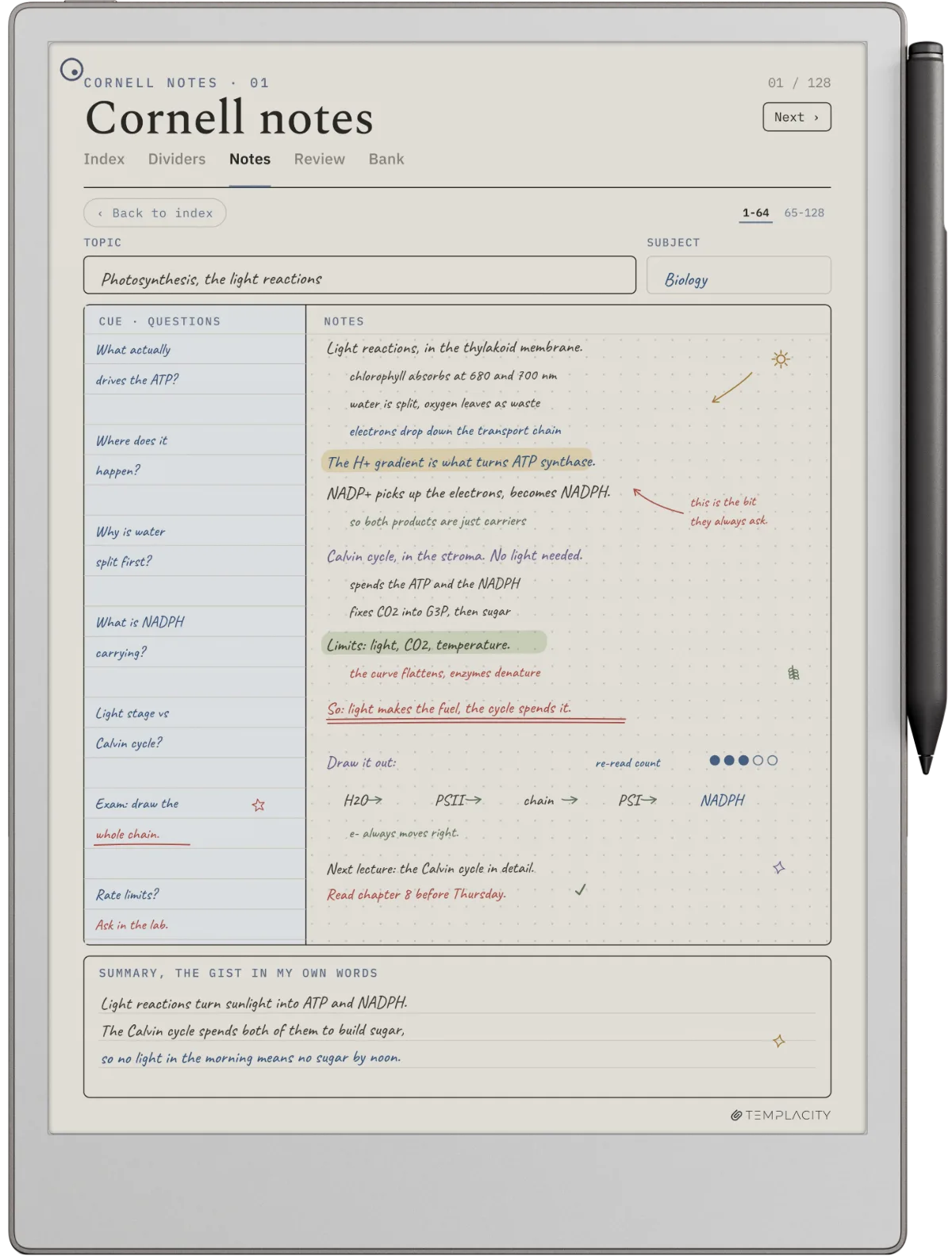
If you have used the Cornell notes layout, the shape is familiar: capture in one column, reduce afterwards in another. A zettelkasten does the same two-step, except the reduced version leaves the page and goes into a box where it can meet notes from other books entirely. The cheapest way to try that two-step is the free Cornell notes template, which rules the two columns for you.
The medium
Paper, e-ink, or an app
This is the question every beginner asks first and it is the least important one on the page. All three work. They fail differently, which is the only thing worth knowing before you pick.
Apps genuinely win on two things and it would be dishonest to pretend otherwise. Backlinks are automatic, so you see what points at a note without maintaining the reverse link yourself, and full-text search across ten thousand notes is instant. Obsidian is the usual starting point and is free for personal use with no sign-up, with paid add-ons for sync at $4 per user per month billed annually and publishing at $8 per site per month billed annually (obsidian.md, checked August 2026). If you want the software comparison rather than the method, our roundup of zettelkasten apps covers the five built for this, and our wider note-taking app guide covers the rest of the field.
| Medium | Linking | Finding | How it fails |
|---|---|---|---|
| Paper cards | By hand, one direction only | By walking the box | Stops scaling somewhere past a few thousand cards, and there is no backup |
| E-ink tablet | By hand, page links in a PDF | By index page, search is uneven on handwriting | Recall depends on your own index, so a sloppy index is a lost box |
| App on a laptop | Automatic, both directions | Instant, full text | Configuration replaces writing, and the graph view flatters a box with no real links |
The app failure is worth dwelling on because it is the common one now. Setting up a vault is pleasant, produces visible progress, and costs nothing intellectually. Writing a note in your own words is uncomfortable and produces one small card, for the same reason the Feynman technique works: it shows you exactly where your understanding stops. Given the choice, most people spend the first month on plugins, decide the method does not suit them, and conclude that a system failed when what actually happened is that they never used it. Slowness is not the enemy here. It is the mechanism.
That is the case for writing the note by hand, on paper or on an e-ink tablet, and keeping the app for the index and the search. Handwriting is too slow to transcribe with, which means you are forced to compress, and compression is exactly what makes a note atomic. For a longer look at how that feels on a device, our notes on note-taking on a Kindle Scribe and the research planner both cover the practical side.
Starting
Your first twenty notes
The smallest version of the zettelkasten method that actually works is twenty notes and one index. Not a folder structure, not a tagging scheme, not a template with eight fields. Twenty notes, each with an address, each linked to at least one other, and a single page listing where to start reading.
Checklist
Twenty notes and one index
The order we would do it in. Two weeks at a relaxed pace, one weekend if you are impatient.
i. Set the box up
Cards, a notebook, one tablet, or one plain-text folder. The choice is reversible and the deliberation is not free.
A running number is fine. A date and time stamp is fine. Never change it afterwards.
ii. Fill it
Old material is easier because you have forgotten the phrasing and have to use your own.
If nothing connects, that is a signal about your reading, not about the box.
iii. Check it works
The ones that do not are the lesson. Rewrite them shorter and in your own words.
Written August 2026
Twenty notes will not feel like much. That is expected, and it is roughly four days of Luhmann’s average. What changes at twenty is that the box starts pushing back: you go to file something and find it already has neighbours, and the neighbours are not the ones you expected. That moment is the entire return on the method, and no amount of setup brings it forward.
FAQ
Common questions, answered briefly
What is the zettelkasten method in simple terms?
Do you need an app to use a zettelkasten?
How many notes before a zettelkasten becomes useful?
Is the zettelkasten method the same as a second brain?
If your question is not up there, leave it in the comments and we will add it. We are especially interested in how people handle the handwriting-to-index step, because that is the part with no settled answer.
People also ask