Start here
Two notebooks that look alike and differ inside
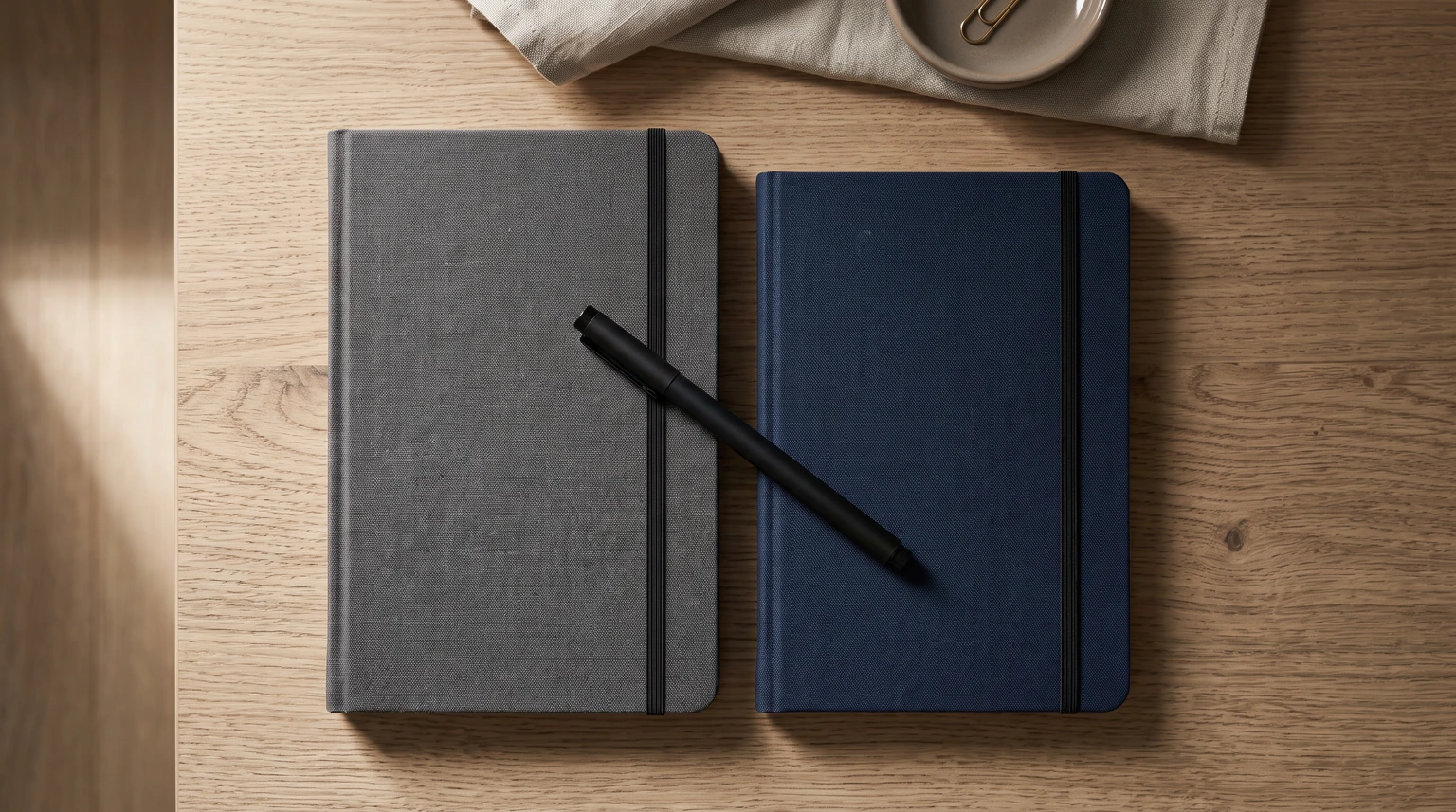
Put a Moleskine Classic and a Leuchtturm1917 Notebook Classic side by side on a desk and you could mistake one for the other: hard cover, rounded corners, an elastic band, a ribbon, a pocket in the back. The Moleskine vs Leuchtturm question gets asked so often because the outsides are nearly the same. The answer sits inside, in three places: the weight of the paper, whether the pages are numbered, and how much page you get for the price.
Most of what ranks for this comparison today is a planner review from 2017 or a watercolour test from 2019, and both makers have changed their ranges since. So we went back to the source. Every spec and price below comes from Moleskine’s own US store and Leuchtturm1917’s own site, read in October 2026, and where a maker does not publish a number, we say so rather than borrow one from a forum.
One thing to settle first. The usual pair people compare is the Moleskine Large against the Leuchtturm1917 Medium (A5). They are the same height and the closest match in each range, so that is the pairing this page uses unless it says otherwise.
Side by side
Moleskine vs Leuchtturm, side by side
The two cards agree on more than they disagree. Both come in the same four page layouts, both have an elastic closure and a pocket inside the back cover, both are made with FSC-certified paper, and both say they open flat. Moleskine puts it as lying flat at 180 degrees; Leuchtturm1917 says its thread-bound book opens flat. If you only care about the object in your bag, either will do the job.
| MoleskineClassic Large | Leuchtturm1917Medium A5 | |
|---|---|---|
| Paper weight | 70 g/m² | 80 g/m² |
| Numbered pages | No | 251 |
| Table of contents | No | Blank, printed |
| Ribbon markers | 1 | 2 |
| Perforated sheets | No | 8 |
| Labels for archiving | No | Sticker set |
| Paper colour | Ivory | Not stated |
| Lost-and-found page | ‘In case of loss’ flyleaf | Not stated |
Read the table as two different ideas of a notebook. The Leuchtturm1917 is built to be organised and found again: numbered pages, a contents page waiting to be filled, two ribbons for two places, labels for the spine once it is full. The Moleskine is built to be carried and written in: one ribbon, warm ivory paper, a flyleaf printed with ‘In case of loss’.
The paper
70 grams against 80: the paper question
Paper weight is measured in grams per square metre, and it is the closest thing a spec sheet gives you to how a page will feel and how much shows through from the other side. Moleskine lists ivory-coloured, 70 g/m², acid-free paper for the Classic. Leuchtturm1917 lists 80 g/m² across its Medium, Pocket, Paperback and Composition sizes, and 100 g/m² in its two A4+ Master notebooks.
Paper weight, grams per square metre (each maker’s own spec, October 2026)
Ten grams is about a seventh more paper per sheet. In general a heavier sheet is a little thicker and lets less of the next page show through, which is what people mean when they talk about ghosting. It is not the whole story, though. How a page takes ink also depends on how the paper is finished and on the pen, which is why one person’s fountain pen bleeds where another person’s gel pen does not. We have not run our own pen tests, and a number on a spec sheet will not tell you how your pen behaves.
So the useful test is cheap: buy the notebook, turn to the very last page, and write a line with every pen you plan to use. If nothing shows through on the back, the paper weight question is settled for you, whichever brand is in your hand. If you write mostly with a pencil or a fine ballpoint, the gap between 70 and 80 will rarely matter. If you use markers, brush pens or a broad fountain pen, start with the heavier page.
Structure
Numbered pages and an index: why journals lean Leuchtturm
The reason the Leuchtturm1917 became the default notebook for bullet journalling is less about paper and more about two printed details. Its pages arrive numbered, all 251 of them in the A5 hardcover, and the front carries a blank table of contents. The bullet journal method runs on exactly those two things: you number every page and keep an index at the front, so that a collection started on page 34 can be found again in March.
A notebook you will search later needs page numbers and an index more than it needs better paper.Structure
A notebook you will search later needs page numbers and an index more than it needs better paper. With the Moleskine you can still keep a bullet journal, plenty of people do, but you number the pages yourself and rule your own index, which is an evening of setup before the first real entry. The Leuchtturm1917 also adds a second ribbon, handy for marking both today’s page and the monthly spread, plus eight perforated sheets you can tear out cleanly and a sticker set for labelling the spine once the book is full.
If you write a notebook front to back and never go looking for an old page, none of this matters, and the Moleskine’s single ribbon and unnumbered pages will feel like less clutter rather than less function. Our guide to the bullet journal method explains the index, the logs and migration in full, if you are choosing a notebook to start one.
Size and price
Same height, different width, different currency
The Moleskine Large is 5 by 8.25 inches. The Leuchtturm1917 Medium is A5, 145 by 210 millimetres, which works out to about 5.7 by 8.3 inches. The heights match; the Leuchtturm1917 is roughly two thirds of an inch wider, and that extra width is where its two-column spreads and A5 printables fit without trimming. Leuchtturm1917 also notes that any A5 double page photocopies straight onto a sheet of A4.
| MoleskineUS store | Leuchtturm1917Own store | |
|---|---|---|
| 3.5 x 5.5 in, $22 | Pocket A6, 187 pages, €18.50 | |
| In between | Medium, 4.5 x 6.9 in | Paperback B6+, 219 pages, €21.95 |
| Large / A5 | 5 x 8.25 in, $26 | A5, 251 pages, €24.50 |
| Bigger | XL 7.5 x 9.75 in, XXL 8.5 x 11 in | Composition B5, 219 pages, €28.50 |
Prices need a note. Moleskine’s US store lists the Classic hard cover at $26 for the Large and $22 for the Pocket, in dotted and ruled alike, with free standard shipping over $75. Leuchtturm1917’s own store prices in euros, including VAT: €24.50 for the A5 hardcover and €22.95 for the 123-page A5 softcover. Its US store did not load for us on the day we checked, so we quote the euro list price rather than guess at a dollar one, and US retail prices for both brands move with the retailer.
What we can say is that the two land in the same band, and that only one of them tells you how many pages you are paying for. Leuchtturm1917 publishes a page count for every format. Moleskine’s product page does not list one, so any price-per-page comparison you see is built on a number Moleskine is not printing on its own store today.
The third option
When neither notebook is the answer
People searching for a Moleskine alternative are often not unhappy with the paper. They are unhappy with what a paper notebook cannot do: it runs out, the index never quite keeps up, and the collection you want is in last year’s book on a shelf. That is a different problem, and a better notebook does not solve it.
An e-ink writing tablet does. You still write by hand on a matte screen, but the pages never run out, and a hyperlinked template does the indexing for you. Our digital bullet journal guide walks through how that works, and the e-paper tablet explainer covers what the screens feel like to write on. We built The Logbook System for exactly this reader: a linked daily, monthly and future log with an index and collections that open with a tap.
None of that makes paper wrong. A notebook needs no charging, costs a fraction of a tablet, and some people simply think better with ink. The honest split is this: if the problem is the notebook, pick between the two above; if the problem is that paper fills up and gets lost, look at a tablet before you buy a third brand of notebook.
The call
Which one to buy
For most people settling Moleskine vs Leuchtturm for a journal, a planner or study notes, the Leuchtturm1917 is the better tool. The heavier 80 g/m² paper gives your pens more margin, and the numbered pages, contents page and second ribbon do work you would otherwise do by hand. If you plan to keep a bullet journal, it is the notebook the method assumes.
Choose the Moleskine if you want a notebook to carry and fill rather than to organise: field notes, sketches, a commonplace book, a pocket book for ideas. The ivory paper is warmer on the eye, the single ribbon keeps it simple, and the Pocket size slips into a jacket. Just test your pens on the last page first.
If the notebook is chosen and the method is next, start with our bullet journal method guide. If you are weighing paper against a tablet for school, the digital notebook guide for students covers that choice, and the reMarkable hub sits above all of it.
FAQ
Common questions, answered briefly
Is Leuchtturm1917 paper thicker than Moleskine?
Does Moleskine have numbered pages?
How many pages does a Leuchtturm1917 A5 have?
Which is better for a bullet journal, Moleskine or Leuchtturm1917?
Is the Moleskine Large the same size as a Leuchtturm1917 A5?
If yours isn’t above, drop the question in the comments and we’ll add it.
People also ask
Other questions, briefly answered
If you have kept a journal in both, we would rather hear that than another spec sheet: tell us in the comments which one you went back to, and which pen made the decision.