The honest cut
What counts as the best E Ink phone in 2026
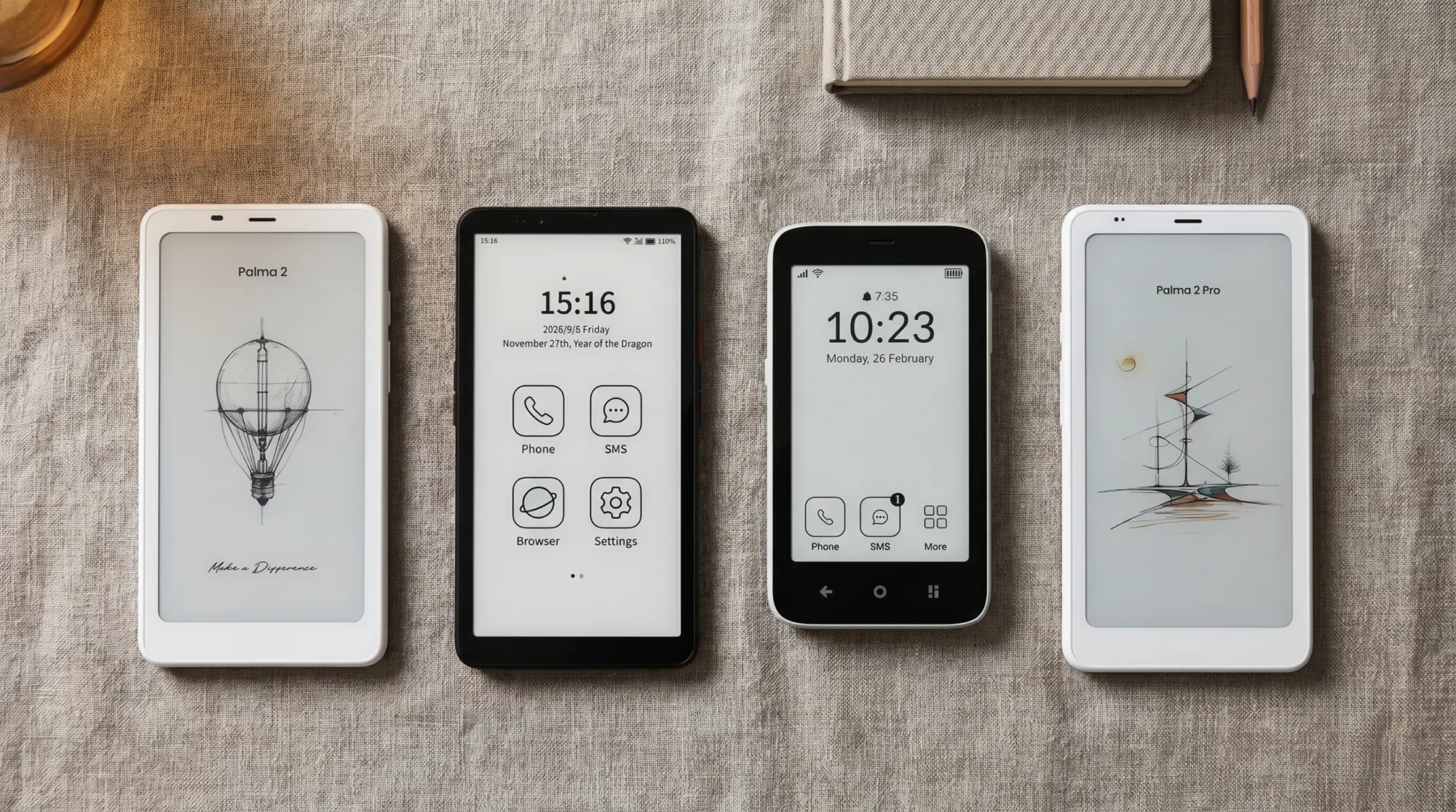
Half the devices sold as the best e ink phone cannot place a phone call. That is not a footnote; it is the whole decision. The category splits into three honest tiers: true phones with a SIM and a dialer (Bigme’s HiBreak Pro, HiBreak Dual and HiBreak S, and the Mudita Kompakt), data-only devices that take a SIM but route no calls or SMS through it (Boox Palma 2 Pro), and Wi-Fi pocket readers shaped like phones (the Boox Palma 2 and its successor, the Palma 3). Blur these tiers and you buy the wrong device; we would rather you buy once.
One name missing from our list on purpose: the Minimal Phone. The original was an E Ink phone with a physical keyboard, but it is no longer on Minimal Company’s store, and its successor is not E Ink. Minimal Company says so on the product page itself: the Minimal Phone 2 has a 4-inch AMOLED screen. It is a keyboard phone for people who want less screen time, on preorder at $599 for 256 GB and $699 for 512 GB, shipping December 2026. If the paper-like screen is the reason you are shopping, it is not the phone for that.
Two hardware traits separate the credible picks from the junk drawer: a 300 ppi panel, because coarser screens read greyer and softer than any modern e-reader, and a real Android stack, because messaging, banking, ride apps, and two-factor codes have to work or the device goes in a drawer by week two. The mono Bigme and Boox picks clear both bars at 300 ppi; color panels drop to 150 ppi on color content, the cheaper HiBreak S is 276 ppi in black and white, and the Kompakt skips apps deliberately rather than by failure.
| Device | Price | Calls | Screen | OS | Best for |
|---|---|---|---|---|---|
| Bigme HiBreak Pro | $439 | Yes, dual SIM 5G | 6.13″ E Ink, 300 ppi | Android 14 + Play Store | Your only phone |
| Boox Palma 3 | $339.99, not yet on sale | No cellular | 6.13″ mono, 300 ppi | Android 16 | Pocket reader beside your phone |
| Boox Palma 2 Pro | $399.99 | Data only, no dialer | 6.13″ Kaleido 3 color | Android 15 + Play Store | Color reading with 5G data |
| Mudita Kompakt | On Mudita’s store | Yes | 4.3″ E Ink touch | MuditaOS, minimal apps | Leaving the smartphone behind |
| Bigme HiBreak S | $219-$279 | Yes, 4G calls | 5.84″ E Ink, 276 ppi mono or color | Android 14, open system | The cheapest way in |
| Bigme HiBreak Dual | From $389, early-bird listing | Yes, dual SIM 5G | 6.13″ E Ink + small rear LCD | Android 14 + Play Store | 5G calling for less than the Pro |
Pick 1
Bigme HiBreak Pro: the best E Ink phone you can actually call from
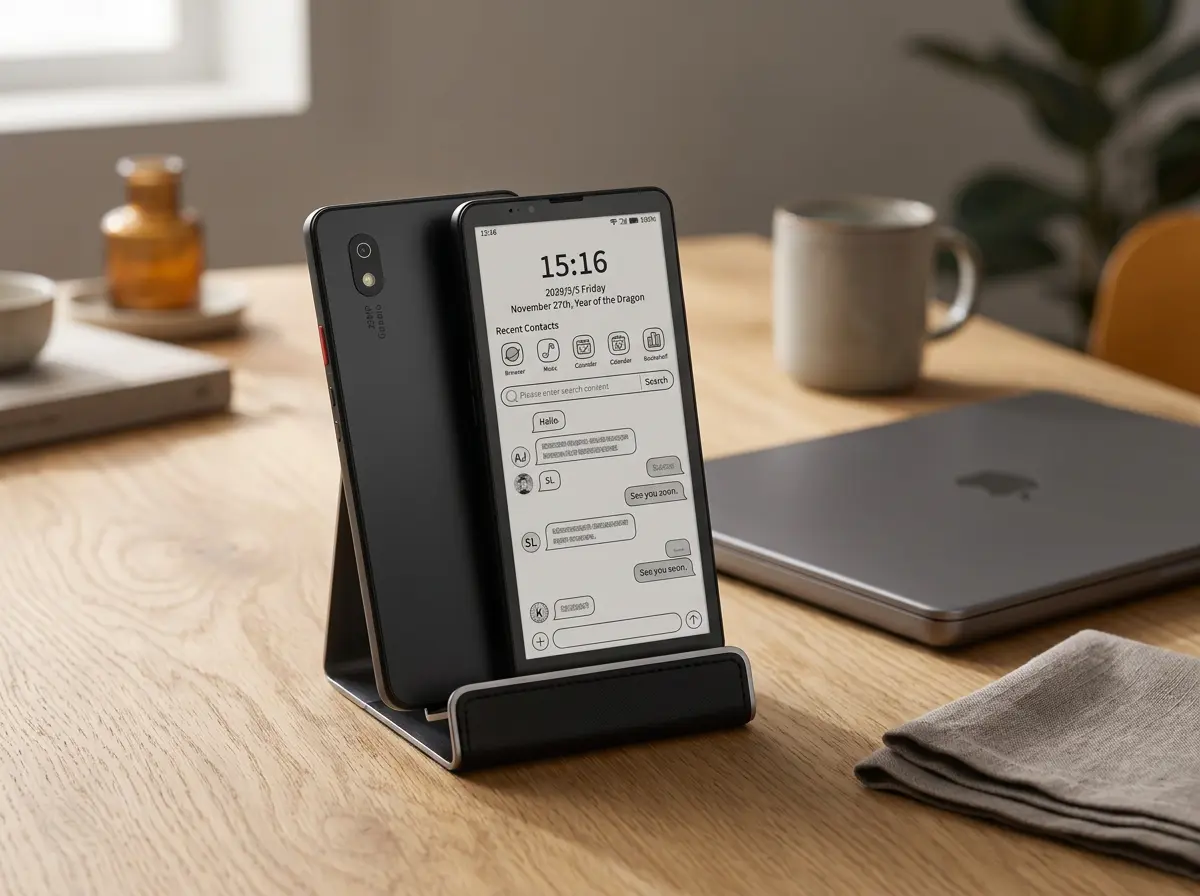
The HiBreak Pro is the fullest normal phone on this list with an E Ink screen, rather than an e-reader cosplaying as one. Dual SIM with 5G, a working 20 MP camera, fingerprint unlock, GPS, and full Android 14 with the Play Store. Messaging, maps, ride and banking apps install from the Play Store like on any Android phone; how well each behaves on E Ink is the app’s business, not Bigme’s. A calm screen you can still get a ride with is the entire pitch.
- Price
- $439 for the mono build; the color HiBreak Pro is listed at $459 to $479 depending on configuration
- Screen
- 6.13-inch E Ink, 824 x 1648, 300 ppi
- Engine
- MediaTek Dimensity 1080, 8 GB RAM, 256 GB storage
- Cellular
- Dual SIM, 5G, regular calls and SMS; check your carrier’s bands against Bigme’s list
- Battery
- 4,500 mAh with 18 W fast charging; Bigme gives no day count
- The catch
- E Ink refresh makes video and fast scrolling rough; this is a feature if you want a calmer phone, a dealbreaker if you do not
The refresh-rate trade is the point. A 300 ppi E Ink page is crisp and bookish, static screens look like paper, and a pocket screen that does not glow is the whole reason to buy one. Bigme pitches the 20 MP camera for scanning, with automatic OCR, which is the right expectation: documents, not photography. If the HiBreak Pro replaces your main phone, you are accepting that trade with open eyes.
Pick 2
Boox Palma 3 and Palma 2: the pocket E Ink reader, and not a phone
We will say it before the spec sheet does: the Palma has no cellular modem. No SIM slot, no calls, no texts away from Wi-Fi. It is a phone-shaped Android e-reader, and the line is between generations. The Palma 2, a 6.13-inch Android 13 reader, is sold out at Boox’s US store. Its successor, the Palma 3, is listed at $339.99 and marked available soon: the same 6.13-inch size at 300 ppi, Android 16, 6 GB of RAM and 128 GB of storage, and still Wi-Fi and Bluetooth only (checked October 2026). Either way, Android reading apps such as Kindle, Kobo and Libby install on it.
The reason it earns a place despite not being a phone is the use pattern it enables. Your actual phone stays in the bag; the Palma rides in the pocket. Notifications live on the device that is not in your hand, so the easy thing to open is a book. Our full Boox Palma 2 review covers the buttons, the microSD slot, and the speaker in detail.
A calm screen you can still get a ride with is the entire pitch.From the HiBreak Pro section
Pick 3
Boox Palma 2 Pro: color and 5G data, still no dialer
The Palma 2 Pro is the newest Boox you can buy with a SIM slot, and the easiest device here to misunderstand. It adds a Kaleido 3 color panel, Android 15, 8 GB of RAM, and a hybrid SIM slot with 5G support, and at $399.99 it reads like the HiBreak Pro with color. It is not. The official spec sheet is plain about it: the SIM is data-only. No native calls, no SMS. WhatsApp and Signal calls over data work fine; your phone number does not move in.
Read it as a Palma that never needs a hotspot, with muted paper-style color for covers, comics, and highlights. The color layer costs some contrast on plain text, the same Kaleido trade we cover in our color e-ink guide, so pure-text readers should wait for the mono Palma 3, listed $60 lower. Color readers who want maps and messages on the move without carrying a hotspot get exactly that, at 175 grams.
Pick 4
Mudita Kompakt: the phone for people leaving their phone

The Kompakt inverts the question. Every other pick asks how many smartphone jobs an E Ink screen can keep; Mudita asks how few it can get away with. The 4.3-inch E Ink phone runs MuditaOS K with a fixed toolkit: calls and texts, offline maps for navigation, music, and a camera for digitizing documents. There is no app store and no feed of any kind. Mudita lists a 3.5mm headphone jack and up to six days of battery life, because nothing on the device wants your attention.
It costs real money for deliberately less, and that math only works if the less is the product. For a digital-minimalism reset, a distraction-free season, or a first phone for a teenager, it is the strongest purpose-built option in the category; the official product page is refreshingly direct about what it leaves out. If you suspect you will sideload your way back to a smartphone, buy the HiBreak Pro instead and save yourself the detour.
Pick 5
Bigme HiBreak Dual: 5G calling, with a second screen
The HiBreak Dual is Bigme’s newer route to a 5G E Ink phone: a 6.13-inch E Ink front screen, a small 360 x 360 LCD on the back, dual 5G SIM, and Android 14 with Google Play. Bigme lists it from $389 for the 8 GB black-and-white build without stylus or case, $409 for color, and from $419 for 12 GB, all under early-bird labels, and its page still carries a pre-order note (checked October 2026). A HiBreak Dual 3 on Android 16 is up for pre-order from $569, shipping early to mid November.
It is $50 under the HiBreak Pro for 5G and a dialer, and the rear LCD covers the jobs E Ink does badly, such as a quick look at a photo, answering a call or framing a selfie with the main camera. We rank it last because the listing is the least settled thing on this page: confirm the ship date on Bigme’s page before you pay. If 5G is not the point, the cheaper door is the 4G HiBreak S from $219, covered below.
Android and 5G
Which E Ink phones run Android, and which take a 5G SIM
Two questions decide the best e ink phone for you before price does, and they are not the same question. “Does it run Android” is about whether your apps install. “Does it take a SIM” is about whether the device has its own number. Five of the six devices here clear the first bar, and four clear the second in the way people assume.
On the Android side the field is healthier than its reputation. The Bigme HiBreak Pro ships what Bigme calls an Android 14 certified open system with the Play Store already installed. The HiBreak Dual runs Android 14 with Google Play as well, and the cheaper HiBreak S runs an open Android 14 that Bigme does not list with Play. Boox puts Android 15 on the Palma 2 Pro, with the Play Store, and lists Android 16 for the coming Palma 3. The one exception is deliberate rather than accidental: the Mudita Kompakt runs MuditaOS and has no app store by design. So yes, an E Ink Android phone is a real product you can buy today, from Bigme and Boox, at several price points.
The SIM side is where the marketing gets slippery. Two devices on this page pair 5G with a working dialer, both from Bigme: the HiBreak Pro, which Bigme lists as 5G Dual SIM Dual Standby, and the HiBreak Dual. The Palma 2 Pro also takes a SIM and also reaches 5G, but Boox is explicit on the product page that it is a data-only SIM, so the radio is there and the phone number is not. The mono Palma 3, like the sold-out Palma 2, has no SIM slot at all and connects over Wi-Fi and Bluetooth only. And the cheapest device that genuinely rings, the HiBreak S, does it over 4G LTE rather than 5G. If you have been searching for a cheap 5G E Ink phone, that gap is the answer: 5G and a dialer meet at $389 on the HiBreak Dual’s early-bird listing and $439 on the HiBreak Pro. Anyone picking the best e ink phone on network alone can stop reading there.
- 5G plus calls
- Bigme HiBreak Dual from $389 (early-bird listing); HiBreak Pro $439 mono
- 5G, data only
- Boox Palma 2 Pro, $399.99; no dialer, no SMS
- 4G plus calls
- Bigme HiBreak S from $219; Bigme HiBreak Plus $249; Mudita Kompakt
- No cellular
- Boox Palma 3, $339.99 and not yet on sale, Wi-Fi and Bluetooth only
- Play Store
- HiBreak Pro, Dual and Plus, and the Palma 2 Pro; Bigme does not list it for the HiBreak S; not the Kompakt
The low end
The cheapest E Ink phones, and what the low end costs you
The cheapest E Ink phone at list price in 2026 is the Bigme HiBreak S, which starts at $219 for the 4 GB black-and-white build, $249 for 6 GB with 128 GB, and $279 in color. It is a 5.84-inch panel rather than 6.13, a 3,300 mAh battery rather than 4,500, and an octa-core chip well below the HiBreak Pro’s Dimensity 1080. What it does not cut is the part people assume gets cut first: it is a 4G LTE phone that makes and receives calls on the device, on an open Android 14 system that installs third-party apps.
Bigme’s own store holds three neighbours. The HiBreak Plus is $249 in black and white or $259 in color: a 6.13-inch 4G dual-SIM phone on Android 14 with the Play Store, a 4,500 mAh battery and stylus support, the stylus sold separately. The 2024 HiBreak is listed at $229, and a flash-sale listing of it sits at $209, but it runs Android 11, three versions behind the HiBreak S. The honest floor for a current-Android phone is $219, and Boox’s pocket reader is now the Palma 3 at $339.99, listed but not yet on sale, which costs about $120 more than the HiBreak S and cannot dial at all. That is the whole trade at the bottom of this market: the extra money buys a better reading screen, not a phone number. The best e ink phone on a tight budget is therefore a two-line answer, the HiBreak S if it has to ring and a Palma if it has to read well.
Buying one in the US is simpler than it was. Boox ships the Palma line from its own US store, Bigme sells every HiBreak direct, and Mudita sells the Kompakt from its own site with a North American version, so none of them needs an importer or a customs gamble. Grey-market imports are the reason the category still has an import reputation; if you want the calm screen without a project attached, buy from a maker that sells here.
Choosing
How to choose the best E Ink phone for your pocket
Strip the spec sheets and the decision is three questions. First: does this device need your phone number? If yes, your list is the HiBreak Pro, the HiBreak Dual, the HiBreak S and the Kompakt; nothing Boox sells will dial. Second: is the goal fewer apps or calmer apps? Fewer means Kompakt; calmer means HiBreak Pro or a Palma. Third: does color earn its contrast cost for what you read? Mostly text says the mono Palma 3; comics, covers, and color highlights say Palma 2 Pro.
And if the honest answer is that you want the calm screen mostly for reading and notes at a desk rather than in a pocket, the move is sideways: a full writing tablet. Our best e-ink tablet guide ranks that category the same way this one ranks phones, and the reMarkable hub and Boox hub hold the deeper device coverage.
Whichever side of the calls line you land on, buy for the trade you are actually making: slower screen, longer attention. If you own one of these, or bounced off one, tell us what the first two weeks were like in the comments; real ownership patterns are the data this category is shortest on.
FAQ
Common questions, answered briefly
What is the best E Ink phone in 2026?
Can the Boox Palma 2 make phone calls?
Is there a color E Ink phone?
How long does an E Ink phone battery last?
Should you buy an E Ink phone or an e-reader?
Is there an E Ink phone that runs Android?
What is the cheapest E Ink phone?
Is the Minimal Phone an E Ink phone?
Can you buy an E Ink phone in the US?
One pattern worth naming across the whole field: the questions people ask before buying are about specs, and the questions they ask after are about habits. The device that survives is the one whose missing features you stop noticing.
People also ask