The form
What an SOP template is for
Every team has a job that only one person really knows how to do, and everyone finds out which job it is the week that person is away. An SOP template is how you get that job out of their head and onto a page. SOP stands for standard operating procedure, and the US Environmental Protection Agency’s guidance on preparing them defines one plainly: a set of written instructions that document a routine or repetitive activity.
The template’s job is to make sure you write down the parts people forget: who owns the procedure, when it stops applying, what to do when a step fails, and when somebody last checked that it is still true. The same EPA guidance is blunt that there is no one correct format, so treat ours as a starting shape and cut what you do not need.
Free download
Download the free SOP template
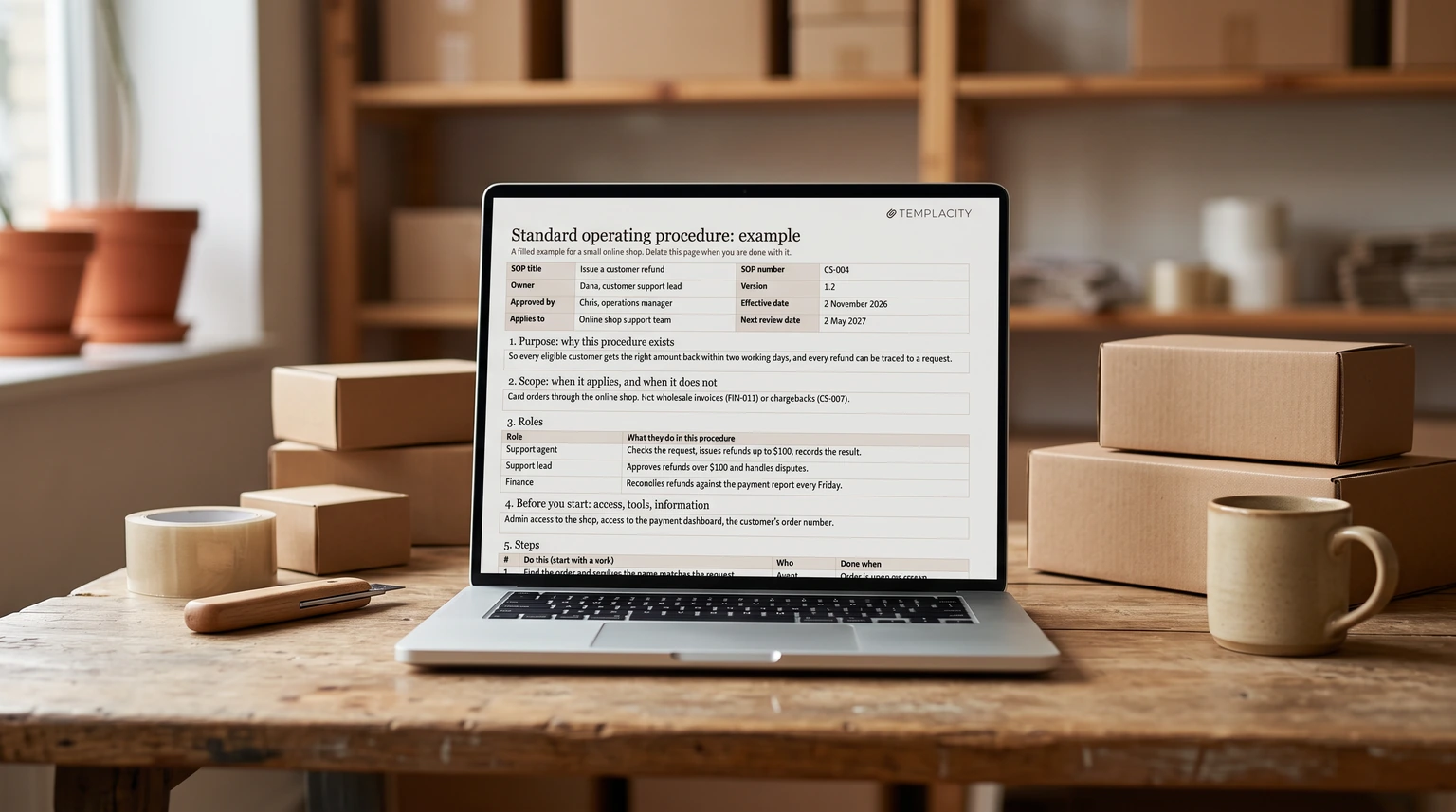
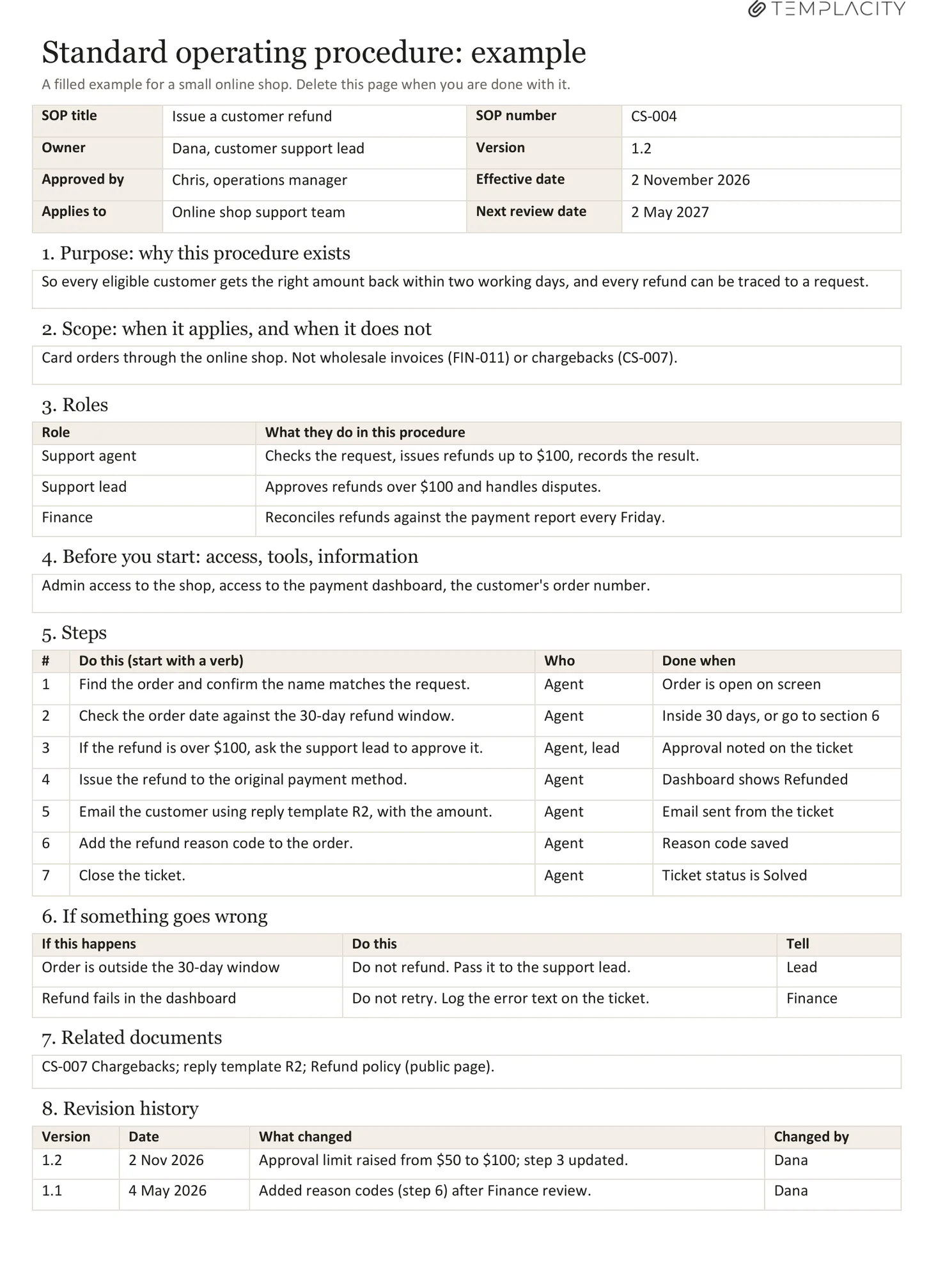
The file is two pages. Page one is the blank standard operating procedure template, and page two is the same form filled in for a small online shop’s refund procedure, so you can see how much detail each box wants before you start yours. Delete page two when you are done with it.
For a Google Docs SOP template, upload the file to Google Drive and double-click it. Google’s help page on Office files says that opens it for editing in Docs, and the tables are plain so there is nothing special to convert.
The sections
What goes in a standard operating procedure
Eight sections cover almost any routine job, each one answering a question a new person would otherwise have to ask someone:
| Section | The question it answers |
|---|---|
| Control box | Is this the current version, and who stands behind it? |
| Purpose | Why does this procedure exist? |
| Scope | When does it apply, and when does it not? |
| Roles | Who does what? |
| Before you start | What access, tools or information do you need first? |
| Steps | What exactly happens, in what order, and how do you know each is done? |
| If something goes wrong | What do you do when a step fails, and who do you tell? |
| Related documents and revision history | What else do you need, and what changed last? |
Two details do most of the work. Done when sits on every step and turns “check the order” into something a person can tick off. Next review date sits in the control box, because an SOP nobody has looked at in two years is worse than none: people follow it and get the wrong answer.
Writing it
How to write an SOP in six steps
- Pick a job that repeats and hurts when it goes wrong. Refunds, month-end close, new starter setup. A task done once a year by one careful person rarely earns an SOP.
- Watch it being done, and write down what really happens. The person doing the job will skip the steps that have become automatic if you only ask them to describe it.
- Write one action per step, starting with a verb. The EPA guidance asks for a concise, step-by-step format in the active voice and present tense. “Issue the refund to the original payment method” passes; “refunds should be processed appropriately” does not.
- Fill in “Done when” for every step. If you cannot say what finished looks like, the step is too vague to follow.
- Add the failures you already know about. Each “If this happens” line is a phone call somebody no longer has to make.
- Hand it to someone who has never done the job. The EPA notes it is especially helpful when drafts are tried out by someone other than the writer. Every place they stop to ask a question is a line to fix.
If several people share a procedure and nobody is sure who signs off, settle that before you write the Roles section; our free RACI matrix template does exactly that job. And when a process changes in a meeting, a line in the meeting minutes template with an owner and a date is what gets the SOP updated.
Example
An SOP example: issuing a customer refund
The example in the file is invented, and deliberately ordinary. A support agent gets a refund request for an order paid by card. These are the steps, as the page has them:
| Do this | Done when |
|---|---|
| Find the order and confirm the name matches the request | Order is open on screen |
| Check the order date against the 30-day refund window | Inside 30 days, or go to section 6 |
| If over $100, ask the support lead to approve it | Approval noted on the ticket |
| Issue the refund to the original payment method | Dashboard shows Refunded |
| Email the customer with the amount, using the reply template | Email sent from the ticket |
Notice what is not there: no background on why refunds matter, no paragraphs about customer care. The purpose gets one sentence, the exceptions get their own table, and “the order is outside the window” points to a named person rather than leaving the agent to guess.
If you cannot say what finished looks like, the step is too vague to follow.Writing the steps
Formats
Which SOP format fits the job
A numbered step table, which is what our SOP template uses, fits most straight-line jobs. A plain checklist is enough when the people doing the work already know how and only need not to forget, like a closing routine. A flowchart earns its place when the job branches at several points; the EPA guidance suggests one for illustrating a process, and it can sit beside the steps rather than replace them.
If you work in a regulated field, a form like this is only a starting point. US drug manufacturers, for example, must have written production procedures reviewed and approved by the quality control unit under 21 CFR 211.100, and your quality system will dictate its own numbering and sign-off. Use your organization’s required format and treat this one as a drafting aid.
Upkeep
Keeping an SOP true after you write it
Most SOPs fail slowly. The EPA guidance says to update and re-approve an SOP whenever the procedure changes, and to review it periodically, giving every one to two years as its example. For a fast-moving small business, six months is a more honest gap, which is why the example’s review date is half a year out. Keep one current copy somewhere everyone can reach, name one owner, and add a line to the revision history every time something changes.
Procedures also tend to multiply once the first one works. If they start needing a schedule or a tracker beside them, our project plan template guide and the Excel templates roundup cover that side, and a one on one meeting template is a good place to ask whether the procedure is still the way the work really happens. More of our work and planning guides are collected under planning.
Which job in your team most needs writing down, and who is the only person who knows it? Tell us in the comments; the best ones may become the next example in the file.
FAQ
Common questions, answered briefly
What is an SOP template?
Is there a free SOP template for Word?
Can I use this SOP template in Google Docs?
How long should an SOP be?
How often should an SOP be reviewed?
If yours isn’t above, drop it in the comments and we’ll add it.
People also ask