The basics
What a letter of gratitude is, and what it is not
A letter of gratitude is a letter to someone who did something for you that you never properly thanked them for. It names what they did, describes how it changed your life, and ideally gets read aloud to them. If you came here for a letter of gratitude template, that is what ours is built for: one person, one act, said plainly.
It is a different thing from a thank-you note for a gift or an interview. Most of the template galleries that rank for this search, such as Canva and Adobe Express, are thank-you letter designs: a pretty border and room for three polite lines. That works for a wedding present. It does not help you say the thing you have been meaning to say to a teacher, a parent or an old friend for ten years.
The gratitude letter as an exercise comes from positive psychology. The Gratitude Letter practice published by UC Berkeley’s Greater Good Science Center asks you to pick someone you could meet in the next week, write to them directly (“Dear ______”), describe in specific terms what they did and how it affected your life, and then deliver it in person. That shape is what our template follows.
The structure
How to write a gratitude letter in four parts
A gratitude letter that works makes the same four moves, in roughly this order. Plan them before you write and the letter almost writes itself; skip the plan and you end up with a page of adjectives.
| Part | What it does | Example line |
|---|---|---|
| What they did | Names one act, not a list | You made me book the hall again for the next Saturday. |
| The moment | Puts them back in the scene | You found me outside the hall after I walked off stage. |
| What it changed | Shows the act had a result | On the bad shifts I still hear that sentence in your voice. |
| Where you are now | Brings the story to today | I teach new nurses now, and I say it to them. |
Open with “Dear” and their name and one line on why you are writing now. Close with thank you in your own words and your name. Leave out three things: a long apology for not writing sooner, a list of everything they ever did, and any request or news. Each of those turns the letter into a different letter.
Length matters less than people think. Half a page to a full page is where most letters land, and the studies Greater Good summarizes gave participants anywhere from five to thirty minutes to write. Spelling and grammar do not matter at all; the practice says so in as many words.
Free template
Our free letter of gratitude template: five pages, fillable
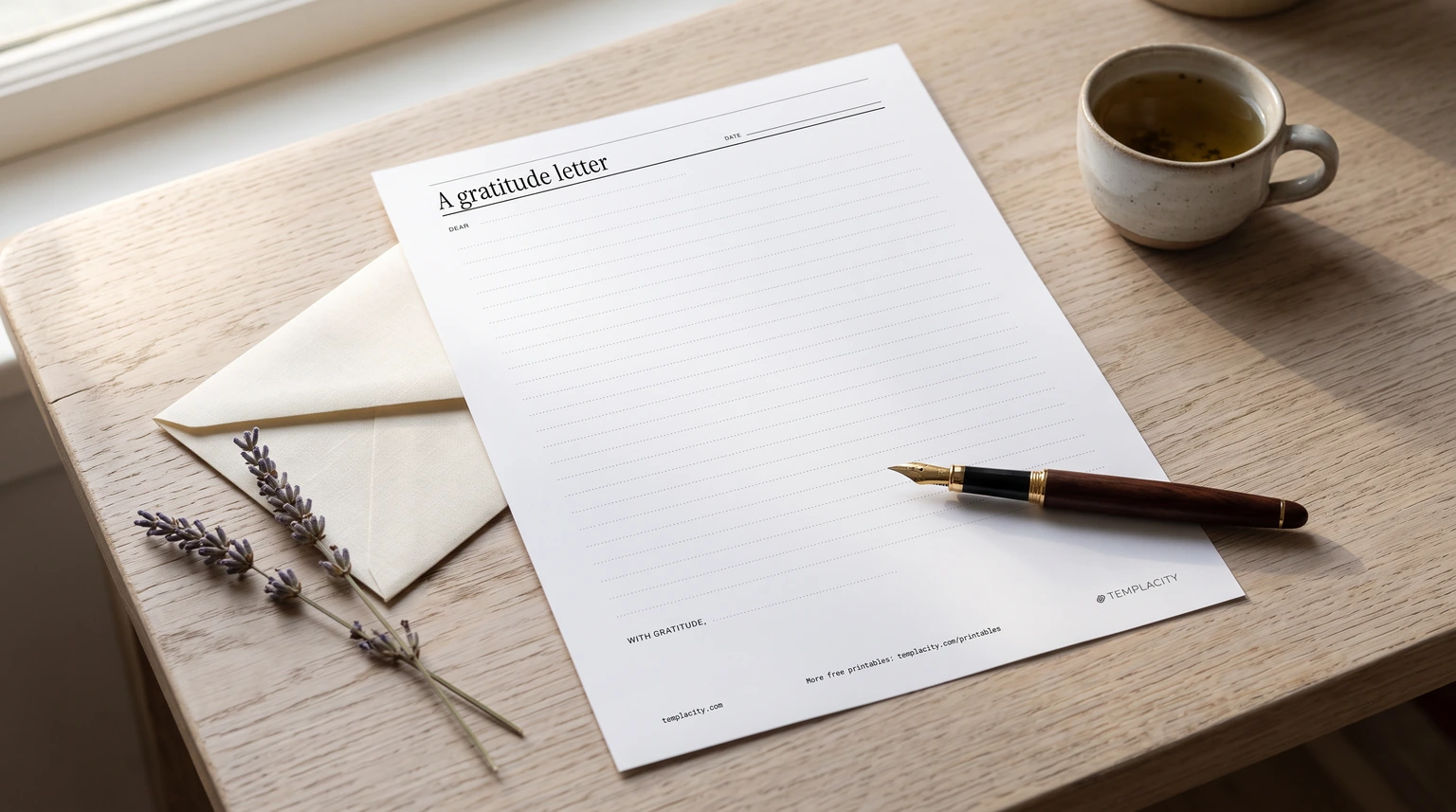
Our free gratitude letter template is a five-page PDF in US Letter, also in A4, as a direct download with no sign-up. Every writing line is a form field, so you can click and type straight onto the dotted lines in any PDF reader, then print it or send it. Or print it blank and write by hand, which is what we would do.
- How to write a gratitude letter. The five steps on one page, plus what to leave out.
- Plan your letter. Lines for who it is to, what they did, the moment, what it changed, where you are now, and how and when you will deliver it.
- The letter page. “Dear” at the top, a full page of lines and a “with gratitude” sign-off.
- An example letter, annotated. A made-up letter to a piano teacher with each of the four parts marked in the margin, plus a three-line letter to a teacher.
- Opening and closing lines. First sentences for a parent, a teacher, a friend, a mentor, a partner and someone you lost touch with.
The free page that ranks first for this search is Character Lab’s Gratitude Letter playbook, a three-page PDF with an overview, a blank page and an annotated student example. It is good, and it is written for students. Therapist Aid’s gratitude letter worksheet is built for children. Ours is written for adults, adds a planning page and opening lines, and every writing line is fillable.
The PDF works on a tablet too. Import it into Goodnotes, Notability or an e-ink tablet and write on the letter page with a stylus, then export the page as a PDF or print it to hand over.
Examples
Gratitude letter examples: a teacher, a parent, a friend
These are short examples we wrote to show the four parts at work, not real letters. Change every detail; the shape is the part to keep.
A gratitude letter to a teacher. “Dear Mr. Haddad, in ninth grade you kept me back after class to say my essay on the bridge collapse was the best in the set, and then you showed me exactly why the last page was weak. Nobody had ever been that honest with me and that kind at the same time. I edit a trade magazine now. I still read every last page twice. Thank you. Priya”
A gratitude letter to a parent. “Dear Dad, I have never told you this properly, so here it is in writing. The winter I failed my driving test twice, you took the Sunday shift off and drove the test route with me every weekend until March. You never once said it was costing you anything. I drive my own kids to school now, and every time I check the mirror twice at that roundabout, I think of you. Thank you. Ana”
A gratitude letter to a friend. “Dear Jo, we do not say this kind of thing to each other, so I am going to write it instead. The week after the move, when I knew nobody in the city, you texted me a photo of your sofa and the words ‘it folds out.’ I stayed four nights. That city is home now, and it started on your sofa. Thank you. Sam”
Notice what each one does not do. None of them says “you are amazing” or lists five virtues. Each one names a single act, a detail you could picture, and what is different now. That is the whole technique, and it is the part a template cannot do for you.
Each one names a single act, a detail you could picture, and what is different now.Gratitude letter examples
Delivering it
How to deliver it, and what the research found
The practice is specific about delivery. Plan a visit without saying exactly why, ask them to let you read to the end without interrupting, read it slowly, talk about it afterwards, and leave the letter with them. If distance is the problem, a phone or video call is the stated alternative. Posting it still counts as thanking someone, but reading it aloud is the version that was studied.
On the evidence, Greater Good cites a 2005 study by Seligman and colleagues in which writing and delivering a gratitude letter gave the biggest boost to happiness of five exercises tested, measured one month later. By six months it had faded back to where people started, which is why some researchers suggest doing it again every six weeks or so. A 2009 study found that adolescents who rarely felt positive emotions got a significant boost two months after writing and delivering one.
The same page is honest about the limits. In cross-cultural research, South Korean participants saw smaller gains than Americans, and Indian adults reported feeling more guilty and indebted after writing gratitude letters. If writing to someone makes you feel you owe them more than you can repay, that is a known effect, not a failure on your part; a gratitude journal kept for yourself may suit you better.
Next step
When one letter turns into a habit
One letter every few weeks is a slow habit, and the time between letters is where a journal helps. Our gratitude journal guide covers how to keep one going past the first month, and our gratitude journal prompts include a set of questions about the people in your life, which is often where the next letter comes from. If you would rather have plain lined sheets, our printable journal pages are free too.
If you want the letters to live alongside a daily practice, A Year of Gratitude is our undated gratitude journal ($29): 365 prompts in twelve chapters, three good things and a kindness each day, pages for the people you are grateful for, and thank-you letter pages, with iPad, e-ink and printable editions in one download. The free letter of gratitude template is the right place to start with one letter first.
Who did you write to, and did you read it to them or post it? Tell us in the comments. We read every one, and the opening lines that work best for people go into the next version of the free template.
FAQ
Common questions, answered briefly
What should a letter of gratitude include?
How long should a gratitude letter be?
Is there a free gratitude letter template?
Should you read a gratitude letter out loud?
How often should you write a gratitude letter?
If yours isn’t above, drop the question in the comments and we’ll add it.
People also ask