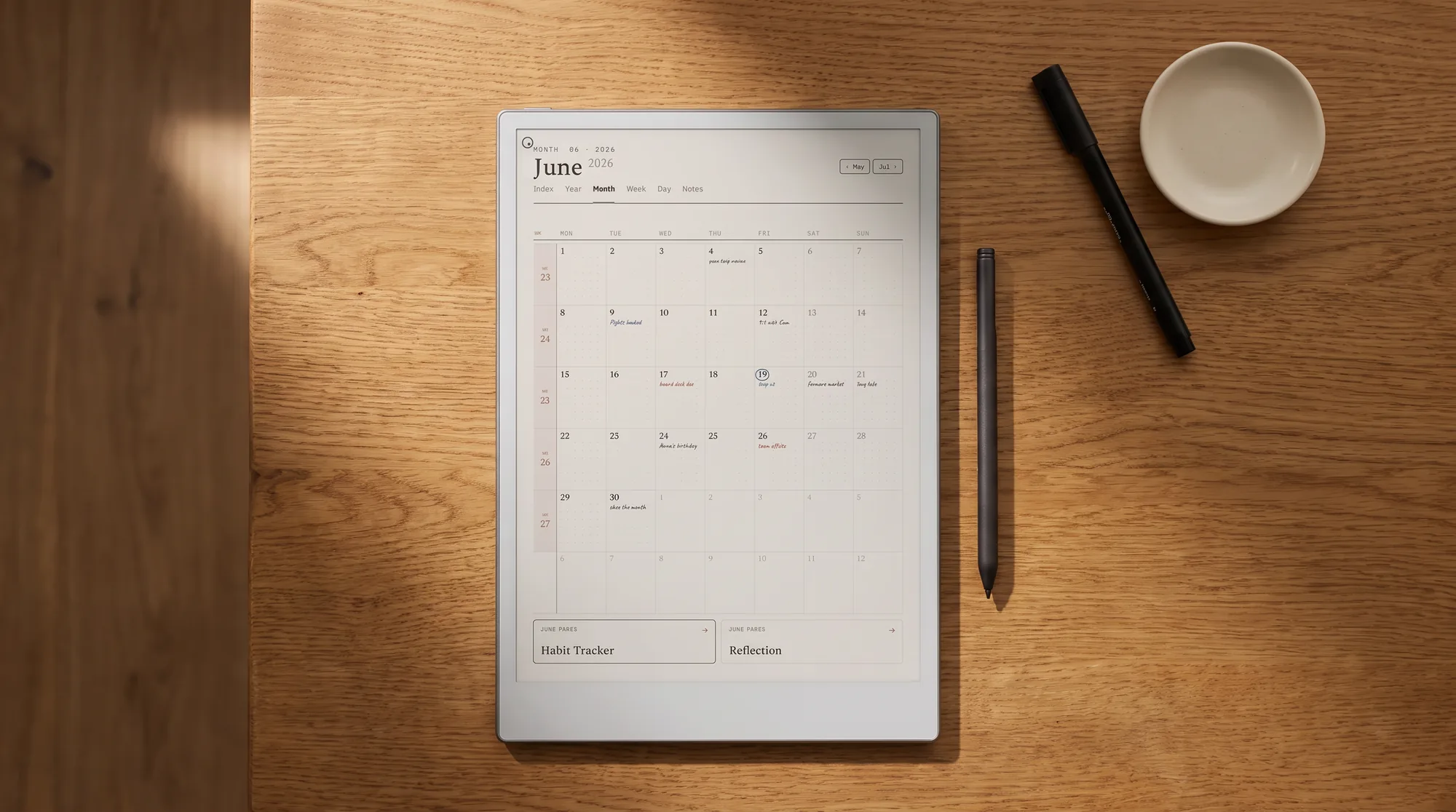
This is the anchor page for our Planning Hub, where we keep the calendar-math answers people actually look up. If you came for a single number, it is right here; if you want the reasoning, it is right under it.
The short answer
How many weeks in a year, exactly?
There are 52 weeks in a year. More precisely, a common year of 365 days is 52 full weeks plus 1 extra day, and a leap year of 366 days is 52 full weeks plus 2 extra days. So whenever someone asks how many weeks in a year, the honest answer is “52 weeks, and then a day or two that does not quite finish a 53rd.” The number you write on a planner is 52. The number a calendar’s week column sometimes reaches is 53, and that is a different way of counting we will get to below.
Both facts are true at once, which is why the question feels slippery. Fifty-two is the count of whole weeks. Fifty-three shows up only when you number the weeks on a calendar and the leftover days push a stub of a week past the year’s edge. Neither is wrong. They answer slightly different questions, and knowing which one you mean saves a lot of confusion when you are laying out a year.
The math
Why it’s 52 weeks and a little more
The arithmetic is short. A week is 7 days. A common year is 365 days. Divide 365 by 7 and you get 52 with a remainder of 1, because 52 weeks account for 364 days and there is 1 day left over. A leap year has 366 days, so the same division leaves a remainder of 2. That single leftover day is the whole reason the answer is not a clean 52.
- Common year: 365 days = 52 weeks + 1 day (52 × 7 = 364, then 1 spare).
- Leap year: 366 days = 52 weeks + 2 days.
- The spare days never add up to a full week on their own, so the count of whole weeks stays at 52 every single year.
You feel this leftover day without doing any math. It is why a birthday or a holiday falls one weekday later each year, and two weekdays later when a leap day sits in between. A date that was on a Monday this year lands on a Tuesday next year, because the 52 whole weeks bring you back to the same weekday and the 1 extra day nudges it forward by one. Over a leap year the nudge is two. The calendar is not drifting; it is just carrying that remainder. It is also why a printable weekly planner is usually undated: the weeks never line up with the calendar the same way twice.
The 53-week years
When a year has 53 weeks

Here is where the second answer comes in. If you number the weeks of a year the way businesses, payroll systems, and most European calendars do, using the ISO 8601 standard, then a small share of years get a 53rd week. This is not a different length of year; it is a side effect of how the numbering handles those leftover days at the start and end.
Under ISO 8601, weeks run Monday to Sunday, and week 1 is the week that contains the year’s first Thursday. Because of that rule, a year picks up a 53rd numbered week when its leftover days land in just the right place. The plain version: a year has 53 weeks when it starts on a Thursday, or when it is a leap year that starts on a Wednesday. Everything else has 52.
| Year type | Days | Full weeks | Numbered weeks (ISO) |
|---|---|---|---|
| Common year | 365 | 52 + 1 day | 52, unless it starts on a Thursday |
| Leap year | 366 | 52 + 2 days | 52, unless it starts on a Wednesday or Thursday |
| A 53-week year (e.g. 2026) | 365 or 366 | 52 + 1 or 2 days | 53 numbered weeks |
2026 is a live example. The 1st of January 2026 falls on a Thursday, so 2026 is a 53-week year: its calendar runs from ISO week 1 all the way to week 53. On average this happens in about 71 of every 400 years, which works out to roughly one year in every 5.6. The next few after 2026 are spaced a handful of years apart.
- Recent and upcoming 53-week years: 2020, 2026, 2032, 2037, 2043, 2048.
For the full list, the pattern behind it, and why payroll and budgeting teams care about a 53-week year, see our companion piece on the years with 53 weeks. It also covers the practical side: an extra pay period, an extra weekly invoice, one more line in any tracker that runs a row per week.
Week numbers
Week numbers, and what counts as week 1
If a year can have 53 numbered weeks, it helps to know how the numbering works, because “week 1” is not always the week that holds the 1st of January. Two systems are in common use, and they disagree at the edges of the year.
- ISO 8601 (most of the world, and business): weeks start on Monday, and week 1 is the week containing the year’s first Thursday, which is the same as the week containing the 4th of January. Under this rule the early days of January can still belong to the last week of the previous year.
- North American / calendar convention: weeks often start on Sunday, and week 1 is simply the week that contains the 1st of January. This is the numbering you see on many US wall calendars and spreadsheet functions.
The gap between them is small but real: it changes which week number a given date sits in near New Year, and it is the reason two calendars can label the same Tuesday as week 1 or week 52. We walk through both systems, how to read a current week number, and the week numbers for 2026 and 2027 in week numbers, explained.
Leap years
Leap years and the extra day
Leap years are the other half of the leftover-day story, because a leap year is where the second spare day comes from. A leap year has 366 days instead of 365, adding the 29th of February, which means 52 weeks plus 2 days rather than 52 plus 1.
The rule for which years get that extra day is older than it looks and only has three parts. A year is a leap year if it is divisible by 4. The exception: years divisible by 100 are not leap years, so 1900 was a common year. The exception to the exception: years divisible by 400 are leap years after all, which is why 2000 was a leap year and 2400 will be. That correction keeps the calendar lined up with the sun over the long run.
The everyday version most people want is simply whether the current or next year is a leap year, and how the 366 days change the week count. Our leap-year explainer, is 2027 a leap year, gives the rolling answer for the years just ahead and ties the extra day back to the weeks question here.
Months and what’s left
Weeks in a month, and weeks left in the year
Two related questions come up the same way. The first is how many weeks are in a month, and the quick answer is about 4.3. No calendar month is exactly four weeks except February in a common year, which is 28 days, or four weeks to the day. The rest run over: a 30-day month is four weeks plus 2 days, and a 31-day month is four weeks plus 3 days. Averaged across the year, 365 days across 12 months is about 30.4 days each, which is roughly 4.35 weeks.
That small overhang is why a “monthly” cycle and a “four-weekly” cycle slowly drift apart: four weeks is 28 days, but the average month is longer, so a strict four-weekly schedule laps the calendar by about one extra cycle a year. The second question, how many weeks are left in the year, is simpler: subtract the current week number from 52, or from 53 in a long year like 2026. At the end of week 40, for instance, there are about 12 weeks left, which is why the final quarter always seems to arrive in a hurry.
Planning
Turning 52 weeks into a plan
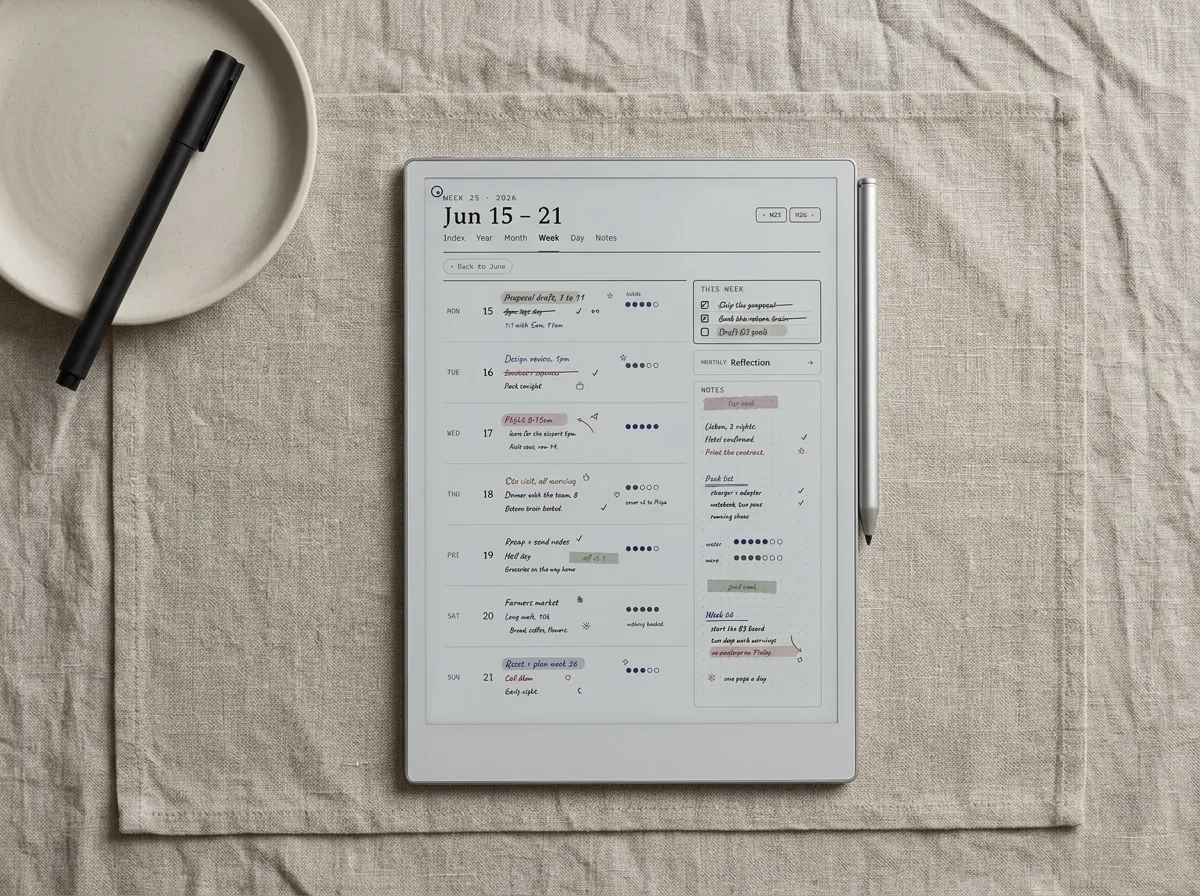
Most people who look up how many weeks in a year are about to plan something against those weeks: a study schedule, a savings target, a content calendar, a training block. Fifty-two is a friendlier number than 365 for that, and it divides in useful ways. Planning against all 365 is its own tradition, which is what the page-a-day book is for: our explainer on what a Hobonichi is covers the best known of them.
- Quarters: 52 weeks split into four quarters of 13 weeks each. A 13-week block is a common planning unit for exactly this reason.
- Pay periods: weekly pay usually means 52 paychecks a year, or 53 in a 53-week year. Fortnightly pay means 26 periods, occasionally 27.
- Halves and thirds: 26 weeks to the midpoint, and roughly 17-week thirds if you plan in three seasons rather than four.
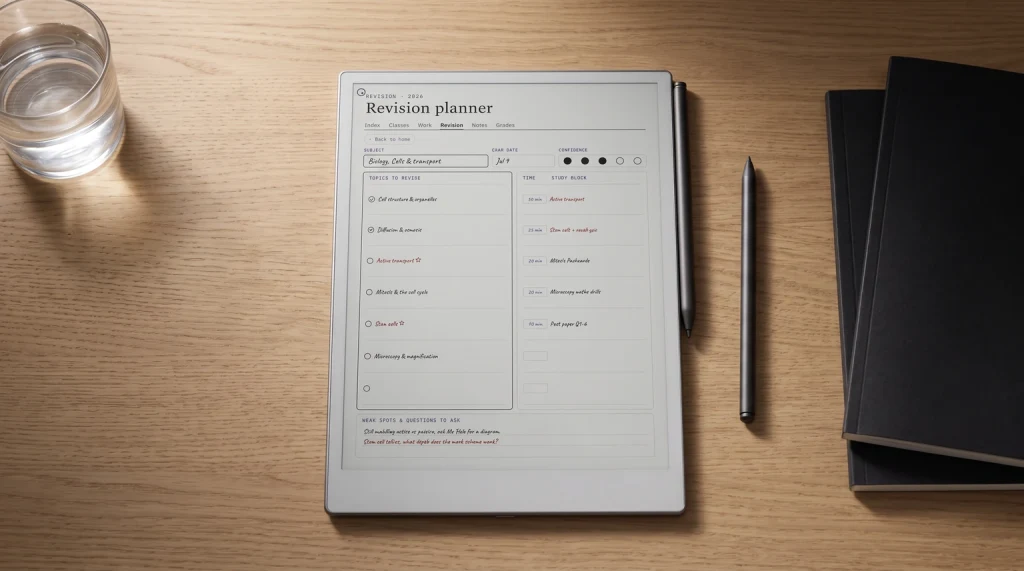
The trap is planning a full 52-week grid and forgetting the leftover day, or hitting a 53-week year and finding your weekly tracker is one row short. A layout built to hold 52 or 53 weeks without breaking is the quiet difference between a plan you keep and one you abandon in February.
However you count them, 52 weeks is enough time to do something and short enough to feel it moving. If you keep a running tally of the weeks left in the year, or have a favorite way to break them into blocks, tell us in the comments; we fold the good ones back into this page and the rest of the Planning Hub.
FAQ
Common questions, answered briefly
How many weeks in a year?
Are there ever 53 weeks in a year?
How many weeks are in a leap year?
How many weeks are in half a year?
Why does my birthday fall on a different day each year?
People also ask