What it is
What journal prompts for anxiety can do
Journal prompts for anxiety are questions that give a worried mind somewhere to put things. A blank page asks too much when your thoughts are racing; a prompt asks one small, answerable question, and the answer is usually more manageable on paper than it was in your head.
Health services describe journaling in modest, useful terms. The University of Rochester Medical Center’s health encyclopedia says keeping a journal can help you manage anxiety and reduce stress, partly by helping you prioritize problems and fears, and by tracking symptoms day to day so you can recognize what triggers them. The NHS gives similar advice: keeping a diary of what you are doing and how you feel at different times may help you understand why you are anxious. Both frame it as one helpful habit among several, alongside sleep, movement and support, not as a cure.
The order
How to use anxiety journal prompts
Most lists of anxiety journal prompts mix grounding questions, deep reflection and gratitude into one long column, which is no help when you open it in the middle of a bad hour. The prompts below are grouped by the moment you are in. Use the short ones when worry is loud, and save the reflective ones for a calmer day, when you have room to think.
- One prompt is enough. Five to ten minutes. Stopping early is fine; the habit matters more than the length.
- Write it as it sounds. Put the worry down in its own words before you try to argue with it.
- Keep a set time. The NHS suggests a daily “worry time” for going through your concerns, so the rest of the day has room for other things.
- Close gently. End each entry with one small next step, or one thing that went all right today.
In the moment
Prompts for when worry spikes
These are deliberately small. They pull your attention to the room you are in and to facts you can write in a line, which is about all a racing mind can manage.
- Write the worry in one sentence, exactly as it sounds in your head.
- Where do you feel it in your body right now? Describe it in three words.
- Name five things you can see from where you are sitting.
- What is actually happening in the next hour? Only the facts.
- On a scale of 0 to 10, how strong is the worry? Write the number and the time.
- What is one thing within reach that would make the next ten minutes easier?
- Have you felt like this before and come through it? When?
- Who could you message right now, even just to say hello?
A blank page asks too much when your thoughts are racing; a prompt asks one small, answerable question.What it is
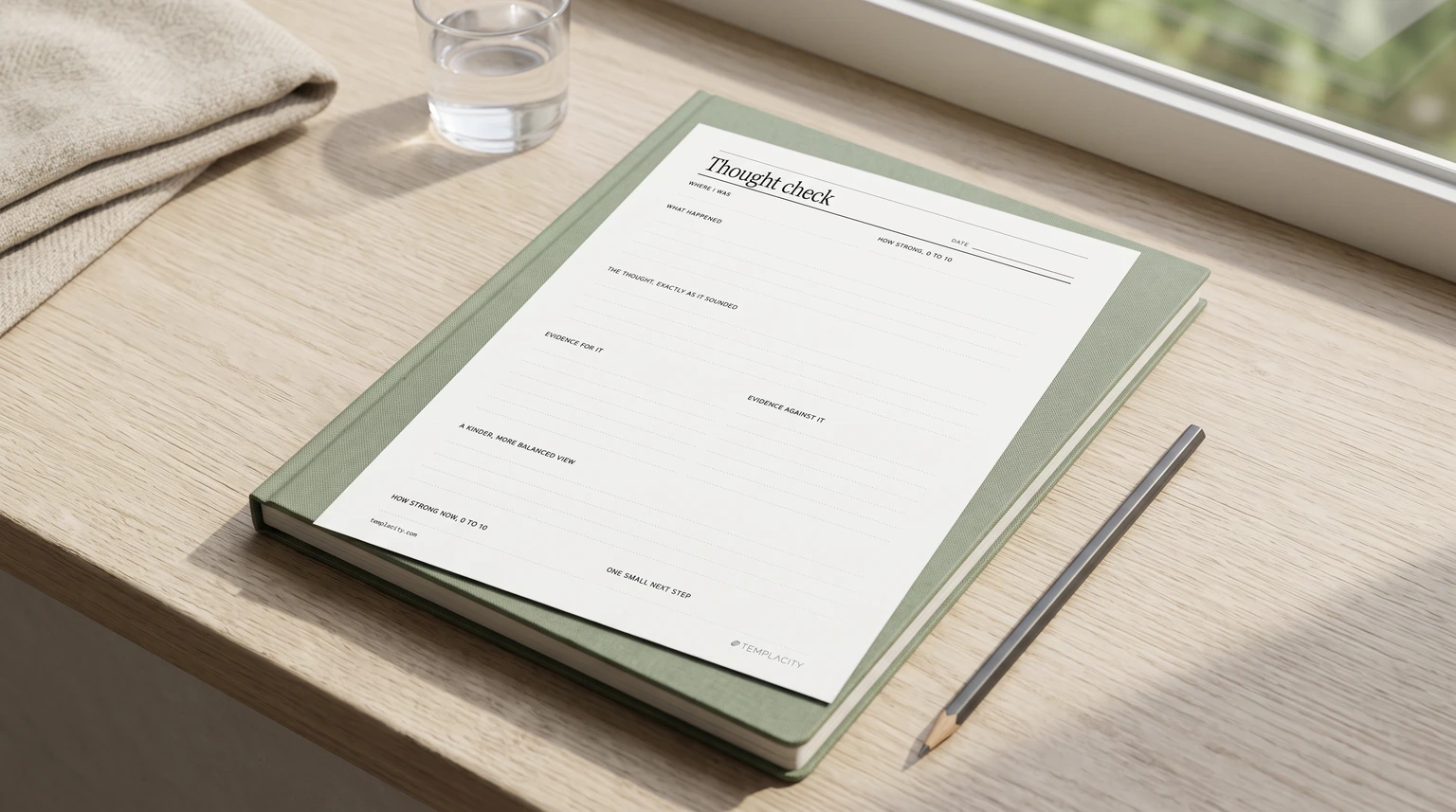
Thought check
Prompts to check an anxious thought
Anxious thoughts often arrive sounding like facts. A thought check slows one down long enough to look at it. The NHS points people to its cognitive behavioural therapy (CBT) self-help guides for working through worries and unhelpful thoughts; the steps below are a simple journaling version of looking at the evidence, not a substitute for that or for a therapist.
-
1
Write the thought word for word
“I am going to mess up the meeting and everyone will notice.” Rate how strongly you believe it, 0 to 10.
-
2
List the evidence on both sides
What supports it, and what does not. Facts only: things that happened, not things you fear.
-
3
Write a kinder, more balanced version
Not a cheerful one; a fair one. “I am nervous, I have prepared, and a stumble would not undo that.”
-
4
Re-rate it and pick one next step
How strong is the thought now, 0 to 10? Then one small action you can take today.
If you would rather work from questions than steps, these cover the same ground:
- What exactly am I afraid will happen?
- What makes it feel likely, and what makes it less likely than it feels?
- What is the worst outcome, the best, and the most realistic?
- If the worst did happen, what would I do first, and who would help?
- What would I tell a friend who had this same thought?
- Is this a worry I can act on, or one I cannot control? Sort it into one of the two.
- Am I reading a feeling as a fact? Write the feeling, then the facts, on separate lines.
- What is one small step I can take on the part I can control?
Worry time
Prompts for a set worry time
Worry time works best at the same time each day, and not right before bed. When a worry turns up outside it, jot one line (“the email from the landlord”) and come back to it then. These prompts give the session a shape so it does not become twenty minutes of going round in circles.
- List every worry you parked today, one line each.
- Which of them still feel important now that you look at them again?
- For each one you can act on: what is the very next step, and when will you do it?
- For each one you cannot act on: what would it take to set it down for today?
- Which worry has come up most often this week? What does it keep asking you?
- What did you worry about a month ago? How did it turn out?
- What helped today, even a little? Write three things.
- Close the session with one sentence: “For today, I have done what I can about…”
Calm days
Anxiety journal prompts for a calm day
Calm days are when the most useful writing happens, because you can think clearly about the hard ones. The idea is to write yourself a plan while you are steady, so it is there, in your own handwriting, on a day you are not.
- What are your early signs that anxiety is building, in your body, your sleep or your habits?
- Which situations, times of day or people tend to set it off?
- What settles your body when it is wound up: a walk, a shower, slow breathing, cold water?
- What settles your thoughts: a person, a playlist, a place, a task for your hands?
- Who are three people you can contact on a hard day? Write their names and how to reach them.
- What words would you want to read on a bad day? Write them to yourself now.
- Which worries from last year never came true?
- What have you handled that once felt impossible?
Evening
Evening prompts to close the day
Short and light on purpose. The point at night is to put the day down, not to open new problems. If a big worry shows up, park it for tomorrow’s worry time.
- What went better today than you expected?
- What is one thing you handled, however small?
- What is on your mind that can wait until tomorrow? Write it down so it can.
- What is one thing you are looking forward to this week?
- Who or what made today a little easier?
- How did you look after yourself today?
- Rate today’s worry from 0 to 10. How does it compare with yesterday?
- Write one kind sentence to yourself before you close the journal.
For nights that need a lighter page, our gratitude journal prompts are sorted the same way, by the kind of evening you are having. If you want to look at older patterns once you feel steadier, our shadow work prompts go slowly and in a safe order.
Honesty
When a journal is not enough
Feeling anxious is a normal part of life. The US National Institute of Mental Health draws the line at anxiety that does not go away, shows up in many situations and can get worse over time, which is how it describes anxiety disorders. The NHS puts it in everyday terms: anxiety becomes a problem when it feels intense or overwhelming and starts to interfere with daily life or relationships. If that sounds like you, a journal can sit alongside help, but it should not replace it. Talk to your doctor; it is a common conversation for them.
If you are in crisis or thinking about harming yourself, do not wait for an appointment. In the US you can call, text or chat with the 988 Suicide and Crisis Lifeline, which is free, confidential and open around the clock. Elsewhere, your local emergency number or a crisis line in your country will help.
To try the practice on paper first, our free printable anxiety journal pages are a 5-page PDF: thirty starter prompts, a daily check-in, a worry log, a thought check page and a steadying plan to fill in on a calm day. US Letter, with A4 and A5 versions.
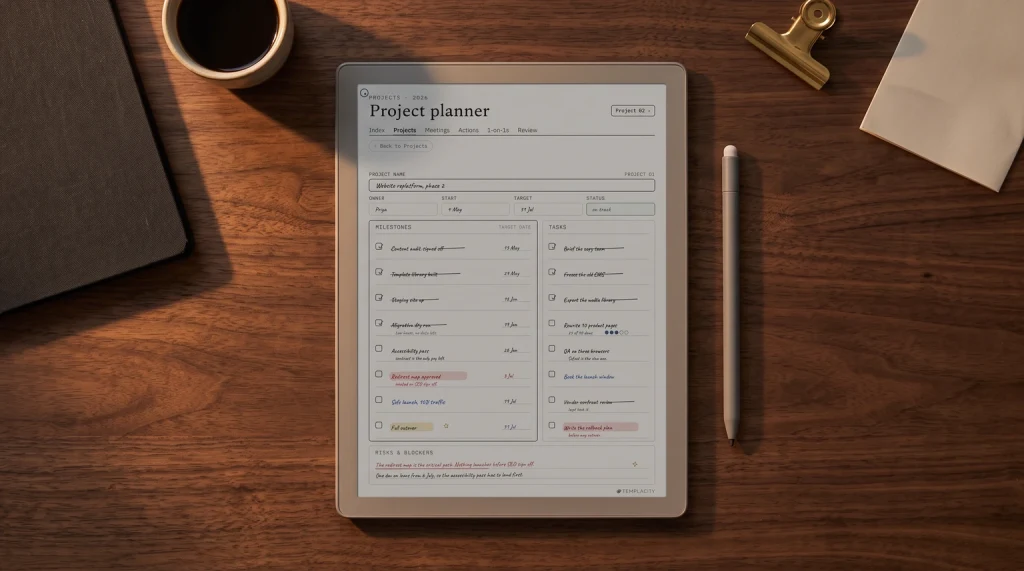
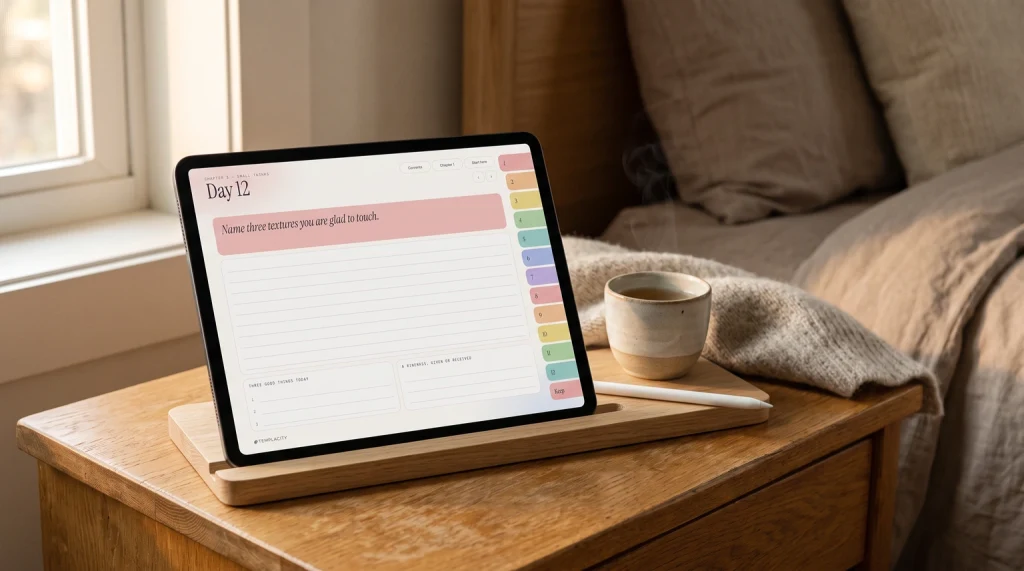
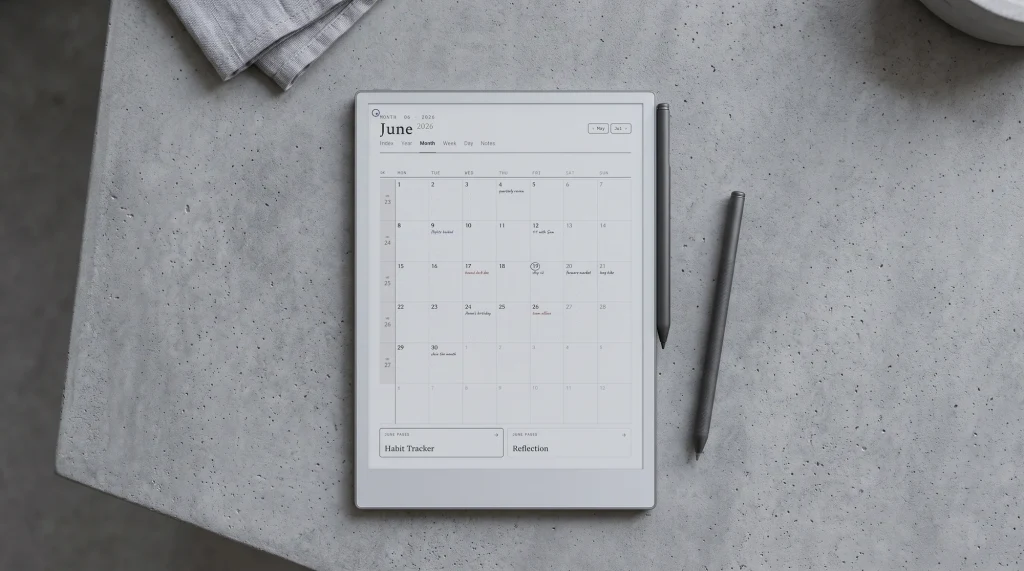
Full disclosure: we also make the longer version. The Anxiety Journal holds the steadying plan, a two-minute daily check-in, a worry log, thought checks, thirteen weekly look backs and 100 prompts in five parts, cut for iPad, reMarkable, Kindle Scribe, Boox and Supernote and to print. It carries the same limits as this list: a journal for reflection, not medical advice. If you would rather build your own, our guide to a digital journal template covers the setup on a tablet.
Everyone’s anxiety has its own shape, and the question that settles one person does nothing for another. If a prompt here, or one of your own, has helped on a hard day, share it in the comments. Only what you are comfortable making public; someone else may need it tomorrow.
FAQ
Common questions, answered briefly
Does journaling help with anxiety?
What should I write in an anxiety journal?
When is the best time to journal for anxiety?
Can journaling replace therapy for anxiety?
Can I keep an anxiety journal on a tablet?
If yours isn’t above, drop the question in the comments and we’ll add it.
People also ask