The basics
What a gratitude list is, and why most stop working
A gratitude list is a short written record of things you are thankful for: people, moments, comforts, lucky breaks. You can write one once and keep it on the fridge, or write a fresh one each evening as a small habit. Either way, the point is to notice good things on purpose instead of letting them pass unremarked.
Most people start strong and stall within two weeks. The reason is usually the list itself. “Family, health, coffee, my home” is true on the first night and on the fortieth, so by the fortieth it feels like a chore. The lists that last are the ones where each line could only have been written on that day.
That is why this page gives you two things. First, a list of 100 things to be grateful for, grouped, so you have somewhere to look on a blank night. Second, a way to turn any item on it into a line that still means something when you read it back. If you want the wider habit, our gratitude journal guide covers how to keep one going past the first month.
Method
How to write a gratitude list that keeps meaning something
The research on gratitude writing is encouraging. In a ten-week study by psychologists Robert Emmons and Michael McCullough, reported by Harvard Health, people who wrote each week about things they were grateful for were more optimistic and felt better about their lives than people who wrote about irritations. It is not a cure for anything, and studies like this show an association, not proof.
How you write matters more than how much. Berkeley’s Greater Good Science Center collected research-based tips from Emmons, and four of them change what a gratitude list should look like:
- Depth over breadth. Writing in detail about one thing carries more benefit than a superficial list of many things.
- People over things. Focusing on people you are grateful to has more impact than focusing on objects.
- Subtraction, not only addition. Picture your life without something good, rather than just tallying it.
- Surprises. Unexpected events tend to bring out stronger gratitude than the things you count on.
The same article adds one more that surprises people: writing once or twice a week was more beneficial than writing every day. A list of twenty things written in a minute feels good once; one thing written in detail feels good again when you read it back.
The list, part one
Things to be grateful for: people, body, home, food, work
The first fifty things on this gratitude list are the ones closest to you. People come first because they are the group the research singles out.
People
- The friend who texts back the same day
- A colleague who covered for you without being asked
- A habit you picked up from a parent or grandparent
- The neighbour who brings your bins in
- A teacher who saw something in you early
- Whoever taught you to cook one dish well
- A stranger who held a door, a lift or a train
- The person you could call at two in the morning
- A private joke with a brother or sister
- Whoever made the coffee this morning
Body and health
- A night of sleep that lasted until the alarm
- Legs that carried you up the stairs
- A cold that finally passed
- Eyes that can read this sentence
- The first deep breath outside after a long day in
- Hands that can write, type, knit or fix things
- A meal you could taste properly
- A clear answer from a doctor
- Stretching after sitting too long
- Laughing until it hurt
Home
- Hot water whenever you turn the tap
- A bed with clean sheets
- The one chair that fits you
- A lock on the door
- Light through one particular window
- A drawer that finally closes
- The quiet after everyone is asleep
- A dry roof in heavy rain
- A warm room on a cold morning
- Coming home and knowing exactly where everything is
Food and drink
- The first coffee or tea of the day
- Bread that is still warm
- Fruit in season
- A recipe someone wrote down for you
- Leftovers that taste better on day two
- Clean water from the tap
- A meal someone else cooked
- Salt on a ripe tomato
- A table with more than one person at it
- Soup when you are ill
Work and learning
- Work that pays the bills
- A colleague who explains instead of sighing
- The task you finally finished
- A skill that took years and now takes seconds
- A library card
- A book that changed your mind
- A manager who said thank you
- Feedback that stung and then helped
- A commute with time to think
- The day off you earned
A list of twenty things written in a minute feels good once; one thing written in detail feels good again when you read it back.Method
The list, part two
More things to be grateful for: the wider world and harder days
The second fifty reach further out, and include the group most lists leave off: things to be grateful for when the week has been hard. Those are often the lines that matter most when you read them back.
Nature and outdoors
- The first warm day of spring
- Rain on the window while you are indoors
- A tree you pass every day
- Frost on the grass
- The smell of the street after a storm
- A walk with no destination
- Birdsong before the traffic starts
- Long summer evenings
- The view from a hill you climbed
- The moon on a clear night
Small moments
- A green light when you were running late
- Money found in a coat pocket
- A song you forgot you loved
- An empty seat on a full train
- A parcel that arrived early
- A pen that writes well
- Someone remembering your name
- Ten minutes with nothing to do
- The last slice of something you like
- Clean socks
Hard times
- A problem that turned out smaller than you feared
- Someone who sat with you and did not try to fix it
- A mistake you can still put right
- A loss that showed you what mattered
- The friend who stayed
- Getting through a week you dreaded
- Help you were too proud to ask for, and got anyway
- An apology, given or received
- Test results that came back clear
- Knowing you have come through worse
Growth and yourself
- A habit you kept for a month
- Saying no and meaning it
- An opinion you changed
- Patience you did not have five years ago
- A fear you faced once
- Your sense of humour
- Curiosity that still switches on
- Something you made with your own hands
- A boundary that held
- Being kinder to yourself than last year
Ordinary freedoms
- Reading whatever you like
- Choosing your own work
- Public parks
- Libraries, free to anyone
- A road out of town when you need one
- Saying what you think
- A hospital that is open at night
- Electricity at the flick of a switch
- A vote that counts
- A day of rest
Examples
Gratitude list examples: from a category to a line
Every item above is a category. Written as is, it will feel flat by the second week. The fix is to add who, when and why, so the line could only belong to one day. Here is what that looks like for seven items from the list.
| From the list | Written as a specific line |
|---|---|
| The friend who texts back | Maya texted at lunch to ask how the interview went. She had remembered the date. |
| A night of sleep | Slept from eleven to the alarm, the first full night this week. |
| A warm room | The hall radiator came on at six, so the floor was warm under bare feet. |
| A recipe written down | Dad’s lentil soup from the card in his handwriting tasted the way his did. |
| A manager who said thank you | The report went out at four and Sam replied with one line: this is clear. |
| Frost on the grass | First frost on the car this morning, and the whole street went quiet and white. |
| Test results | The scan came back clear after three weeks of waiting for that one sentence. |
Notice what the right-hand column does. Most lines name a person, a time or a detail you could photograph. Several carry a little subtraction too: the soup matters because the cook is not always there, and the scan matters because of the three weeks before it. Those are the moves the research points to, and they are why these gratitude list examples still read as true a year later.
Routine
A daily gratitude list in two minutes
If you want a daily gratitude list rather than a one-off, the best-studied version is called three good things. In the practice as Greater Good in Action describes it, you write down three things that went well each day for at least a week, and explain why each one went well. It also stresses writing them down rather than only thinking them.
The “why” is what turns a list into something you actually think about. “Dinner with Jo” becomes “dinner with Jo, because she moved her shift to make it.” A routine that holds:
- Tie it to something you already do each evening, like brushing your teeth or setting an alarm.
- Write three things from today, one line each, and add the reason after a comma.
- If nothing comes, scan one group from the list above and ask which of those happened today.
- After a week, try it two or three nights a week instead of every night, and see which keeps the entries fresher.
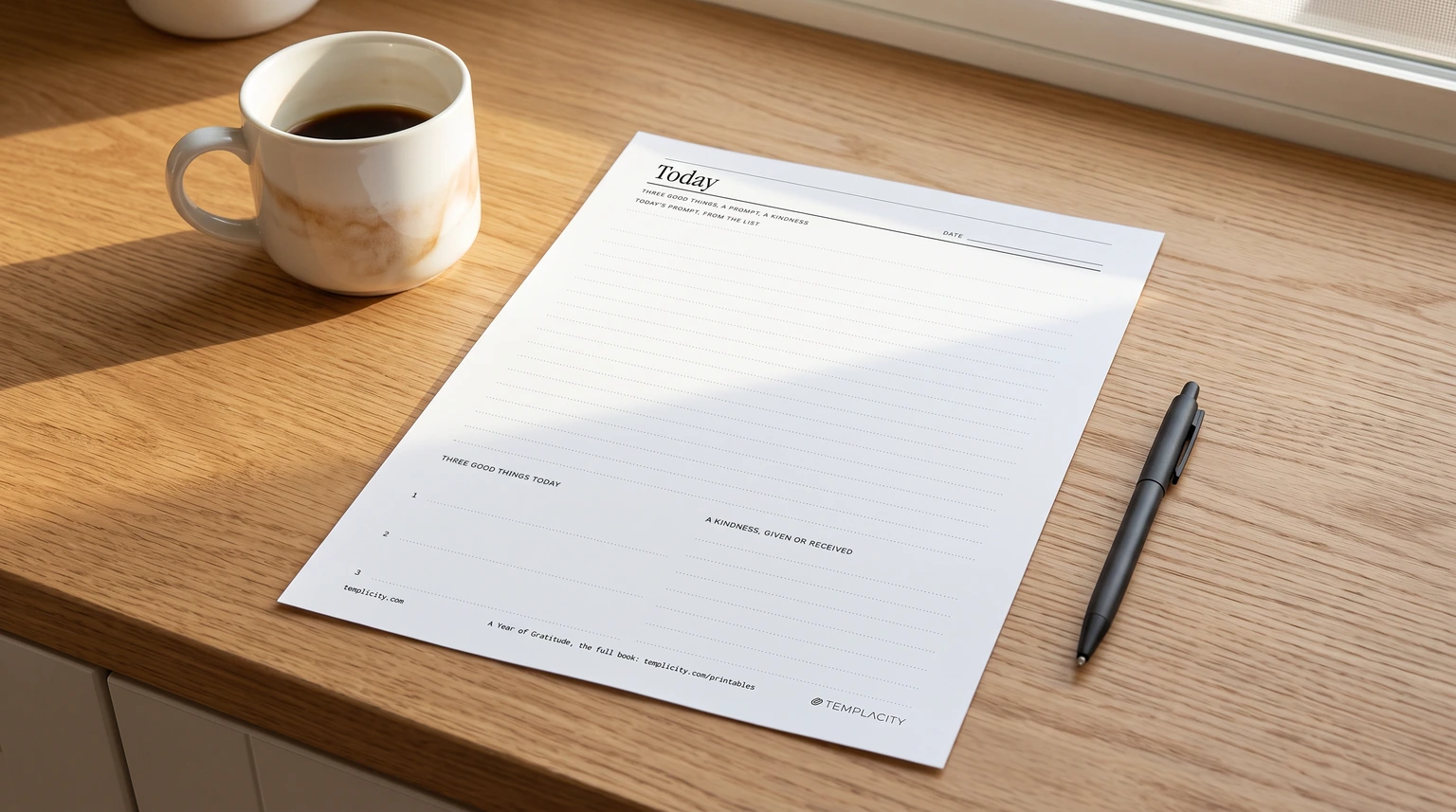
Our free printable gratitude pages include a day page built for exactly this: three good things, a prompt and a kindness given or received, plus thirty starter prompts and a thank-you letter page. They come in US Letter, A4 and A5. On nights when a list will not come at all, a question works better than a category, and our gratitude journal prompts are written for those nights.
Format
Where to keep your gratitude list
The best place is the one you can open in ten seconds at the moment you remember. For most people that means one of four places:
- A card on the fridge or desk. Good for a one-off list you want to see every day. Rewrite it each season so it does not fade into the background.
- A notebook by the bed. The classic daily list. Printed pages from our printable journal pages work if you want lines and a little structure.
- Your phone’s notes app. Always with you, easy to search later, easy to skip. Write the reason, not only the item.
- A tablet you write on by hand. An iPad with a notes app or an e-ink tablet gives you handwriting with no stack of paper to store.
If you would rather follow a structure for a full year, A Year of Gratitude is our undated gratitude journal ($29): 365 prompts in twelve chapters, three good things and a kindness each day, and thank-you letter pages, with iPad, e-ink and printable editions in one download. The free pages above are the right place to find out whether the habit suits you first.
Gratitude lists are personal, and what you would put first is probably not on ours. Tell us in the comments what is at the top of yours, or which item from this list you would swap out. The most useful additions we get come from readers, and we fold the good ones into the next update.
FAQ
Common questions, answered briefly
What is a gratitude list?
What should I put on a gratitude list?
How many things should be on a gratitude list?
How often should I write a gratitude list?
What is the difference between a gratitude list and a gratitude journal?
If yours isn’t above, drop the question in the comments and we’ll add it.
People also ask