The job
What an ADHD student planner is actually for
Almost every recommendation for a student planner is written as though the planner gets used in a quiet room in the evening. It does not. The moment that decides whether a planner works is at the end of a lesson, when a teacher says the essay is due Friday and there are about four seconds before thirty people stand up.
Everything else the planner does happens later and can be fixed later. If the deadline gets captured, a bad layout can be worked around at home. If it does not get captured, the most beautiful weekly spread ever printed has nothing in it to organise.
So the first question for an ADHD student planner is not which layout is best. It is: how many actions does it take, from closed on a desk to a deadline written down. Any answer above two is a design problem, and a surprising number of planners aimed at students answer four, because you have to find the right week, then the right day, then the right subject box.
This is a different problem from the one adults have with planners, which we went through in the main piece on what a planner page has to do. Adults mostly abandon planners over missed days. Students mostly abandon them over friction at the exact second the planner is needed.
The surface
The argument for paper that actually holds up
Most paper-versus-screen arguments are sentimental. Leslie Josel, the ADHD family coach who writes on this for ADDitude, makes one that is not, and it is about capture speed rather than about paper being nicer.
Her point is that “when they go to open an app on their phone or computer to write down something, Instagram/Snapchat/text messages/YouTube starts calling out their name”. The cost of the app is not the typing. It is that the route to the text field passes a series of things engineered to interrupt the journey, at the precise moment a four-second window is open.
She also argues that writing by hand engages more than typing does, noting that “typing only activates the ‘language’ areas of our brain; whereas writing with a pen or pencil activates multiple brain regions”, and reports that paper tested faster than devices with the students she works with.
Take the strong version or the weak version of that; the practical conclusion is the same. For the capture moment specifically, a notebook that is already open beats a device that has to be unlocked. It is worth pairing this with our look at where apps genuinely beat paper, because they do, just not here. An app is better at holding and moving work once it is captured. It is worse at the four seconds.
The view
Seeing the week is the second requirement
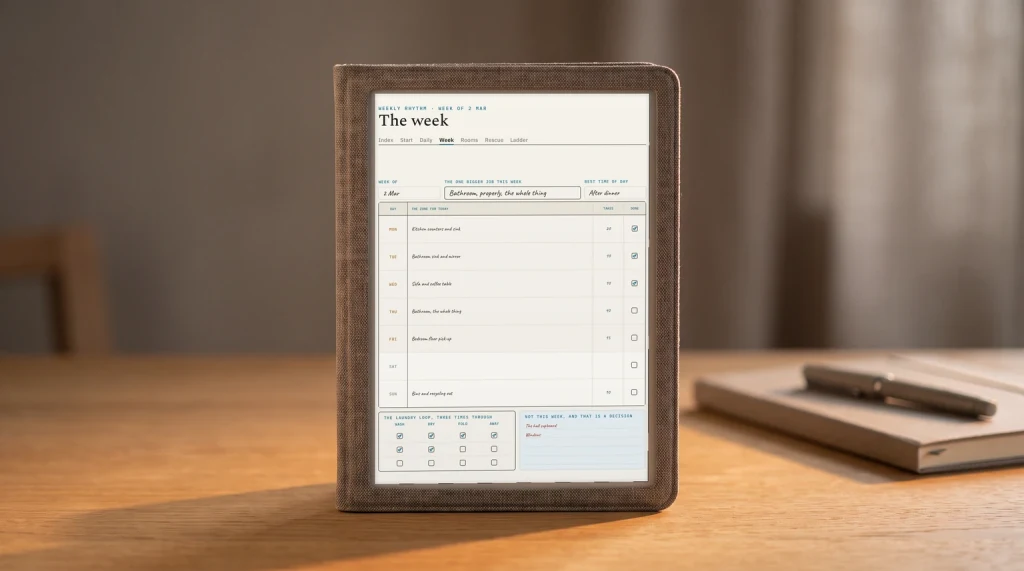
Josel’s second criterion is that the planner has “clear weekly and monthly views” so a student can see the big picture, on the principle that students have to see their time in order to manage it.
This is where student planners diverge sharply from the adult advice. An adult planner benefits from being undated and flexible, because an adult’s failure is a missed day. A student’s week is not theirs to make flexible. The timetable is imposed, the deadlines are imposed, and the useful thing a planner can do is show that imposed shape all at once so the free space in it becomes visible.
An adult’s failure is a missed day. A student’s week is not theirs to make flexible.
Practically, that argues for a week across two pages rather than a page per day. A page per day hides Friday’s deadline until Friday, which is exactly the information a student needed on Tuesday. It also means the four-second capture lands somewhere already visible rather than several page-turns away.
The gap
The gap between written down and started
Here is the failure that belongs specifically to students, and that no planner sold to them is built for.

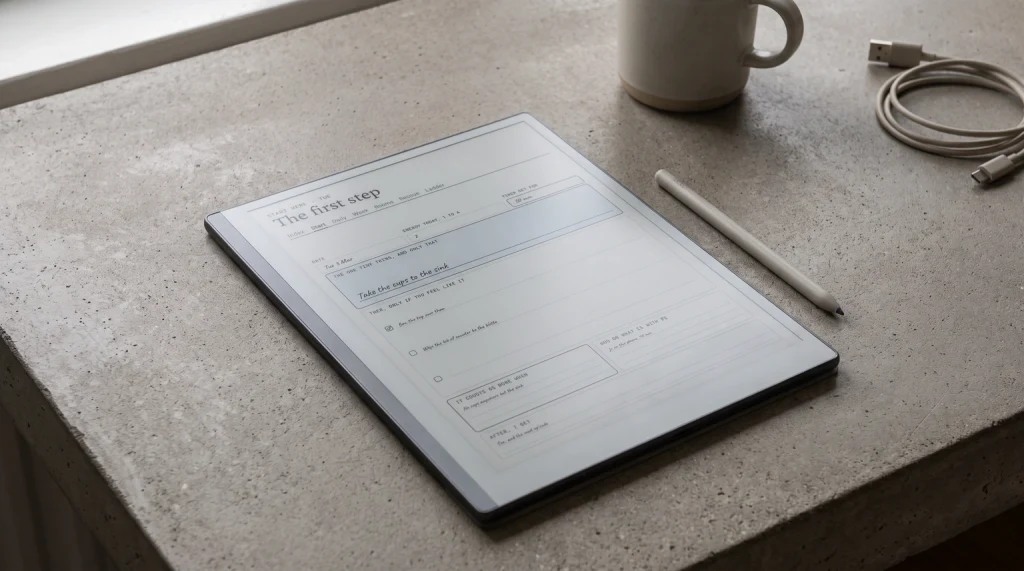
An essay due Friday gets written in Friday’s box. Friday’s box is correct and useless. The work does not happen on Friday, it happens on Tuesday and Wednesday, and nothing in the planner has ever asked for those. The deadline was captured perfectly and the task was still never started, which from the outside looks like not caring and from the inside feels like being ambushed by a date you had written down.
The fix is free and takes about three seconds more at capture. When the deadline goes in Friday, a second mark goes in on an earlier day, and that mark is the appointment. ADDA’s general advice about task size applies straight to this: “clean the kitchen” is unusable and has to become three specific actions, and “essay due Friday” is the same sentence in school uniform. What goes in Tuesday is not “essay”. It is “essay, find three sources”.
The constraint
When the school picks the planner for you
A lot of this advice runs into the fact that many schools issue a planner and require it to be used, sometimes signed weekly. In that case none of the choosing above is available, and buying a second, better planner tends to produce two half-used planners rather than one good one.
The workable move is to leave the issued planner as the official record and add one thing to it rather than replacing it. A sticky note on the current week, or the inside cover, holding the started-on dates that the school’s grid has no room for. It travels with the book that already has to be in the bag, it satisfies whoever is checking, and it does not create a second system to remember.
If you are on the other side of this, issuing the planners rather than filling them in, the same two-entry idea is worth building into the template itself. We touched on the layout side of that in the piece on what a teacher’s planner has to carry, and the best teacher planner comparison covers which format survives a school year.
The fix
A layout that works on whatever you were given
None of this requires the right planner. It requires four habits that fit any planner, including a bad one.
Keep it open on the current week.
Not closed in the bag. The number of actions between the teacher speaking and the words landing on paper is the whole game, and closing it adds two.
Write the due date, then immediately write a start date.
Two marks, one moment. The start date is a smaller, more specific action than the deadline, and it goes at least two days earlier.
Capture badly rather than not at all.
Three words in the wrong box beats a neat entry that never happened. Tidying is an evening job and a cheap one. Recovering a deadline nobody wrote down is neither.
Look at the week, once, on Sunday.
Not to plan it. Just to see where the deadlines have clustered, which is information you cannot get from a page-per-day layout at any point before it is too late.
That is the whole system, and it is deliberately small, because a student system with more than four rules is a system that gets abandoned in October. The planner is a place to put deadlines quickly and see them early. Everything else it is sold as doing is optional.
FAQ
Common questions, answered briefly
What should I look for in an ADHD student planner?
Is paper or an app better for a student with ADHD?
Why does my child write everything down and still not do it?
What if the school makes us use their planner?
Should a student planner be dated or undated?
If yours isn’t above, drop the question in the comments and we’ll add it.
People also ask
If you have watched a student planner work or fail, we would like to know whether the deadline ever made it onto the page, or whether it made it on and still went nowhere. Those are two different problems with two different fixes, and people rarely separate them. Tell us in the comments.