The problem
Why mornings are the hardest part of the day
Mornings pack a lot of small decisions into a short, fixed window. What to wear, what to eat, where the keys went, whether there is time for one more thing. CHADD, the US national ADHD organisation, makes the point in its piece on smoother mornings: morning tasks lean on executive functions such as attention, working memory, flexibility and planning, the same skills ADHD makes harder.
Psychologist Michele Novotni, quoted in that piece, puts it this way: “If you look at the different things you have to do in the morning it requires a lot of self-regulatory behavior, a lot of decision-making, a lot of time management, and a lot of organization.” Every one of those is a place where the morning can stall.
So an ADHD morning routine that works is mostly a way of removing decisions. Some of them move to the evening, some get written down in a fixed order, and the rest get a time and a buffer. The sections below take those in turn, and end with a checklist you can copy.
The night before
The morning starts the night before
Psychologist Kathleen Nadeau, writing in ADDitude, is direct about it: “The less you need to do in the morning, the more likely you’ll get to work on time.” Her evening list is practical, and almost every item is a morning decision made early:
- Lay out tomorrow’s clothes, down to the socks and shoes.
- Put everything you take with you on a launch pad, an area near the door you leave by: bag, keys, phone, coat, umbrella, the shopping list.
- Get breakfast half ready. Fill the coffee maker and set it to brew, with a clean mug beside it.
- Make lunch, or check you have what you need to buy one.
- Put screens away an hour before bed.
- Set the alarm for at least seven hours of sleep and an hour before you need to leave.
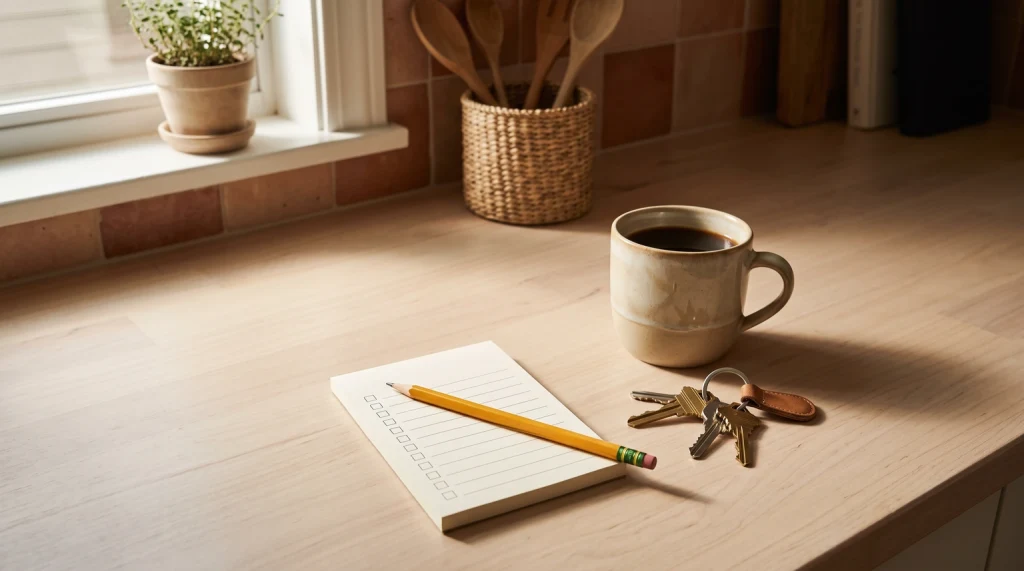
The launch pad does the most work for the least effort. CHADD’s guide to day planners suggests the same idea for the planner itself: one safe place to keep it, near the front door or wherever the car keys live, so you know exactly where it is on the way out. A tray, a hook and a basket by the door turn the morning hunt into a single grab.
The checklist
An ADHD morning routine checklist you can copy
With the evening half done, the morning itself can be short. Keep it to a handful of steps, always in the same order, each one a single action you could start without thinking. This is the shape we would start from; swap the steps for your own and keep the order fixed.
-
i.
Get up at the first alarm
Step oneFeet on the floor, light on. If the alarm sits across the room, the first step is already done by the time you reach it.
-
ii.
Wash and dress
Into the clothes that are already laid out. Nadeau’s rule for parents: get yourself showered and dressed before you start on the children.
-
iii.
Breakfast
The coffee is made and the bowl is out. Eat sitting down, with the TV and the laptop off until everything for leaving is done.
-
iv.
Read today’s three
A one-minute look at the planner or today’s list. CHADD suggests checking your planner in the morning as you look ahead to the day.
-
v.
Launch pad, then out
Last stepPick up everything on the tray in one go and leave with fifteen minutes to spare.
Five steps is enough. A long morning list goes the same way as a long to-do list: it becomes something to avoid looking at. If a step keeps getting skipped, it either belongs in the evening or does not belong in the routine at all. Our ADHD to-do list guide covers the “read today’s three” step in more detail.
The clock
Put a time on every step, worked back from the door
A checklist tells you what comes next. A time beside each step tells you whether you are still on track, which is the part that tends to slip without anyone noticing. Start from the time you have to walk out, take off the fifteen minutes of slack Nadeau recommends for traffic and the unexpected, and work backwards.
| Timeclock | Allowminutes | |
|---|---|---|
| Up, light on | 7:00 | 5 |
| Wash and dress | 7:05 | 25 |
| Breakfast | 7:30 | 20 |
| Today’s three | 7:50 | 5 |
| Launch pad, out | 7:55 | 5 |
| Slack | 8:00 | 15 |
The numbers are an example; time your own steps for a few days and use what they really take, not what they should take. The slack line is the one people cut first and miss most. On a good day it is fifteen quiet minutes. On a bad day it is the reason you are still on time.
On a good day it is fifteen quiet minutes. On a bad day it is the reason you are still on time.
A timer helps the start as much as the steps. Nadeau suggests setting a watch or a timer to go off five minutes before a routine has to begin, so the start does not depend on noticing the clock.
Making it stick
Keep the routine where you can see it
A routine only works from memory once it is a habit, and it takes a while to get there. Nadeau’s point is that a routine needs little planning or working memory, but only after it has been practised regularly for several weeks. Until then, the list has to do the remembering for you.
So put it where the morning happens. Nadeau suggests the fridge door or the bathroom mirror. The evening half can sit by the launch pad, so setting up for tomorrow and leaving today both start at the same spot. If you plan on paper or a tablet, the routine can live on the inside cover of the planner, the page you open first anyway; our ADHD planner guide covers how much structure a page like that should carry.
Some people find the evening half harder than the morning, because nothing forces it. Doing it at the same time as something that already happens every night, like clearing up after dinner, gives it a hook. Doing it alongside someone else helps too: body doubling, getting a job done while another person is there doing theirs, works for ten minutes of laying out clothes and packing bags as well as it does for a stuck task.
When it breaks
When the ADHD morning routine falls apart
It will, sooner or later. A late night, a week of illness, guests, travel, a change of job. Nadeau’s advice for when that happens is specific: set a date for resuming the routine. Not “when things settle down”, an actual day on the calendar.
It also helps to know your minimum version in advance: the two or three steps you keep even on the worst morning, usually dressed, keys from the launch pad, out the door. A short routine that survives a bad week is more use than a full one that only runs on good ones. When things settle, add the other steps back one at a time.
With children
Running a family morning around ADHD
When the children have ADHD too, or it is just a busy house, the same rules apply to everyone. CHADD’s National Resource Center publishes a short school morning routine infographic for parents, built on the idea that a routine gets children ready for the day. Nadeau suggests the children’s evening routine mirrors yours: clothes out, bags on the launch pad, bath.
Give each child their own short checklist, with pictures for the ones who cannot read yet, stuck at their height. And get yourself ready first. A parent who is dressed and has had coffee by the time the children are up has the whole morning’s attention free for them, instead of splitting it between two routines at once.
An ADHD morning routine does not have to be ambitious. It has to be short, in the same order every day, and mostly finished the night before. If you have a launch pad trick or a step that finally made your mornings calmer, share it with us in the comments; the small details are what help the next person most.
FAQ
Common questions, answered briefly
What is a good morning routine for ADHD?
How long should an ADHD morning routine take?
Do you need an evening routine as well?
How do you stick to a routine with ADHD?
People also ask