The shape of it
What the eisenhower matrix actually is
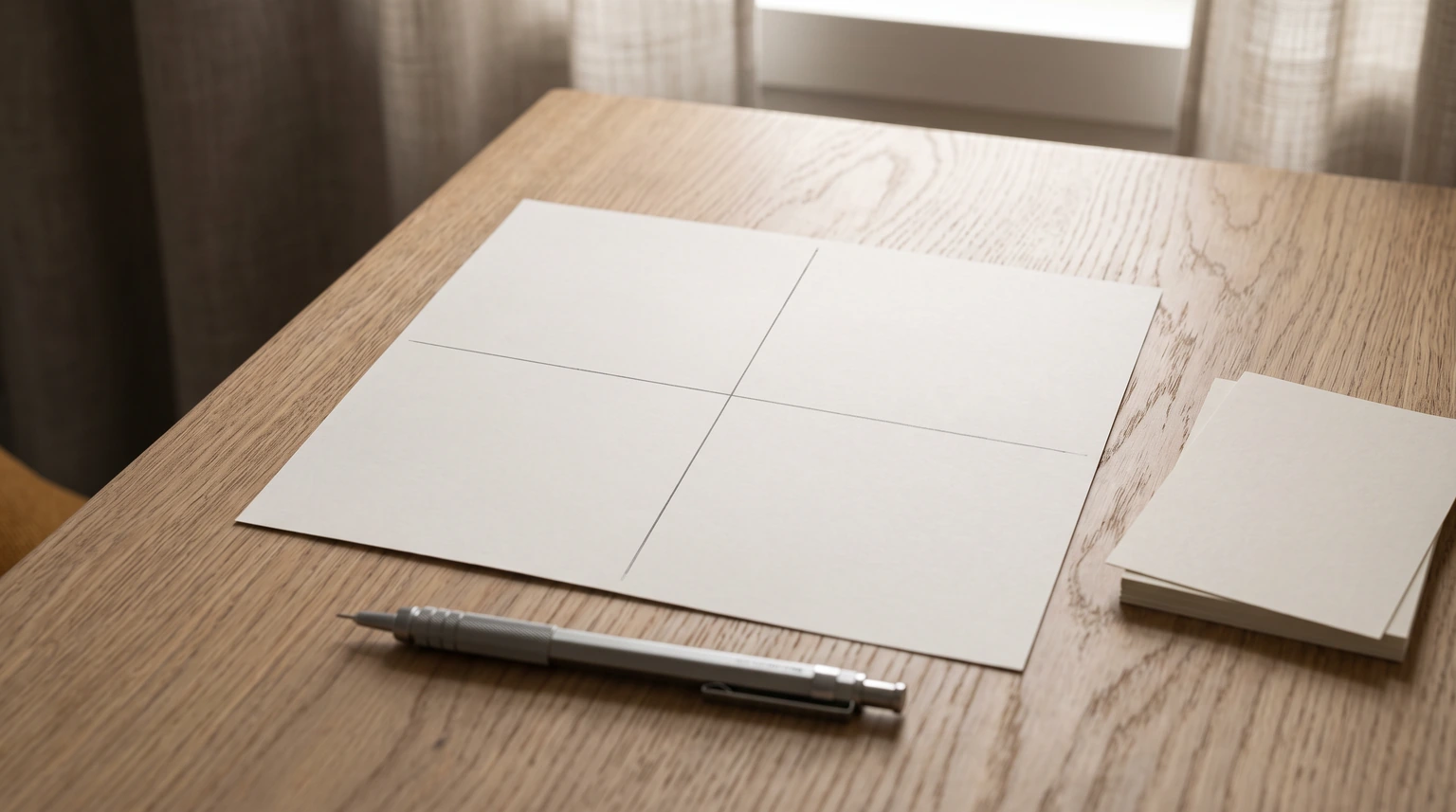
The eisenhower matrix is a two by two grid that sorts everything on your plate by two questions asked separately: is it urgent, and is it important. Urgency runs across the top, importance runs down the side, and every task lands in one of four boxes. Nothing about it is complicated, which is both why it spread and why most people who try it abandon it inside a month.
The value is not in the drawing. It is in the insistence that those two questions are separate. Left alone, a working day answers them as one question and calls it priority, and the thing that gets done is whatever arrived most recently with the most volume behind it. Splitting the question is the entire mechanism. Once urgent and important sit on different axes, a task that is loud and pointless has nowhere to hide, because it has to score twice and it only scores once.
That is worth stating plainly, because the grid gets sold as a productivity technique and it is really a diagnostic. You do not run it to feel organised. You run it to find out how much of last week went to things that had a deadline and changed nothing, which is a number most people would rather not have.
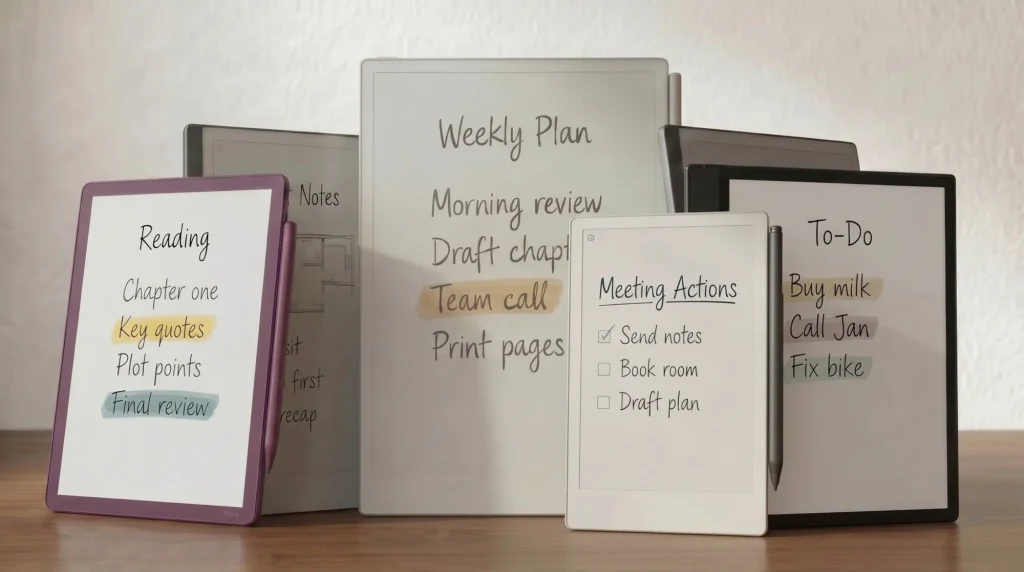
It also survives any medium. Four boxes work on a napkin, in a notebook, on an e-ink tablet, in a spreadsheet, or inside project software. Nothing in the method needs an account. A great deal of the writing about it assumes otherwise, and that assumption is the most expensive thing a beginner inherits from a search result.
The source
The quote Eisenhower did not write
Almost every article about this grid opens with a version of the same sentence, attributed to Dwight D. Eisenhower: that he had two kinds of problems, the urgent and the important, and that the urgent were never important. It is a good line. He did say it out loud, in public, on a stage. He was quoting somebody else.
The occasion was his address to the Second Assembly of the World Council of Churches, delivered on the Northwestern University campus in Evanston, Illinois, on 19 August 1954. In the transcript he introduces the line as a borrowed one: he illustrates his point, in his own words, by quoting the statement of a former college president. The line then runs, as he gives it, that this president had two kinds of problems, the urgent and the important, that the urgent are not important, and that the important are never urgent.
Two things follow from reading the transcript rather than the roundups. The first is that the attribution in circulation is wrong twice over. It is not his sentence, and the president he was addressing that afternoon, Dr J. Roscoe Miller of Northwestern, is named separately in the same passage as somebody in the room rather than as the author. A great many pages have quietly merged those two people. The second is that no grid appears anywhere in the speech. Eisenhower gave a sentence. Somebody else drew the box.
None of this makes the method worse. It makes it more honest, and it changes what you should expect from it. A president did not hand down a system with his name on it. A working aphorism got turned into a diagram decades later by people writing about management, and a diagram is a teaching aid rather than a law of nature. Treat it as a way of forcing two questions apart, which is what the sentence is actually about, and it holds up. Treat it as presidential doctrine and you will follow it further than it goes.
We are making a point of this because the claims that feel like common knowledge are the ones nobody checks. The transcript is public, it is linked at the foot of this post, and the relevant paragraph takes about ninety seconds to read.
Two questions
Urgent and important are not the same question
Urgent has a clock in it. There is a date, and something happens when that date passes: somebody is blocked, a fee lands, a window shuts, a person is left waiting. That is the whole test. Volume is not a clock. A message marked high priority by a colleague who marks everything high priority carries no date, and it is not urgent, whatever it feels like at 9am.
Important has a consequence in it. If the task were done, something you actually care about would be different: the work is better, the risk is smaller, the relationship is repaired, the thing you have been meaning to build exists. If nothing would be different, it is not important, and no amount of effort spent on it converts it.
Almost everything that ruins a working week answers yes to the first question and no to the second. That combination is not a moral failing and it is not laziness. It happens because urgency is visible and importance is not. Urgency arrives attached to a person, with a face and a tone and a follow-up. Importance sits quietly in a document nobody is chasing you about. Given one afternoon, the visible thing wins every time, and it will keep winning until something forces the two apart on paper.
There is a practical tell for the second question that costs nothing. Write the task down, then write who asked for it. Not who would benefit, who asked. Over a fortnight that column fills with a handful of names, and the honest read of your own week arrives without any further analysis.
The quadrants
The four boxes, and what each one is for
Read across the top for urgency and down the side for importance and you get four combinations. They are usually numbered one to four, and the numbering is not a ranking of value, it is a naming convention. Quadrant one is urgent and important. Quadrant two is important and not urgent. Quadrant three is urgent and not important. Quadrant four is neither.
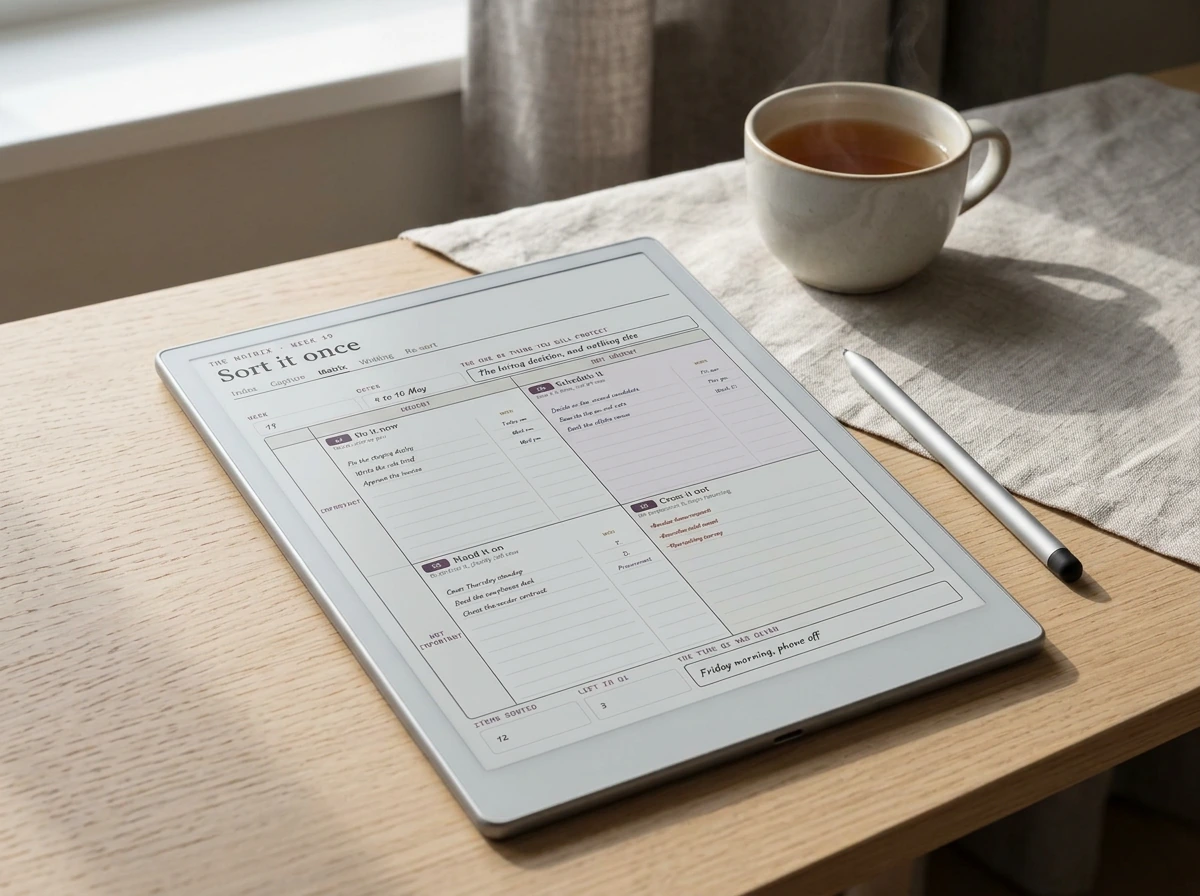
What matters is that each box carries a different verb, and the verb is the instruction. A sorted grid with no verbs is a coloured list.
| Quadrant | Reads as | The verb | How it goes wrong |
|---|---|---|---|
| Q1, urgent and important | A real deadline on work that matters | Do it, today, yourself | Everything ends up here, because a full Q1 is what an unsorted month produces |
| Q2, important, not urgent | The work nobody is chasing you about | Give it a time, not a hope | It gets a tick and no slot, so it is still sitting there next month |
| Q3, urgent, not important | Somebody else’s deadline, handed to you | Hand it on, or decline it plainly | Nothing records who has it, so it returns in Q1 a fortnight later |
| Q4, neither | Noise that survived because nobody killed it | Cross it out on purpose | It is left blank rather than struck through, so it quietly reappears next week |
Quadrant three is the one worth slowing down on, because delegate is doing a lot of work in most explanations and it assumes you have somebody to delegate to. Plenty of people running this grid do not. For them the verb is decline, and declining is the same action with the same requirement: it needs a name, a date and a sentence, or it is not a decision, it is a delay. Handing something over is not finishing it either. It is a debt with somebody else’s name on it and a date it comes due.
Quadrant four gets skipped almost universally, and it is the cheapest box on the grid. Crossing something out on purpose is not the same as leaving it off the list. A struck line is a decision you can point at in three weeks, when the same request arrives again with a slightly different subject line.
Where it pays
Quadrant two is the only box that shrinks the others
If you keep one idea from this page, keep this one. Quadrant one is where the fires are, and fighting them is necessary and produces nothing durable. Quadrant three is other people’s urgency. Quadrant four is noise. Only quadrant two holds the work that makes next month lighter than this one: the process nobody has written down, the conversation being avoided, the system that would stop the same fire starting a fourth time.
It is also the only box with nobody chasing it. Q1 chases itself by definition. Q3 has a person attached who will follow up. Q2 has a deadline of never, which is precisely why it loses every afternoon it is put up against anything else, and why it has to be defended rather than merely identified.
Quadrant two has a deadline of never, which is precisely why it loses every afternoon it is put up against anything else.
Defending it means one thing in practice: giving a Q2 item a day and a part of the day, in writing, the same week you sorted it. Not a tick, not a highlight, a slot. And one item, not five. A week that protects five things protects none of them, because the first Q1 fire takes the afternoon and the other four were never real. Pick the single item whose absence you would notice in a month, put it somewhere on the week that you would have to actively cancel, and let the rest wait for the next sort.
Guided paper planners build the same move into the page. A productivity planner caps the day at three to five tasks and asks for the most important one first, which gives the slot quadrant two needs a place on every page.
The measure of whether any of this is working is not how tidy the grid looks. It is whether quadrant one is smaller than it was a month ago. If it never shrinks, the sorting is happening and the acting is not, and that is a different problem with a different fix.
Where it breaks
Why the free templates do not survive the week
Search for a template and the first page is a wall of project software. Asana titles its page as a free Eisenhower Matrix template, the template is free to use, and the same panel invites you to sign up to create your own. That is the shape of the whole category. The grid is the free part, the account is the product, and the matrix is a doorway into a tool you were not otherwise going to open (asana.com, checked August 2026).
None of that is dishonest, and for some people it is the right answer. If your work already lives in a project tool, sorting inside it means the quadrant and the task are the same object, which beats a separate page. The failure is specific and it is not about the software: a matrix living inside a tool you open for other reasons stops being a weekly ritual and becomes a view you never switch to.
The analog end of the market has the opposite problem. Levenger sells an Eisenhower Matrix Time Management System, and what that describes is a category of pads, Circa refills, folders and index cards for classifying tasks (levenger.com, checked August 2026). It works, it is pleasant, and a pad is consumed. When it runs out the system stops until you reorder, which is a strange property for something meant to run for years.
The right-hand column is not a product feature. It is four habits, and you can build all of them with a ruled notebook and twenty minutes. The point of putting them side by side is that the left-hand column is what almost every free template actually hands you, and the gap between the two is the whole reason people conclude the method does not work for them.
The missing half
Sorting is the easy half, landing is the other one
Sorting a list into four boxes takes about ten minutes and feels like progress, which is exactly the trap. Nothing has moved. A sorted grid and an unsorted list hold the same tasks, and the difference is only that you now know which ones are lying to you. The work starts on the far side of the sort, and it is unglamorous: a time in your diary, a name against a handover, a line through something.
Which is why the medium matters less than the wiring. If you already keep a weekly page, the matrix belongs beside it, and quadrants one and two should be written in whatever language that page already uses for time. If you plan in bands rather than hours, write the band. If you keep a task list, our notes on task management layouts and on the digital work planner both cover the handoff from a list to a week. If the problem is less about priority and more about starting at all, the ADHD planner notes are a better place to begin than this grid.
If you would rather see the grid drawn out than rule it yourself, we have collected what a usable one needs on the eisenhower matrix template page, including the free options and the point at which each of them stops.
Starting
How to run your first sort in twenty minutes
Do this once, in one sitting, with everything in front of you. Sorting item by item across a week is how you end up doing whatever you looked at last, which is the behaviour the grid exists to stop.
-
1
Write everything down first, judge nothing
Ten minutes, one page, in the words it was asked in. Add a column for who asked. Deciding while you capture is how things quietly stop getting captured.
-
2
Ask about the clock, then about the change
Deadline first, consequence second, never both at once. Mark each line Q1 to Q4. Do not stop to plan anything yet.
-
3
Give Q1 and Q2 a time, and Q3 a name
A day and a part of the day beside every Q1 and Q2 line. A person and a chase date beside every Q3. This is the step everyone skips and the one that makes the sort real.
-
4
Strike out Q4 while you can still see it
A line through it, not a blank space. Struck on purpose is what stops the same request arriving again in a fortnight wearing a new subject line.
-
5
Next week, count the boxes before you read them
Four numbers, written down before you form an opinion about the week you just had. If Q1 is not smaller than last week, the sorting is working and the acting is not.
Twenty minutes on a Sunday buys the whole week its shape, and the second sort takes half as long as the first because most of the list already carries a quadrant. If you want a page ruled for it, the template roundup and the planner comparison cover what is worth the space on a device, and the Cornell notes layout is the same idea applied to reading rather than to a week.
FAQ
Common questions, answered briefly
What is the eisenhower matrix in simple terms?
Did Eisenhower invent the eisenhower matrix?
Which quadrant should you spend the most time in?
What if you have nobody to delegate quadrant three to?
How often should you redo the matrix?
If your question is not up there, leave it in the comments and we will add it. We are most interested in what people actually do with quadrant three when there is nobody to hand it to, because that is the part of the method with no settled answer.
People also ask