The pattern
Why the free printable stops working in week two
Search for an ADHD cleaning planner and you will be offered roughly the same sheet forty times. Seven columns across the top, one per day. Bathrooms on Tuesday, floors on Thursday, a bin at the bottom for whatever did not fit. It is free, it prints on one page, and it is genuinely well meant.
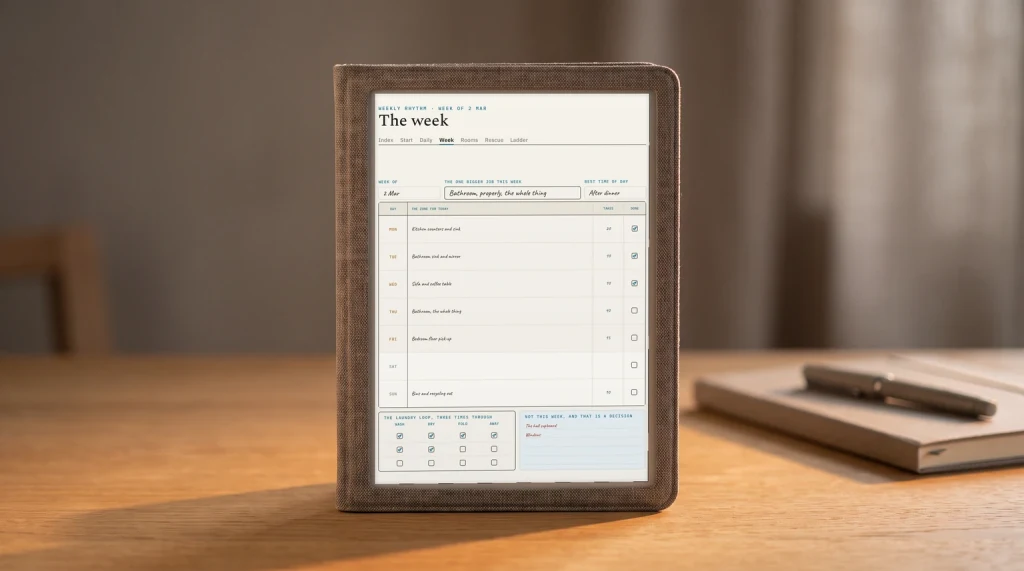
It also breaks in a specific and predictable place. The sheet was filled in on a Sunday, when the week was still hypothetical and Thursday looked like it had room in it. By the time Thursday arrives it does not, and the floors do not get done. Nothing terrible has happened. But the page now carries a visible empty box under a day that has passed, and the next unfilled box arrives tomorrow, and the one after that on Saturday.
Two weeks of that and the sheet is not a plan any more. It is a record of a fortnight you would rather not look at, stuck to the fridge at eye level.
This is the same structural problem the hourly grid has in a daily planner, moved up one level of zoom. We wrote about that in more detail in what an ADHD planner page actually has to do. A row per hour records a slipped morning as five separate misses; a column per day records a slipped week as seven. In both cases the layout is not neutral about failure. It manufactures evidence of it.
What follows is the alternative, which is not a cleaning tip and is not a motivational reframe. It is a change to how the page is divided, and the two organisations that publish guidance for adults with ADHD both arrive at it independently.
The source
What ADDA says a cleaning schedule is built on
The Attention Deficit Disorder Association publishes a guide to building a cleaning schedule, and it is unusually mechanical for the genre. Almost every instruction in it is a property of the system rather than an instruction to try harder.
It starts with a floor rather than a target. Their first step is to “create a baseline, or minimum level of cleanliness, that keeps your space functional and livable”, and the examples they give are deliberately unglamorous: no overflowing bin, no dirty dishes left overnight, walking paths clear. ADDitude’s version of the same idea has a name, the Minimum Level of Neatness, defined there as the state that lets you have someone over at short notice.
Then it gets specific about size. A task written as “clean the kitchen” is treated as unusable, and ADDA breaks it into “put away clean dishes”, “wipe the counter”, “empty the trash”. Three lines you can finish beats one line you can only be behind on.
Their timing advice is a container rather than a quota: “set a 10-minute timer and clean until it ends”, or clean “for the length of one song”. Note what that does to the definition of done. The task is finished when the timer stops, not when the room is finished, so it is possible to succeed at it on a bad day.
The mechanic
Energy categories, not days of the week
Buried in the middle of ADDA’s steps is the one that changes the shape of the page. They advise organising tasks into low, medium and high energy categories, in their words “rather than by time”.
Read against the standard printable, that is not a tweak. It deletes the grid. There is no Tuesday column, because Tuesday is not a category. There are three lists, and the question the page asks you is not “what day is it” but “what have you got right now”, which is a question you can answer honestly at the moment you are standing in front of it holding a mug.
The question the page asks you is not “what day is it” but “what have you got right now”.
The practical effect is that a low day stops being a failed day. On a weekday grid, a day with nothing in the tank produces an empty box. On an energy list, it produces a wiped counter off the low column, which is a completed item. Same day, same amount of cleaning, opposite entry in the record.
ADDA does still use days, but for a different job. Theme days assign a focus area to a day, a bedroom reset on Tuesday, the bathroom on Thursday, so that the question of where to start is answered without a decision. That is days used as a pointer, not as a deadline. The distinction is worth holding onto: a theme day tells you which room, an energy band tells you how much, and only one of those can be missed.
The last piece is habit stacking, attaching a task to something already reliably happening. ADDA’s example is starting the laundry while the morning coffee brews. ADDitude’s Katy Rollins arrives somewhere similar from the opposite direction, keeping a sponge next to the bathroom sink so the counter gets wiped in the seconds that are already being spent there. In both cases the trigger for the task is a thing in the room, not a line in a planner, and the planner’s job shrinks to recording what the room already prompts.
The product
What the planner everyone is buying actually does
The reason this search looks the way it does is one product. TidyMinds is a physical ADHD cleaning planner that spread on TikTok and now sits on the first page alongside the ADHD publications, with its Amazon listing above both.
It is worth looking at what it is actually selling, because the answer is not aesthetics. Their own product page describes “300+ pages of support” and names the modes the pages come in: Low-Energy, Panic and Deep-Clean. There are pre-written morning and evening prompts, so the page arrives already filled in rather than asking to be filled in. The sheets are reusable, meant to be slipped into a clear sleeve and written on with an erasable marker. They offer a “60-day money-back guarantee, no questions, no hoops, no shame”.
Set that beside ADDA’s guidance and the two line up point for point. Energy bands instead of days. Pre-written micro-tasks instead of a blank line. A surface you can wipe, which is a physical answer to the guilt-of-the-record problem: last week does not persist, because last week is gone the moment you wipe it.
We have no stake in whether you buy it, and we do not sell anything that competes with it. It is here because it is the clearest available demonstration that the energy-first layout is not a theory. The same check run on a general productivity book, rather than a cleaning one, is in our look at the Panda Planner. The best-selling product in the category and the main advocacy organisation for adults with ADHD independently landed on the same three-band page.
One note before you shop. Their product page does not publish a price, and the listings that do are resellers on Amazon, Walmart and eBay whose prices move. Check the number on the vendor’s own checkout rather than on a comparison page, including ours.
The spec
The five things an ADHD cleaning planner has to carry
Pulling both sources together gives a checkable list. These are properties of the sheet, so you can hold a printable up against them before you commit a year of Sundays to it.
A written baseline.
Three or four lines describing the state you are actually aiming for, in the room’s own terms. Bin not overflowing, sink empty, floor walkable. Without it, the target is silently “spotless” and every day falls short of it.
Three energy bands, not seven days.
Low, medium and high, each holding tasks you can actually do at that level. The page is sorted by what the task costs, so choosing one is a matter of matching rather than deciding.
Tasks written small enough to finish.
“Wipe the counter”, not “clean the kitchen”. If a line cannot be completed in one standing session it belongs in the high band broken into parts, or it does not belong on the page.
A time container.
Ten minutes, or one song. The container defines done, which is what makes the item completable on a day when the room is not finishable.
No permanent record of misses.
A wipeable sleeve, a reusable card, or a page with no dated boxes. Anything that lets a skipped week disappear rather than accumulate. This is the one the free printables fail hardest, because a printed date cannot be un-printed.
Only the fifth is really about materials. The other four are decisions about how the page is divided, which means they are free, which brings us to the useful part.
The build
How to build one on a single sheet
You do not need a PDF for this and you do not need us. The layout is small enough to describe in a paragraph, and building it yourself has one advantage over every download: the task lines are your rooms rather than a stranger’s.
Take one sheet of paper, landscape. Write your baseline across the top in three or four short lines. Divide the rest into three columns and head them low, medium and high. Then spend ten minutes writing every recurring cleaning task in your home onto the sheet, each one in the column matching what it costs you on an average day, and each one written small enough to be finished standing up. Wiping the bathroom sink is low. Changing the bedding is medium. Anything you have been avoiding for a month is high and should be split into two lines that are each medium.
Put the sheet in a clear plastic sleeve, or laminate it if you have the means, and keep a dry-wipe marker with it. That is the whole system. You tick in marker, and you wipe it when you feel like starting again, which is the mechanism that stops the page accumulating a history.
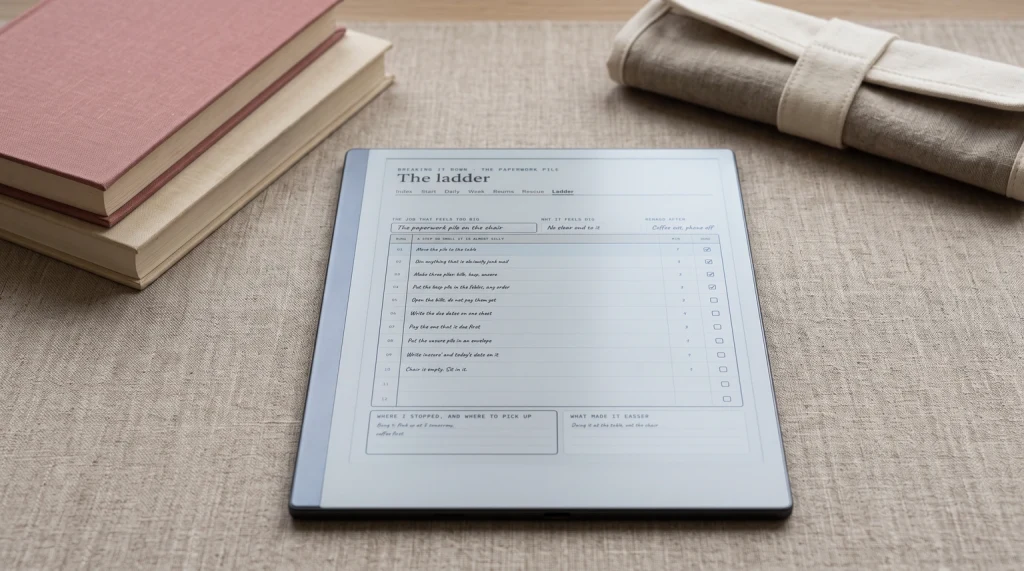
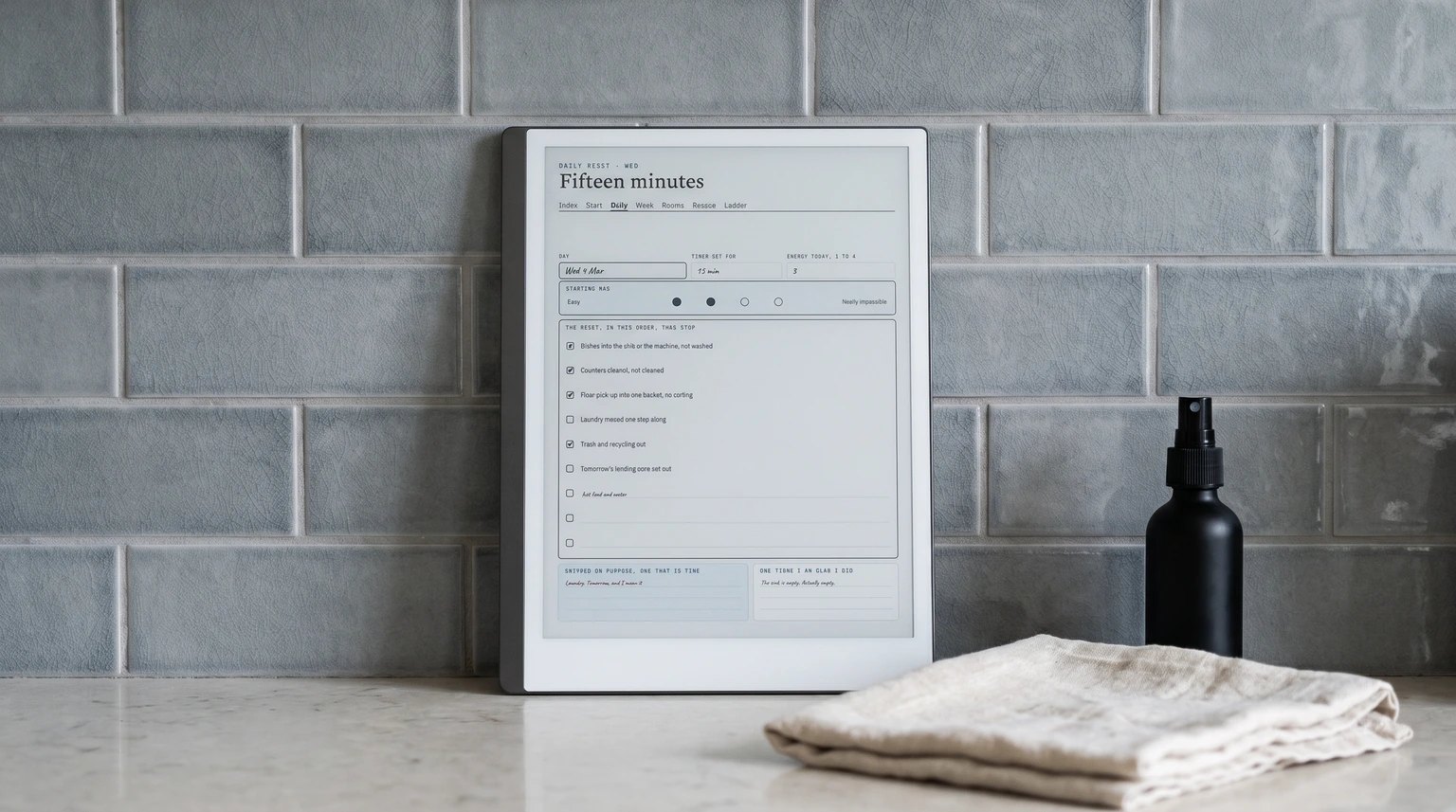
If you want days on it, add theme days in the margin as a pointer only, one room per day, with no boxes to tick. And if you want the streak feeling without the streak penalty, keep it somewhere other than the cleaning sheet; a separate habit tracker can carry the momentum without the cleaning page turning into a scoreboard. The same split works if you keep this on a tablet instead of paper, where a reusable checklist page gives you the wipe for free every time you clear the ticks.
ADDA’s last piece of advice is the one worth writing on the sheet itself. Build in buffer days, expect to miss, and restart immediately rather than waiting for Monday. A page with three columns and no dates makes that easy, because there is nothing on it that knows what day you stopped.
FAQ
Common questions, answered briefly
Is there a free ADHD cleaning planner PDF worth downloading?
Why sort cleaning tasks by energy instead of by day?
Is the TidyMinds ADHD cleaning planner different from a normal one?
How many cleaning tasks should go on the page?
Does this work as a printable, or does it need an app?
If yours isn’t above, drop the question in the comments and we’ll add it.
People also ask
Other questions, briefly answered
If you have run a cleaning system that lasted more than a season, we would like to know whether it was sorted by day or by energy, and which tasks you eventually took off the page altogether. The deletions are usually the interesting part. Tell us in the comments.