The unit
What an atomic note actually is
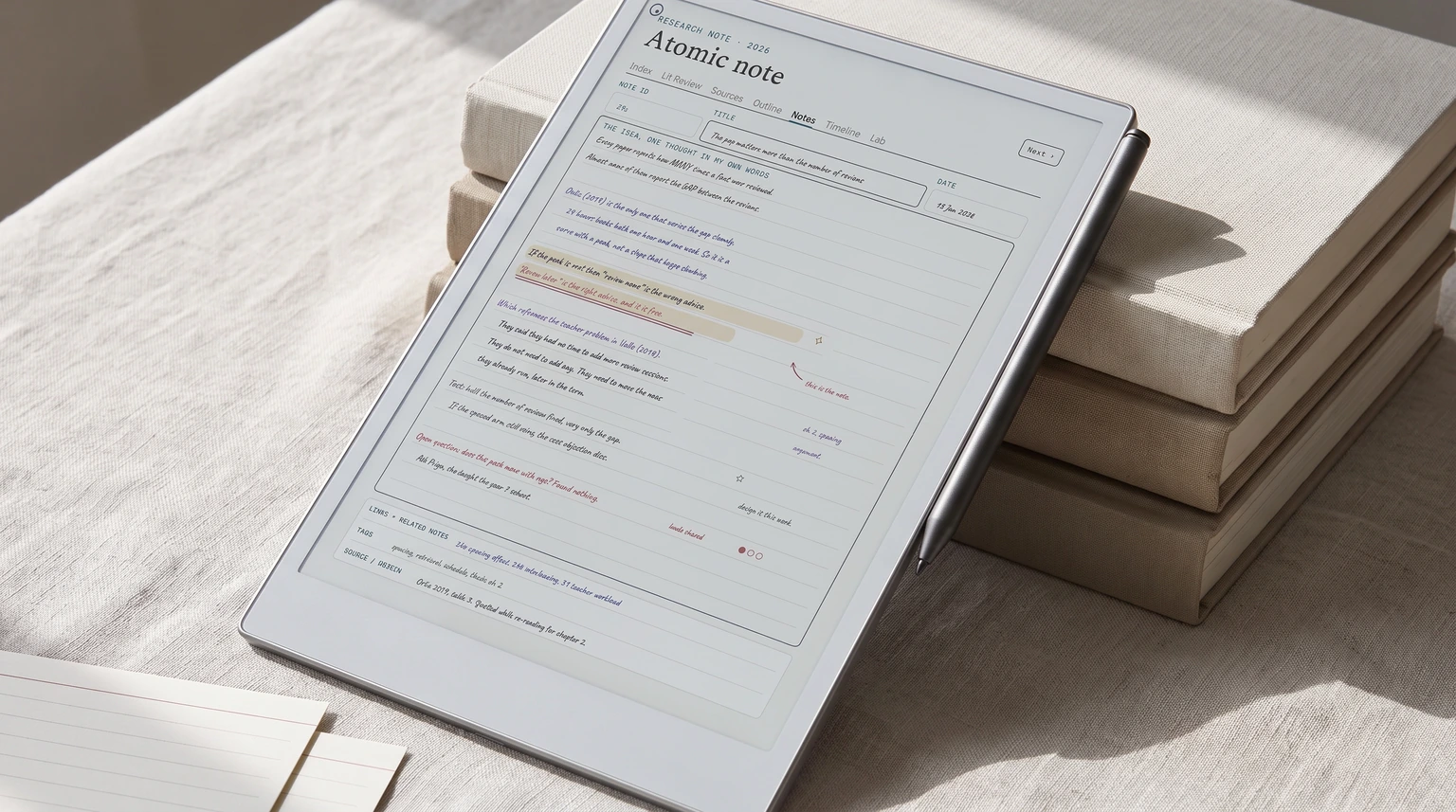
Atomic notes are notes that hold exactly one idea and can be read on their own, years later, with no source open beside them. That is the whole definition, and stated like that it is almost useless, because it never says where one idea ends and the next begins. Everybody can quote the rule. Almost nobody can apply it to the paragraph in front of them.
The reason is that the tempting unit is never the idea. It is the source. You finish a chapter and write a note called “Chapter 4” with six points under it. You have produced something that only makes sense to a person who has just read chapter four, and in two years that person will not exist. You will have the note and not the chapter.
So the workable version of the rule is not a definition at all, it is a test you run on a note after writing it. Cover the title. Read what is left, cold. If it still says something you could disagree with, it is a note. If it needs the book open beside it, it is a bookmark.
This matters more than it sounds, because atomicity is what makes the linking work. A note that holds two ideas can only ever be filed next to one of them, so the second idea is invisible from everywhere it should have been reachable. If you want the method underneath this, our guide to the zettelkasten method covers the four rules in full.
The tests
Four tests a note has to pass
Run these in order. Most notes fail the first one, and fixing the first usually fixes the rest.
-
i.
It reads alone
Run this firstCover the title and the source. If what remains needs context you have not written down, the note is a pointer to something rather than a thing.
-
ii.
It makes one claim
Not one topic, one claim. “Spaced repetition” is a topic and could fill fifty notes. “Recall gets stronger when the retrieval is slightly difficult” is a claim, and you can agree or disagree with it.
-
iii.
It has an address that will not move
A number, a timestamp, whatever you like, decided once. Every link you write is a promise that the address is still there, and a renamed note quietly breaks every promise pointing at it.
-
iv.
It points at something you already have
At least one link out, written when the note is written. This is the test people skip, and skipping it is what turns a box of atomic notes back into a folder of good sentences.
Test two is the one worth sitting with. The difference between a topic and a claim is the difference between a note you file and a note that argues back, and it is usually visible in the first three words. Topics start with nouns. Claims have verbs in them.
Worked example
One passage, three notes: a zettelkasten example
Abstractions are cheap here, so take a specific passage. Suppose you are reading about handwriting and memory, and the paragraph says roughly this: writing by hand is slower than typing, that slowness forces you to summarise rather than transcribe, and summarising is what makes the material stick. Three plausible notes come out of it, and only one of them is worth keeping. The author’s own sentence, if you want to keep that too, is a different object and belongs in a commonplace book, filed under a subject head rather than rewritten as a note.
| Too big | AtomicJust right | Too thin | |
|---|---|---|---|
| The note | Handwriting notes: slower than typing, forces summarising not transcribing, better retention, good for lectures, bad for verbatim capture, see also typing speed studies | Handwriting is slow enough that you cannot transcribe, so you are forced to summarise, and the summarising is what makes it stick | Handwriting aids memory |
| Claims | Four or five, tangled | One, with its mechanism attached | One, with the mechanism thrown away |
| Reads alone in two years | Yes, but you cannot link it anywhere precise | Yes | No, it is a slogan |
| What it costs you | It can only sit beside one of its own ideas | Nothing | You will rewrite it from scratch, because it did not keep the why |
The middle column keeps the mechanism, and the mechanism is the part that makes a note useful later. “Handwriting aids memory” is true, unfalsifiable and completely inert; there is nothing in it to build on. The atomic version says why, and a note that says why can be argued with, extended, and linked to something about a completely different subject that turns out to work the same way.
The failure modes
The four ways notes go wrong
Source-shaped. The note is organised the way the book was, because that was the path of least resistance while reading. One note per chapter, one per talk, one per paper. These feel productive and are almost impossible to link, because a chapter is not an idea.
Quote-shaped. You kept the author’s sentence because it was well put. It stays well put and never becomes yours, and in two years you will not remember whether you agreed with it. Quotes belong on source cards, not in the box.
Topic-shaped. The note is called “attention” or “pricing” or “sleep” and contains everything you have ever thought about it. This is a folder wearing a note’s clothes, and it grows until nobody opens it.
Over-compressed. The rarest to notice and the most annoying to fix, because it looks like success. You reduced the idea until only the label survived. Three words, no mechanism, nothing to disagree with. You will meet it in a year, understand nothing, and go back to the source you were trying to avoid re-reading. The quick check is the one at the heart of the Feynman technique: explain the note to a beginner, and if the label will not expand back into a mechanism, rewrite it.
Over-compression looks like success, which is why it survives. A note stripped to its label has kept the filing and thrown away the thinking.On the failure nobody catches
Three of the four are versions of the same mistake, which is letting the shape of the input decide the shape of the note. The source has a structure, and that structure is about how the author chose to explain things, not about how the ideas actually relate. Reproducing it is the most natural thing to do and it is why so many boxes turn out to be a slower way of keeping a bookshelf.
The seam
Splitting a note that grew two heads
Notes get too big while you are writing them, not afterwards, and there is a reliable tell. Somewhere in the middle a sentence starts with “and also”, or “which relates to”, or “on the other hand”, or “this is similar to”. That phrase is the seam. It is the moment your hand noticed a second idea and tried to keep it in the same container.
The link between the two halves is not a consolation prize. It is often better than either note, because you have just recorded a relationship you noticed while thinking rather than one you reconstructed months later. Splitting is not damage control; it is the box getting denser.
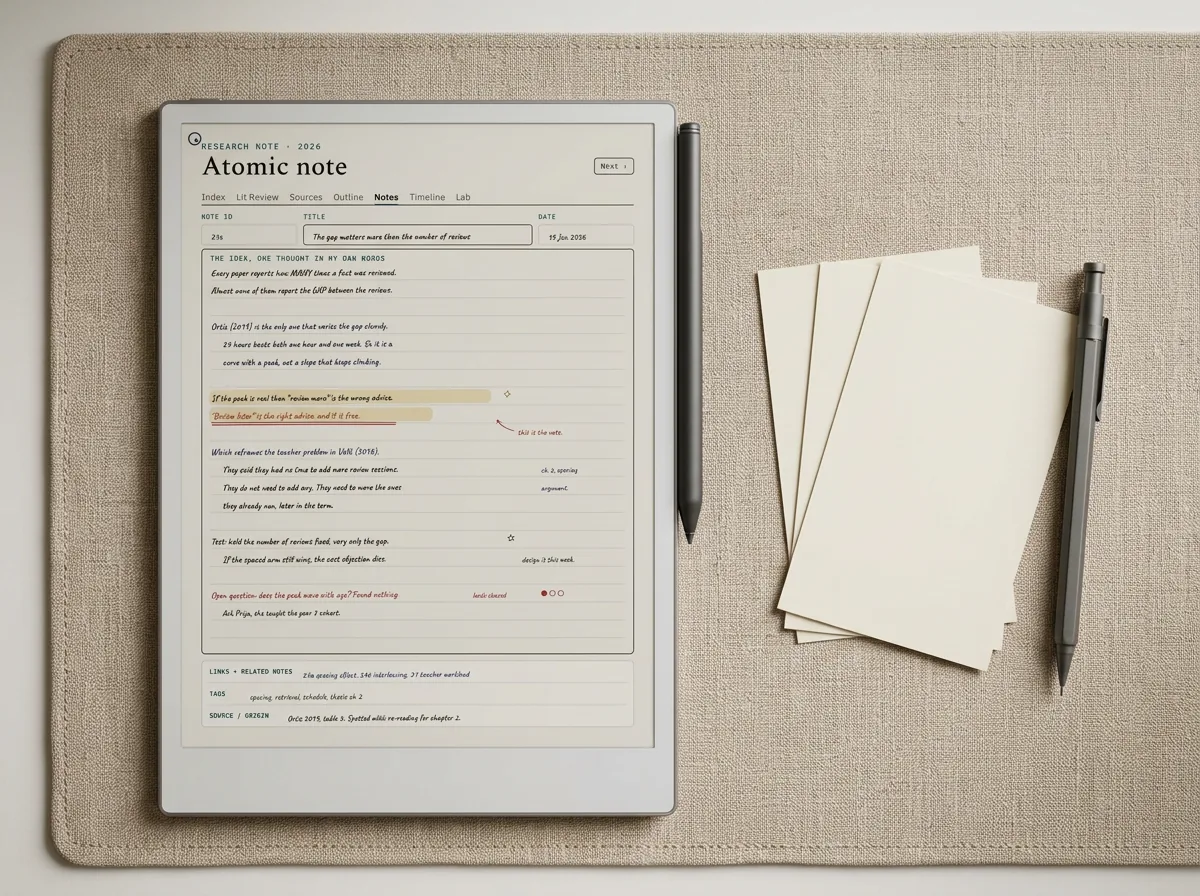
If you write on paper or on an e-ink page rather than in an editor, the seam is easier to see, because handwriting is too slow to let a note sprawl unnoticed. That is the argument we make at more length in our notes on running a zettelkasten alongside Obsidian, and the same two-step appears in the Cornell notes layout: capture in one column, reduce in another, which our free Cornell notes template rules onto the page for you.
In practice
Twenty notes is where it starts paying
None of this is visible in the first week. Twenty atomic notes is roughly the point where the box stops being a list and starts being a structure, because it is around there that you go to file something and find it already has neighbours you had forgotten writing.
For scale: Niklas Luhmann’s archive holds about 90,000 notes written between 1952 and 1997, which is five or six a day. Nothing about that is fast. It is the same twenty-note habit, continued for forty-five years, and the only thing separating it from a drawer of paper is that every one of those notes passed the tests above before it went in.
- Atomic note
- One idea, readable alone, with an address and at least one link out.
- Source card
- What the book said, with page numbers. Written while reading, filed under the source, never linked into the main box.
- Permanent note
- What you now think, in your own words. The thing an atomic note usually is.
- Map of content
- A note whose job is to hold a route rather than an idea: the notes on one topic, in a reading order, with a line on each saying why.
- Note ID
- The address. A number or a timestamp, decided once and never changed.
Start with five notes from something you read this year rather than something you are reading now. Old material is easier to make atomic, because you have forgotten the author’s phrasing and have no choice but to use your own. If you have not decided where they will live, our roundup of zettelkasten apps compares the five that are actually built for a slip box.
FAQ
Common questions, answered briefly
How long should an atomic note be?
What is a good zettelkasten example of an atomic note?
Can an atomic note contain a quote?
Do atomic notes need to be handwritten?
If you have a note you cannot decide how to split, paste it in the comments and we will have a go at finding the seam. Those are the useful cases, because the clean ones were never the problem.
People also ask