The business
What an Airbnb management business actually is
An Airbnb management business is a service company: you run the day-to-day of someone else’s short-term rental and take a cut of what it earns. The owner keeps the asset, the mortgage, and the risk. You take the operations, the guest relationship, and the headache of an 11pm lockout. That trade is the whole product, and it is why the work exists at all.
The field splits into two shapes that get blurred together. The first is co-hosting: you are added to an owner’s listing with permissions inside Airbnb, you handle messages and the calendar, and the owner stays the host of record. The second is full property management: you operate the listing end to end, often under your own systems, including cleaning crews, restocking, maintenance vendors, and pricing. Airbnb’s own hosting resources now treat co-hosting as a first-class way to run a place, which is what makes the small end of this business approachable.
The honest framing for anyone starting out: this is a margin-thin operations company that lives on reliability. You are not buying real estate and you are not getting rich on one listing. You are building a book of properties where each one pays you a slice every month, and the slice only holds if the guests stay happy and the owner trusts the numbers you send.
The money
How Airbnb management companies charge
There is no posted rate card in this business; every fee is negotiated against how much of the work you actually own. Three structures cover almost everything hosts describe, and the gap between them is mostly about who pays for turnovers and supplies.
| Model | Commonly quoted range | What it usually covers | Watch for |
|---|---|---|---|
| Co-hosting (percent of revenue) | 10-25% | Messaging, calendar, pricing, reviews | Owner still pays cleaning and supplies |
| Full management (all-in) | 20-40% | Operations plus cleaning, restock, vendors | Define what is inside the percentage |
| Flat or hybrid | $25-75 / stay + small % | Narrow scope or a starter arrangement | Scope creep without a raise |
The number that decides whether you make money is not the headline percentage; it is the base it applies to. A “15%” fee can mean 15% of the nightly subtotal, of the subtotal plus the cleaning fee, or of the payout after Airbnb host fees come out. Those readings differ by real money on every booking. Settle the base in writing before the first guest checks in, and model a property’s likely take with an Airbnb profit calculator so you are quoting from numbers, not hope.
The on-ramp
Co-hosting is the cheapest way in
Almost nobody starts by signing ten doors. The realistic entry is co-hosting a single listing, because it needs no capital and no company structure: the asset belongs to the owner, and you bring the operations. Our Airbnb co-host guide walks the permissions and fee mechanics in detail, but the reason it matters here is sequencing. Co-hosting one place teaches you the job on someone else’s property before you carry the cost of crews and software across many.
Starting small also fixes the credibility problem every new manager has. Owners hand over a real income stream; they want to see you run one before they trust you with theirs. A single listing you have operated visibly well, with response times and reviews to show for it, is worth more than any deck. If you have never hosted at all, the fastest education is to read the same become-an-Airbnb-host path your future clients used, so you can speak their language from the first call.
First clients
How to land your first owners
Clients in this business are local and arrive by referral, not by ads. The first one is the hardest and usually the cheapest, so treat it as your marketing budget rather than your profit center.
Pick a market you can drive to.
You will be handling lockouts and failed cleans in person at first. Check that real demand exists with market data tools like AirDNA before you commit to an area.
Take one owner at a fair rate.
A neighbor with a second home, a landlord tired of long-term tenants, a host who has lost interest. Run their listing well for three months and document what you changed.
Turn results into the pitch.
Occupancy you lifted, response times, reviews that name the stay. That evidence, plus a one-page scope and fee agreement, is what wins the second and third owner.
Write the agreement down even with a friend. A short scope (what you do, what the owner still pays for, the fee base, how either side exits) is what keeps a good first client from becoming a bad first lawsuit. A simple Airbnb business plan template is enough structure at this stage; you do not need an entity or a brand to manage your first door.
The stack
The operations stack you actually need
The work behind the fee is four jobs running at once: turnovers, guest communication, pricing, and bookkeeping. Turnovers mean a reliable cleaner and a checklist so quality does not depend on memory. Guest communication means fast, templated-but-human replies, because response speed is most of the rating. Pricing means adjusting rates to season and local events rather than setting one nightly number in January and forgetting it.
Bookkeeping is the job that quietly decides whether the business survives, because the moment you manage more than one property, the money stops being legible in your head. Each listing has its own revenue, its own platform fees, its own cleaning and supply costs, and its own owner who wants a clear monthly statement of what they earned and what you took. Miss that and the trust evaporates, however good the occupancy looks.
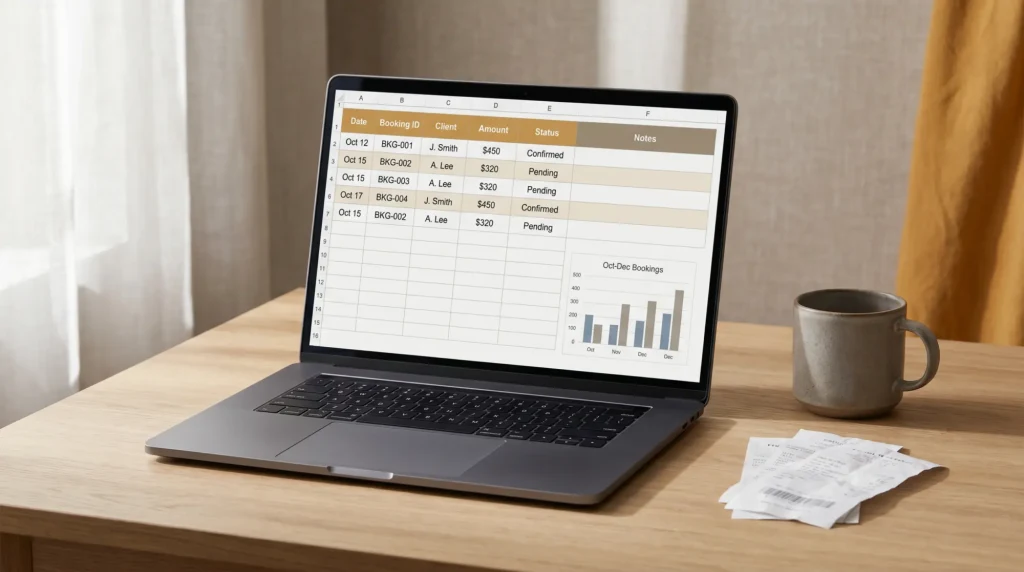
You can run this on accounting software, but most new managers start on a spreadsheet because it shows the owner exactly how their number was reached. If you want a head start, our Airbnb host spreadsheet tracks per-booking revenue, fees, and expenses in one sheet, and you can keep a separate copy per property to hand each owner as a read-only statement. Whatever you use, the rule holds: one source of truth per listing, visible to the owner.
It is an operations job, not passive income. Owners are won on response time and a clean monthly statement, not on a sales pitch.The stack


Everything you hand a guest, matched and priced to move together.
The economics
Whether the numbers actually work
The economics only make sense at the right scale, and the two shapes of this business scale differently. It is worth seeing them side by side before you decide which one you are building.
The rough math that holds up: a single co-hosted listing is a side income, not a salary. The model starts paying like a real business somewhere around five to ten properties clustered in one drivable market, where one cleaner and one set of systems serve several doors and the percentages finally add up against your time. Below that, you are buying yourself a demanding part-time job; the goal is density, not a scattered map of distant listings you cannot service.
If you are weighing this as a path, start with one listing, get the bookkeeping clean enough that an owner could audit it in five minutes, and only add doors in the same town. If you have run a short-term rental management business, or you are deciding whether to take the first client, tell us in the comments what you wish you had priced differently; the experiences readers share keep reshaping this guide.
FAQ
Common questions, answered briefly
Is an Airbnb management business profitable?
How much do Airbnb management companies charge?
How do I start an Airbnb management business with no experience?
Do I need a license or an LLC to manage Airbnbs?
What is the difference between a co-host and a property manager?
If yours isn’t above, drop the question in the comments and we’ll fold it in.
People also ask