The list
What a printable to do checklist does that a sticky note cannot
A printable to do checklist is a page with lines for tasks and a tick box beside each one. On its own that is no better than the back of an envelope. What makes a printed checklist worth using is the structure around the lines: a section that forces you to pick the few tasks that matter, a place for tomorrow, room for the tasks that belong to a bigger project.
That structure is the difference between a list you finish and a list that grows. A sticky note holds everything in the order it occurred to you, so the easy tasks get ticked and the important one waits at the bottom. A page with a small box for the three things that must happen today makes the choice before the day starts, when you are still thinking clearly.
There is no shortage of free lists. The site ranking first for this search, printabletodolist.com, says it offers 455 printable to do list templates. Most of them are variations on the four layouts below, dressed in different fonts and colours, so the real decision is the layout, not the design.
Layouts
Four to do checklist layouts, and who each one suits
Pick the layout by how your tasks arrive: a day’s worth at a time, a week’s worth, or in projects that run for weeks.
| Layout | Suits | Weak at |
|---|---|---|
| Plain list | Errands and quick days | Choosing what matters |
| Must, should, could | Busy workdays | Long projects |
| Week by day | Tasks with a set day | Many tasks a day |
| Project with next actions | Work that runs for weeks | Daily chores |
The plain list is twenty to thirty lines with a box each. It is the right page for a Saturday of errands, where every task is small and the order barely matters. The must, should, could list splits the page into three bands and is the layout we recommend for most working days, because it makes you rank the tasks as you write them. It is covered in the next section.
The week by day list gives each weekday its own short column, plus a box for next week. It suits tasks that belong to a day, such as a call on Tuesday or bins on Thursday, and it keeps them off today’s list until their day comes. The project list puts one project at the top and, beside each task, the next physical action and a due date. It is the page for anything that will not finish this week, where the danger is not forgetting the task but not knowing where to start it.
Priorities
The must, should, could split on a printable to do checklist
The three bands come from a prioritisation method used in software projects, known as MoSCoW, for must have, should have, could have and won’t have. It was developed by Dai Clegg in 1994 for rapid application development, to agree which requirements a deadline could not move. The same idea works on a single day: the deadline is bedtime, and the bands say what gives way first.
Must holds one to three tasks that make the day a success if nothing else happens. Should holds the tasks you plan to do after them. Could holds everything else that would be nice. The rule is that you do not start a should until the musts are ticked. The fourth band, won’t, rarely needs space on paper: anything that did not make the page is already a won’t for today.
A page with a small box for the three things that must happen today makes the choice before the day starts.
Writing it
How to write a to do list you will actually finish
The layout does half the work. The other half is how each line is written, and four rules cover it.
-
1
Start every task with a verb
“Dentist” is a topic. “Call the dentist to book a cleaning” is a task you can do in five minutes and tick.
-
2
Break anything bigger than an hour
“Do the taxes” never gets ticked. “Find last year’s return” does. Big tasks belong on the project list, with only the next step on today’s page.
-
3
Write tomorrow’s list tonight
Five minutes at the end of the day, while you still know what is unfinished, saves the first half hour of the morning.
-
4
Carry forward on purpose
An unticked task is copied to tomorrow, moved to a day in the week, or crossed out. A task copied three days running is a decision you are avoiding.
If your list is shared, with a household or a small team, paper is the wrong tool: our free to do list in Google Sheets lets several people tick the same list and still prints cleanly when you want a copy on the desk.
Printing
Printing a to do checklist for your planner
Match the file to the paper. Most free to do lists are drawn for US Letter, 8.5 by 11 inches. Most of the world prints on A4, 210 by 297 mm, and a Letter file printed on A4 is either cropped or shrunk. A5, at 148 by 210 mm, is the size of most planners and binders, and a to do list is one of the few pages that works well that small, because a day should not need more than a dozen lines. Use a file drawn for your paper and print at 100 percent.
Keep the ink light. You print a to do list more often than any other page, so thin lines and plain tick boxes matter more here than anywhere. Colour-flooded headers and patterned backgrounds use more ink than the list itself, and a highlighter on the must band does the same job.
Ours
The to do checklist set we are drawing
We are drawing a free printable to do checklist set with all four layouts: a plain list, a must, should, could page, a week by day in Monday and Sunday starts with a box for next week, and a project list with next actions and due dates. Each comes in US Letter, A4 and A5 with a binder-safe margin, printed with hairlines rather than colour blocks. It will be linked from this page when it is ready.
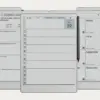
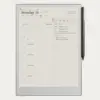
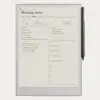
If you plan on an e-ink tablet instead of paper, a daily to do page already lives inside our dated planner for reMarkable and its Kindle Scribe and Boox editions, linked to the week and month views. On paper, our printable weekly planner holds the week the lists feed, and the habit tracker printable keeps the things you do every day off the list altogether. Every page built for paper will collect under printables.
How do you decide what goes at the top of your list each morning? Tell us in the comments; the best systems shape the layouts we draw next.
FAQ
Common questions, answered briefly
What is a printable to do checklist?
How many tasks should be on a daily to do list?
What does must, should, could mean on a to do list?
What paper size should I print a to do list on?
Should I write my to do list the night before?
If yours isn’t above, drop the question in the comments and we’ll add it.
People also ask