This guide is general information, not tax advice. Rules vary by country and change year to year, so confirm the specifics with a qualified tax professional for your situation.
The basics
Do you pay tax on Airbnb income?
In almost every case, yes. Airbnb taxes start from a simple principle: money you earn from hosting is income, and income is taxable. There are narrow exceptions, like the United States “14-day rule” that lets you rent a primary home for fourteen days or fewer per year tax-free, but most active hosts are well past that. If you host regularly, assume the income counts and plan for it.
What you owe depends on how much you earn, what you can deduct, and how your country treats short-term rental income. The good news is that hosting is a business in the eyes of most tax authorities, which means the costs of running it come off the top before tax is calculated. That is where good records turn a scary bill into a manageable one.
Reporting
How Airbnb reports your income
Airbnb reports host earnings to tax authorities once you cross certain thresholds, and it may issue you a form summarising the year. In the United States that form is the 1099-K, and the reporting threshold has moved several times in recent years; for 2026 it has been set back toward the higher $20,000 and 200-transaction mark rather than the lower figures floated earlier. Other countries have their own reporting rules and platform-sharing agreements.
Two things matter here. First, you owe tax on your income whether or not you receive a form, so do not treat a missing 1099-K as a free pass. Second, the figure Airbnb reports is usually gross, before its service fee and your costs come out. Your actual taxable profit is lower, but only if you can document the difference. Check the current rules in the Airbnb tax help center and the IRS recordkeeping guidance.
Deductions
Airbnb tax deductions: what you can write off
Deductions are where hosts save real money. The principle is that ordinary and necessary costs of running the rental reduce your taxable income. The categories below are the common ones; whether each applies, and how much, depends on your country and whether the space is rented full-time or part of your home.
| Deduction category | Examples | Note |
|---|---|---|
| Platform and booking fees | Airbnb host service fee, payment fees | Often the easiest line to miss because it is netted out of payouts. |
| Cleaning and turnover | Cleaner pay, laundry, consumables | Per-stay costs add up fast across a year. |
| Supplies and restocking | Toiletries, coffee, linens, batteries | Keep receipts; small items are a large yearly sum. |
| Insurance and licenses | Host insurance, permit fees | Annual costs, easy to document once. |
| Utilities and internet | Share of power, water, wifi | If the space is part of your home, only the rented share counts. |
| Repairs and maintenance | Fixes, servicing, small replacements | Repairs differ from improvements, which are treated separately. |
The thread running through every row is documentation. A deduction you cannot evidence is a deduction you cannot safely claim. That is the practical reason hosts who track expenses through the year pay less than hosts who guess in April.
Which form
Schedule E or Schedule C: which applies
In the United States, most hosts report rental income on Schedule E as a passive rental activity. Hosts who provide substantial services more like a hotel, such as daily cleaning, meals, or concierge help, may fall under Schedule C as a business, which changes how self-employment tax applies. The line between the two is not always obvious, and it affects what you owe, so this is the part most worth a professional’s eye.
Outside the United States the forms differ, but the same question exists: are you a passive landlord or running a hospitality business? Either way, the records you keep are the same, which is why a single tracking habit covers you regardless of how the return is finally filed.
Records
Keeping records that survive a tax season

Good Airbnb tax records are boring and consistent: every booking logged with its payout and fee, every expense captured with a category and a date, and a monthly sum you can trust. Do this through the year and filing is an export, not an archaeology project. Skip it and you spend April guessing at coffee receipts.
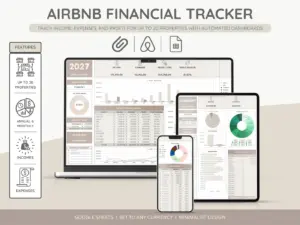
You can do this in a notebook, but a structured sheet is easier because it categorises as you go, which is exactly what your tax form wants. We cover the tracking options in the best Airbnb spreadsheet roundup, and the host tax spreadsheet is built around the deduction categories above.


Everything you hand a guest, matched and priced to move together.
Mistakes
Common Airbnb tax mistakes to avoid
The expensive mistakes are predictable. Reporting only the net payout and forgetting the gross-versus-fee gap. Missing the platform fee as a deduction. Mixing personal and hosting expenses on one card so nothing is clean at year end. Forgetting that income is owed even without a form. And the big one: leaving records until filing season, when half the small deductions are already lost to memory.
Every deductible cost you fail to record is money you pay tax on that you did not actually keep.What we found
None of this requires an accountant’s training. It requires a habit: log as you go, keep hosting money separate, and let the categories do the sorting. Get that right and Airbnb taxes stop being the scary part of hosting.
FAQ
Common questions, answered briefly
Do you have to pay taxes on Airbnb income?
What can I deduct on my Airbnb taxes?
Does Airbnb report my income to the tax authority?
Do I file Airbnb income on Schedule E or Schedule C?
How should I keep Airbnb tax records?
If your question is not above, drop it in the comments and we will add it to the guide.
People also ask
Other questions, briefly answered
Sources: IRS rental income, deductions and recordkeeping, Airbnb tax help center.