The question
Does OneNote have a Kanban board?
Not as a OneNote feature. A OneNote Kanban board is something you build on a page, and the confusion comes from a menu item that looks like the real thing. When people report a greyed-out Kanban board in OneNote, the answer on Microsoft’s own Q&A forum traces it to a Microsoft Loop component rather than a classic OneNote feature. That is a forum answer rather than documentation, but Microsoft’s documentation on Loop in OneNote explains why most readers cannot use it.
Microsoft’s page on using Loop components in OneNote says they work in OneNote for the web and the Windows desktop app, that Mac and mobile are not yet supported, and that “Loop components are available only to people within your organization.” A personal Microsoft account, a Mac or an iPad rules it out on its own.
| Question | Loop component | Table board |
|---|---|---|
| Personal account | No | Yes |
| Mac and iPad | Not yet | Yes |
| Web and Windows | Yes | Yes |
| Lives in your notebook | Embedded | Yes |
So for most people the practical question is not whether OneNote has a board, but which board shape survives every device the notebook is opened on. That shape is a table.
The layout
The OneNote Kanban layout that works on every device
Tables are the one board mechanic OneNote handles the same way almost everywhere. On the Mac, Microsoft documents Insert > Table and even a column sort; on the iPad, Insert > Table starts a 2 x 2 grid. The exception is the iPhone, where Microsoft says “You cannot currently insert a table using OneNote for iPhone”, so build the board on another device first.
The layout we use has five columns, because five is enough to show where work actually waits without turning the page into a spreadsheet:
| Column | A card sits here when |
|---|---|
| Backlog | Agreed, not yet ready to start |
| Ready | Next up, with an owner named |
| Doing | Someone is on it this week |
| Review | Finished, waiting on someone else |
| Done | Closed, until the weekly clear-out |
Review earns its own column for a reason: work that is finished but waiting on someone else is the work that stalls quietly, and a board without that column hides it inside Doing.
The build
How to build a OneNote Kanban board in six steps
- Give the board its own page. Call it Kanban and keep it first in the section, so it is the page that opens.
- Insert a five-column table with two rows. The first row holds the column names; the second row holds the cards.
- Put the limit in the header. Write “Doing (max 3)” rather than “Doing”. The number on the page does more than a rule in your head.
- Write one card as one line. Project name, owner, and the date it is due, separated by a dot. Short enough to scan, full enough to act on.
- Move cards by cut and paste. Select the line, cut it, paste it in the next column. It is the same action on every device that can edit the table.
- Clear Done once a week. Paste the finished cards onto a separate Done page with the date, so the board shows what is live and the record of what shipped lives beside it.
That is the whole mechanism. Everything else in a OneNote Kanban is discipline rather than structure, which is why the rules in the next section matter more than the layout.
The rules
Three rules that keep a OneNote Kanban honest
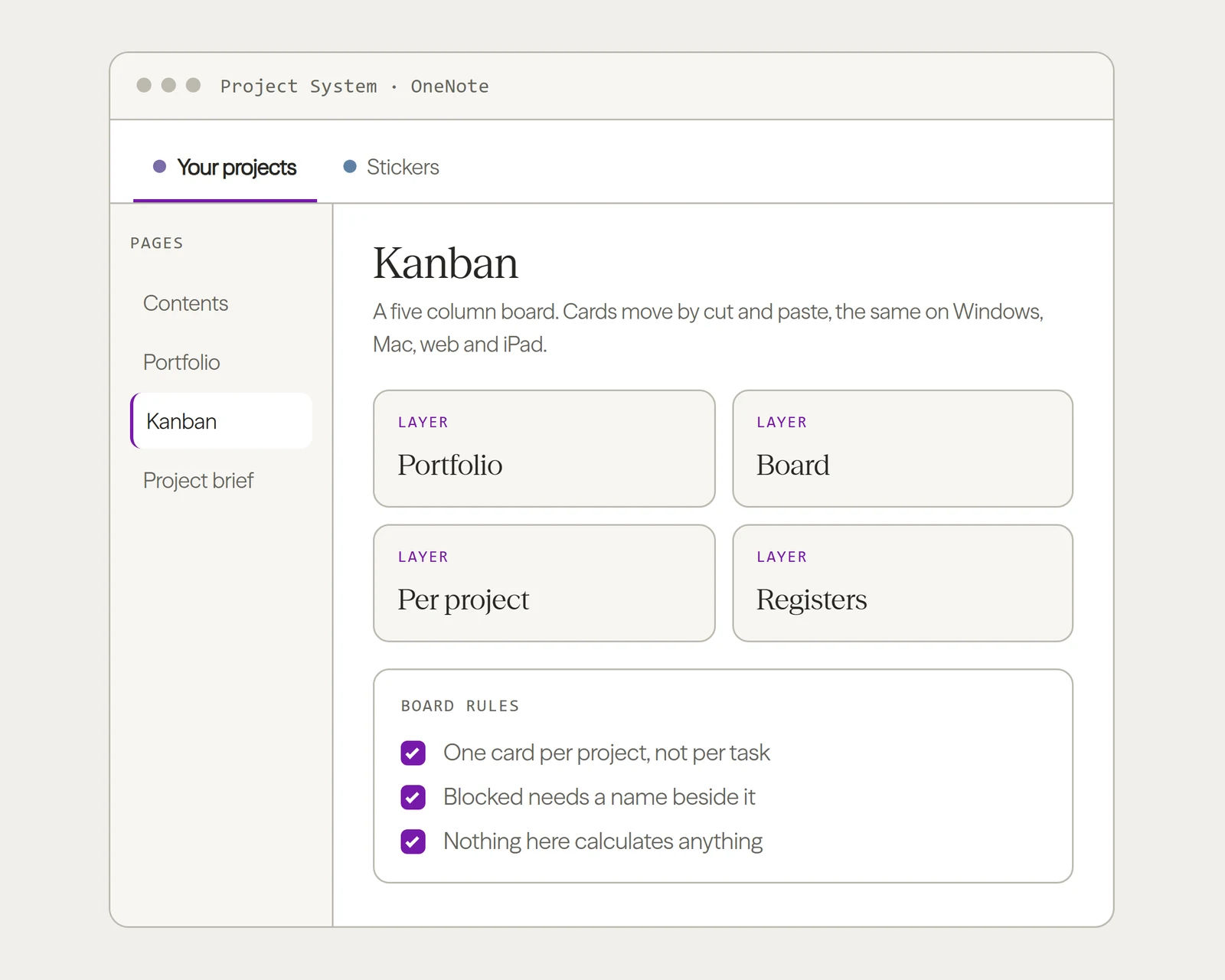
One card per project, not per task. A OneNote board has no filters and no collapsing, so a card for every task buries the page within a fortnight. Keep projects on the board and put their tasks on the project’s own page, linked from the card.
Blocked needs a name beside it. Write “BLOCKED: waiting on finance for the budget” rather than moving the card back. A card that is stuck without a name is a card nobody is chasing.
A card that is stuck without a name is a card nobody is chasing.The rules
Cap Doing and mean it. The limit in the header is the only thing on the page that pushes back. When Doing is full, the next card waits in Ready until something moves to Review, which is the point of a board in the first place.
The limits
When OneNote is the wrong place for a Kanban board
A table board has no drag and drop, no automation, no due-date reminders and nothing that counts for you. For one person or a small team that already works in OneNote, that is a fair trade for keeping the board next to the notes. For a larger team moving dozens of cards a day, or anyone who needs the board to send alerts, a dedicated task tool is the better home, and OneNote becomes the place for the notes behind the work. Our guide to using OneNote for project management covers where that line falls, and the OneNote task management template post covers the task pages that sit behind each card.
Build the table, write the limit into the header, and clear Done every Friday; the board will do the rest. If you have run a OneNote Kanban for longer than a month, tell us in the comments which rule you added that we did not list here, because the boards that last usually carry one house rule nobody else thought of.
FAQ
Common questions, answered briefly
Does OneNote have a Kanban board?
Why is the Kanban board greyed out in OneNote?
How do you move cards on a OneNote Kanban board?
Can you use a OneNote Kanban board on an iPhone?
People also ask