The Feynman technique is a way of finding out whether you understand something by trying to explain it to someone who does not. You write the explanation out in plain language, notice where it goes vague or leans on a word you cannot define, and treat that spot as your next thing to study. It takes about twenty minutes per concept and needs nothing but a blank page.
Below: the four steps done properly, one worked example where the first explanation fails on a checkable fact, where the name actually comes from, how it compares with Cornell notes, flashcards and a Zettelkasten, and how to run it on paper or an e-ink tablet. (If you came for the calculus trick of differentiating under the integral sign, which also carries his name, this page is about studying, not integrals.)
The method
What is the Feynman technique?
Most study habits measure exposure. You reread the chapter, highlight it, watch the lecture again, and each pass feels more familiar. Familiarity is not understanding, and the two feel identical from the inside until an exam question asks you to use the idea rather than recognise it.
The Feynman technique measures something else: whether you can produce the idea yourself, in words a beginner would follow, without the book open. Producing is harder than recognising, so it exposes gaps that rereading hides. That is the whole mechanism. Everything else about the method, the imaginary twelve-year-old, the analogies, the rewriting, exists to make that one test honest.
It works best on concepts, the things with a why or a how inside them: why the seasons happen, how a vaccine trains the immune system, what a derivative measures, why interest compounds. It works poorly on bare facts such as dates, vocabulary and formulas you simply need to recall. Those belong on flashcards, and we come back to that split below.
Step by step
The four steps of the Feynman technique, done properly
Every version online lists roughly the same four steps. The difference between the method working and not working is in the details each list leaves out, so here they are with the details put back.
Pick one concept and write its name at the top of a blank page.
One concept, not a chapter. “Cellular respiration” is a chapter; “why the electron transport chain needs oxygen” is a concept. If the title needs the word and, split it into two pages.
Explain it in plain words, with the source closed.
Write as if to a classmate who missed the lecture. Full sentences, no bullet fragments, because a fragment lets you skip the connecting logic that a sentence forces you to state. Any technical term you use, define on the spot.
Mark the exact sentence where it stalls.
Look for three signals: a jargon word you could not define in the moment, a “because” you could not finish, and a jump where one sentence does not follow from the last. Underline each. These marks are the product of the whole exercise.
Go back to the source for the marked parts only, then rewrite shorter.
Reopen the book at the gaps, not at the start. Then write the explanation again from memory, simpler than the first time, and add one analogy or example of your own. If the rewrite still stalls in the same place, you have found what to ask your teacher.
Two details matter more than the rest. First, the source stays closed during step two. Explaining with the book open turns the exercise into paraphrasing, which feels productive and tests nothing. Second, step four ends with a rewrite from memory, not an edit of the first draft. Editing lets the old wording carry you; rewriting makes you rebuild the logic.
Where it comes from
Feynman never wrote the Feynman technique
Richard Feynman was a Nobel-winning physicist at Caltech, famous as a teacher and for explaining hard physics without hiding behind the maths. The pages ranking for his technique present the four steps as his method. We could not find a four-step method, or the phrase itself, in anything attributed to Feynman; the earliest trace of the name we found is from 2011, more than twenty years after his death.
What the record does hold is shorter and, for a student, more useful. Here is the trail, oldest first, with every item linked in the sources at the end.
A line on his blackboard
After Feynman’s death in 1988, the upper corner of his Caltech blackboard was found to read: “What I cannot create, I do not understand.” Caltech’s own magazine reports it as the line synthetic biologists still quote.
The freshman lecture test
His Caltech colleague David Goodstein recalled asking Feynman to explain a result in quantum statistics. Feynman offered to prepare a freshman lecture on it, came back days later, and said he could not reduce it to the freshman level, which meant “we really don’t understand it.” Goodstein wrote this in Physics Today; Caltech Magazine reprinted it in 2018.
The name appears
The earliest use of “the Feynman Technique” we found is a September 2011 post by the learning writer Scott Young, titled “Learn Faster with the Feynman Technique”, introducing a video in his study course.
The four steps spread
Farnam Street published its short four-step version in April 2012. It still ranks first, and most of the versions you will read today follow its outline, the imaginary child included.
None of this makes the method wrong. It works, and naming it after the most vivid explainer in twentieth-century physics was a fair piece of marketing. But the attribution changes what you should take from it. The four steps are a study routine someone built around Feynman’s standard. The standard itself is the freshman lecture test: if you cannot bring an idea down to a beginner’s level, the problem is your understanding, not the beginner.
Worked example
A Feynman technique example: why we have seasons
Seasons are a good test case because almost everyone has a confident explanation and a large share of those explanations are wrong. Here is the exercise run through once, the way it looks on the page.
First explanation, source closed. “The Earth goes around the Sun in an oval, not a circle. In summer we are closer to the Sun, so it is hotter, and in winter we are further away, so it is colder. The Earth is also tilted, which makes the days longer in summer.”
Where it stalls. Two marks. The first is a jump: if distance causes summer, the whole planet should have summer at once, yet Australia has summer during the northern winter. The explanation cannot account for that. The second is a loose end: the tilt is mentioned, but nothing says what it does apart from the day length.
Back to the source, for those two points only. NASA’s own explainer settles both. Earth’s orbit is slightly lopsided, but the Northern Hemisphere has winter when Earth is closest to the Sun, around January, and summer when it is farthest, around July. The difference is over three million miles, which is small next to the full distance. The seasons come from the tilted axis: whichever hemisphere leans toward the Sun gets its most direct rays.
Rewrite, from memory, simpler. “Earth is tilted, and it stays tilted the same way all year as it goes around the Sun. For half the year the top half leans toward the Sun, so sunlight hits it more directly and for more hours a day: that is summer up there and winter down south. Six months later it is the other way round. Distance is not the reason; the north is actually closest to the Sun in its winter. Think of a flashlight shining straight down on a table compared with at a slant: same light, spread over more table.”
Notice what happened. The first version was fluent and contained one false cause and one idea mentioned but never used. Rereading a textbook chapter on the seasons would probably not have caught either, because both sentences look reasonable. Writing them out, and asking whether each one explained the next, did.
The first version was fluent and contained one false cause and one idea mentioned but never used.Worked example
Why it works
Why explaining exposes what rereading hides
Reading an explanation and producing one use different muscles. When you read, the author supplies every connecting step, and your brain only has to agree with each one. Agreement is cheap. When you write, you have to supply the connecting steps yourself, and the missing ones become visible as the sentence you cannot finish.
The beginner audience does specific work too. Writing for an expert lets you use a term as a stand-in for an idea: “the tilt causes seasons” sounds like an explanation to someone who already knows. Writing for a beginner forces you to unpack the term into the mechanism, and the mechanism is where the gaps live. That is exactly Goodstein’s story in miniature. The difficulty of the freshman lecture was not the freshmen.
Written beats spoken, for the same reason. Talking to yourself lets you wave a hand over a gap and move on; a written sentence sits there and either follows from the last one or does not. If you prefer to talk it through, record it and listen back, and mark the stalls exactly as you would on paper.
Compared
The Feynman method compared with other study techniques
The Feynman technique is a diagnostic, not a full study system. It tells you what you do not understand; it does not help you remember facts, organise a semester of notes, or build connections between courses. Here is where it sits next to the methods it is most often confused with.
| Best forwhat it trains | You end withon the page | Weak atwhere it fails | |
|---|---|---|---|
| Feynman technique | Understanding a concept | A short plain explanation, plus a list of gaps | Facts and recall |
| Cornell notes | Capturing a lecture or chapter | Notes, cue questions and a summary | Testing whether the summary is right |
| Flashcards and active recall | Remembering facts and terms | A deck you review on a schedule | Ideas with a why inside them |
| Zettelkasten | Connecting ideas across sources | Short linked notes in your own words | Exam deadlines next week |
| Rubber duck debugging | Finding a bug in code | Nothing, it is spoken | Anything you need to keep |
They combine well. The natural pairing is with Cornell notes: take notes in the lecture, then use the summary at the bottom of the page as your step two, written from memory the same evening. A summary you cannot write without looking up is a gap found early. Flashcards then cover the bare facts the Feynman pass turned up, and anything worth keeping past the exam becomes a permanent note in a Zettelkasten, which asks for the same thing the Feynman technique does: the idea in your own words, one idea at a time, as our guide to atomic notes explains.
On the page
Running the Feynman technique for studying, on paper or a tablet
The method needs a surface you write on by hand, because typing is fast enough to skim past a gap. A blank sheet works. So does an e-ink tablet, with one advantage: you can keep the first explanation, the marks and the rewrite on consecutive pages in one notebook per course, and find them again before the exam.
A layout that works: the concept as the page title; the first explanation filling the top two thirds; the gaps you marked listed in a narrow column down the side; and the rewrite in a box at the bottom. That is almost exactly the shape of a Cornell notes page, which is why the two methods fit together so easily.
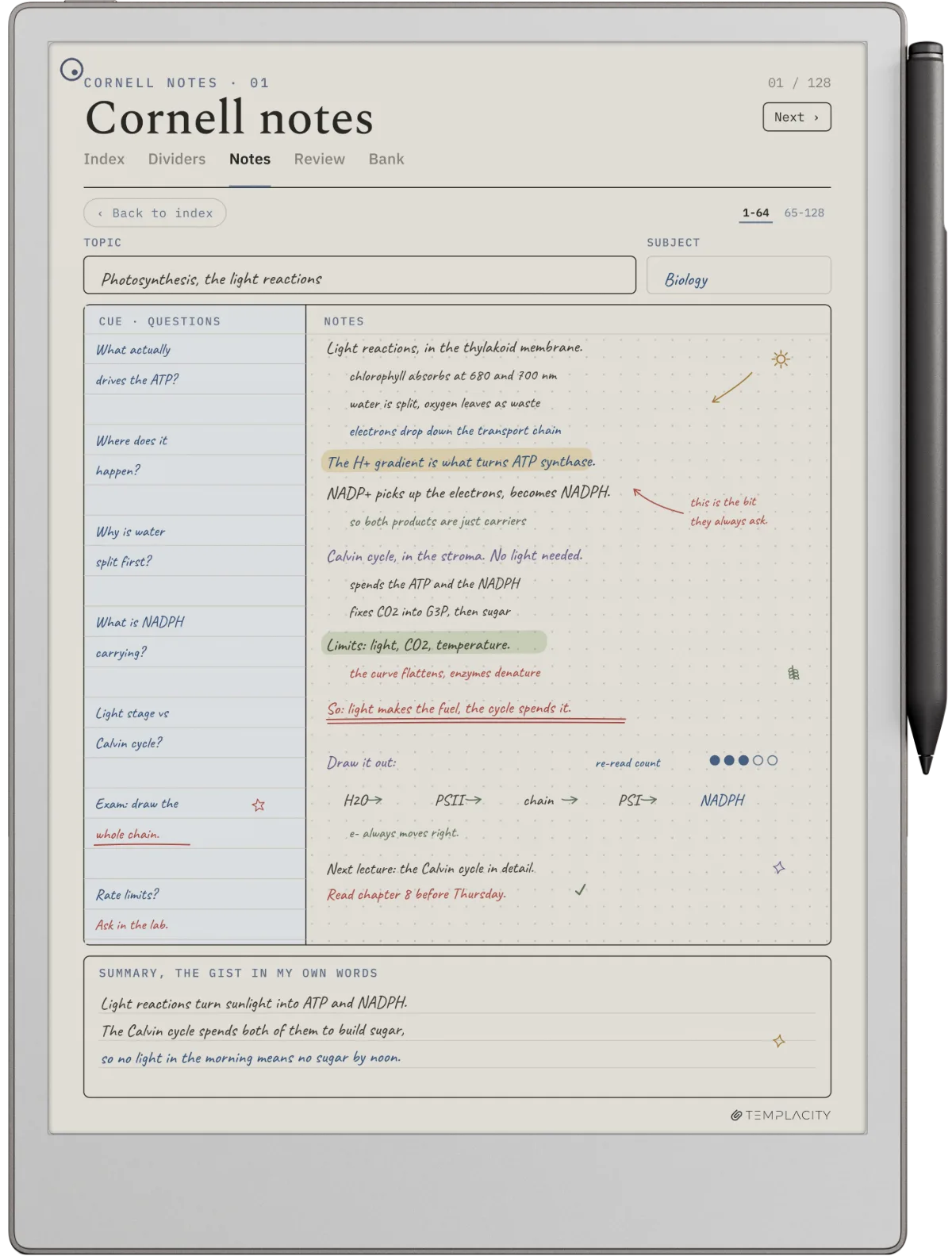
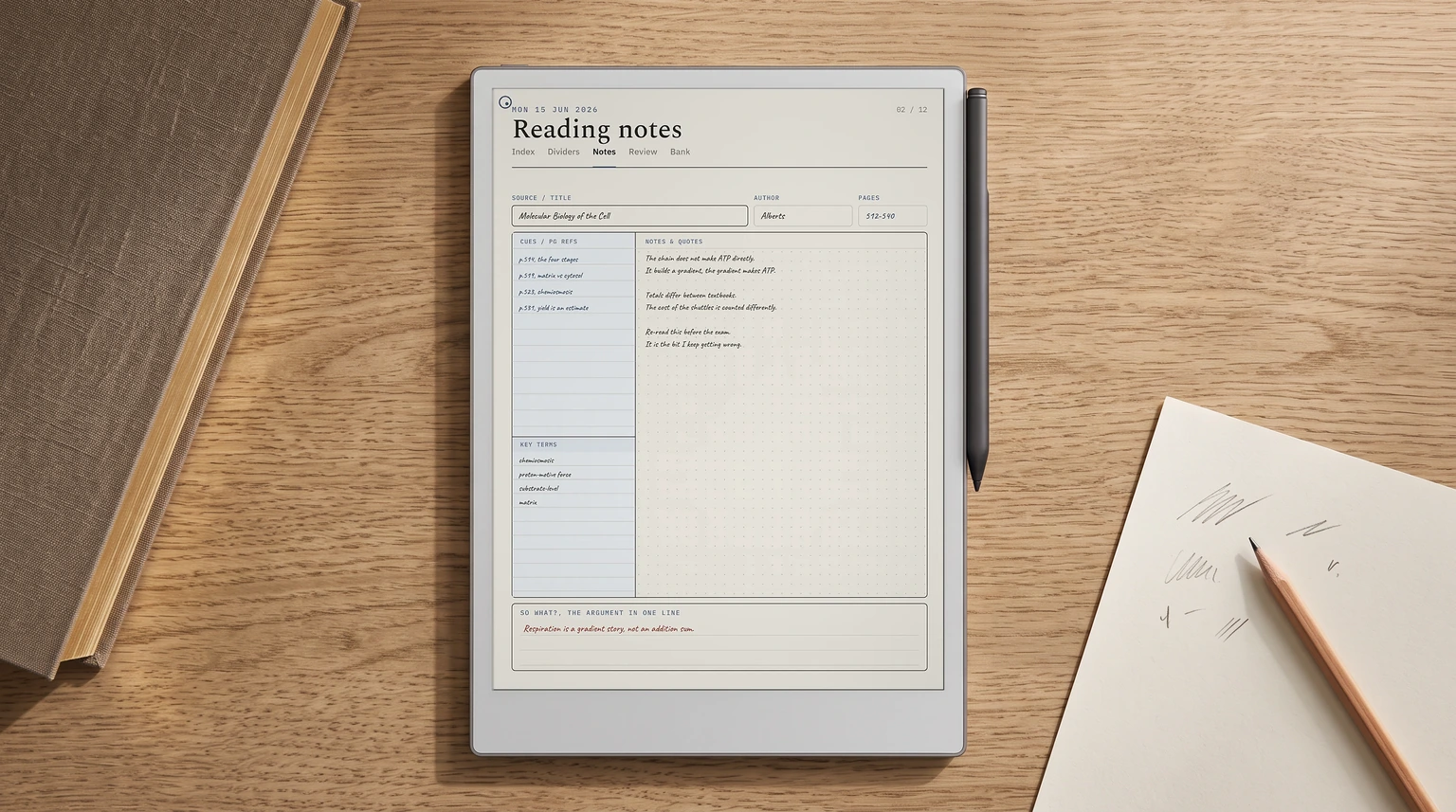
On our Cornell notes pages the bottom box is headed “Summary, the gist in my own words”, and on the reading notes pages it is “So what?, the argument in one line.” Treat either as a compressed Feynman pass: if you cannot write the gist in plain sentences without looking back up the page, run the full four steps on it that evening. The cue column on the left takes the gaps, one per line, so the questions to ask in the next class are already listed when you get there.
Keep a separate page, or a page at the back of each course notebook, for the rewrites alone. Before an exam, read only those. They are the shortest correct version of everything you once misunderstood, which makes them the highest-yield revision material you will own. If you keep a commonplace book, the best of them belong there too.
Mistakes
Five ways the Feynman learning technique quietly stops working
Explaining with the book open. The most common one. It turns a test into copying, and the explanation comes out smooth because it is the author’s, not yours.
Keeping the jargon. If the explanation still contains the words from the textbook heading, it has probably not been explained, only restated. Every technical term either gets defined in plain words or gets underlined as a gap.
Taking too big a bite. “Explain World War One” produces a page of summary with no single place to stall. Narrow the title until the whole explanation fits on one page.
Skipping the rewrite. Finding the gaps feels like the achievement, so the fourth step gets dropped. Without the rewrite from memory you have a list of problems and no evidence you fixed them.
Using it on facts. There is nothing to explain about the year a treaty was signed. Spending a Feynman pass on it wastes twenty minutes a flashcard would cover in ten seconds.
For planning the passes themselves, one concept per evening across the week before an exam is a realistic pace, and a digital student planner is a sensible place to schedule them next to everything else. More study methods, set up for e-ink tablets, live on our reMarkable hub.
FAQ
Common questions, answered briefly
What are the 4 steps of the Feynman technique?
Did Richard Feynman invent the Feynman technique?
Is the Feynman technique good for studying?
How long does the Feynman technique take?
Do you have to explain it to a real person?
If yours isn’t above, drop the question in the comments and we’ll add it.
People also ask
Other questions, briefly answered
Try one pass tonight on the concept you are least sure of, and tell us in the comments which sentence it stalled on. The best gaps readers find tend to be the ones everyone else in the class has too.