The planner
What a homeschool planner printable is actually for
A homeschool planner printable is a set of pages you print and keep in a binder: a place to plan the week’s lessons, a place to note what each child actually did, and the records you may want at the end of the year. It is not a curriculum. The curriculum says what to teach; the planner says when, and remembers whether it happened.
That distinction matters because most printable planners on the first page of this search try to do both. They arrive with dozens of pages, cover designs and subject headings already printed, and a family ends up planning around the planner. The pages that last are plainer: a grid for the week, a line for each lesson, a box to tick when it is done, and room for the thing that went differently.
Paper suits home education better than most planning. The binder sits on the kitchen table where lessons happen, children can see the week and tick their own boxes, and at the end of the year the pages are a record of the year you actually had, in your own handwriting.
The pages
The five pages a homeschool planner printable needs
The pages that keep getting used come down to these five. Anything beyond them is optional, and optional pages are the ones left blank.
| Page | What it holds | How often |
|---|---|---|
| Weekly lesson grid | Subjects by day, per child | Every week |
| Daily page | Times, lessons, done boxes, notes | Busy days |
| Attendance | Days taught, absences, trips | Daily tick |
| Term plan | Books and units for the term | Each term |
| Reading log | Books read, aloud or alone | As you go |
The weekly lesson grid is the heart of it: subjects down the side, days across the top, one grid per child or one family grid with a row per child. The daily page is for the days that need times, such as co-op mornings or appointment days, and for noting what to carry into tomorrow. Attendance is a simple count of days taught, which some families need for their records and many keep anyway, as a count of the year so far. Requirements differ by state and country, so check yours rather than trusting a printed rule.
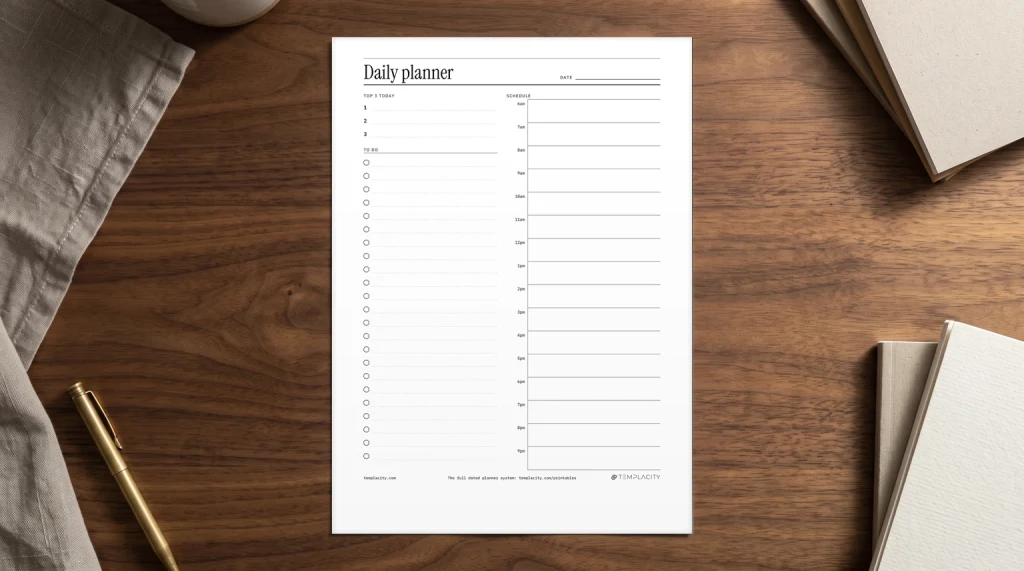
The term plan lists the books and units you mean to cover this term, so the weekly grid can take its share each week. The reading log records every book read, aloud or alone, and becomes one of the nicest records of the year. Our free weekly homeschool schedule covers the first two pages, a week grid and a daily page with a done column, and our free homeschool attendance tracker covers the third, with a numbered 180-day grid and a month-by-month count. Both print on US Letter, and both come in A4 too (schedule, attendance).
Several children
Planning several children on one page
The hardest part of homeschool planning is not any one child’s week; it is fitting three of them around one parent. A separate planner per child hides that problem until Tuesday morning, when two children need you for maths at the same time.
Plan the family first. Put the subjects everyone does together, read-alouds, history, nature study, art, on one shared line of the week, then give each child a row for the work that has to be at their level, usually maths, reading and writing. Stagger those rows, so while one child works alone the other has your attention. A family grid with a row per child shows the clash on paper, where it is easy to move, instead of at the table.
A family grid with a row per child shows the clash on paper, where it is easy to move, instead of at the table.
Gentle days
A planner for Charlotte Mason and morning basket families
Many homeschool families plan around the ideas of Charlotte Mason, the British educator who lived from 1842 to 1923 and whose lectures on educating children under nine were published as Home Education in 1886. Her method favours short lessons with full attention, narration (the child tells back what they heard or read), and what she called “living books” rather than dry textbooks. A planner for that kind of day looks different from a school timetable.
Short lessons mean the weekly grid needs more, smaller boxes rather than long periods, and a narration column is more useful than a grade column. Many of these families also start the day with a morning basket: a basket of books and activities the whole family shares, such as poetry, a hymn or folk song, an artist study, a read-aloud. A morning basket page lists what is in the basket this term and rotates it by day. A nature study page is the other one worth adding, with a box for a sketch, the date, the weather and what was seen, so a year of walks becomes a record of its own.
If the artist study line looks like the expensive one, it need not be. At Home With Holly, a Charlotte Mason homeschool blog, has a guide to doing artist study for free or cheap: library books, secondhand copies and free online collections are enough to fill that line of the basket page for a term.
Printing
Printing and binding a homeschool planner
Print the pages you will use every week in bulk at the start of the term: twelve weekly grids are easier than one every Sunday. Use a file drawn for your paper. US Letter, 8.5 by 11 inches, is the standard in North America; most other countries print on A4, 210 by 297 mm, and a Letter page on A4 is cropped or shrunk. Print at 100 percent so the grid still fits a child’s handwriting.
Ours
The rest of the homeschool printables, free
Beyond the weekly schedule and attendance tracker above, the rest of the set is free on our printables shelf: a weekly lesson grid for up to five children, a term plan, a reading log, and two pages for gentler days, a morning basket planner and a nature study page with a sketch box. No subject names are printed anywhere, so the pages fit any curriculum. They are each drawn separately for US Letter, A4 and A5 rather than scaled from one master, in the Editorial, Hours or Dot-Journal style, with no signup.
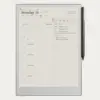
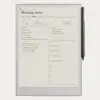
If your family plans on an e-ink tablet rather than in a binder, our Homeschool Planner System already exists in digital form: a dated planner for one to four children, with a family week that opens each child’s daily lesson plan, attendance and hours, term progress and a reading log, for reMarkable, Kindle Scribe and Boox. Teachers planning a classroom week will find our free weekly lesson plan template a closer fit. The rest of our homeschool guides sit under homeschool, and every page built for paper collects under printables.
Still choosing between a printed book, a printable and a digital planner? Our homeschool planner guide compares them by family size and how your lessons run.
What is in your morning basket this term? Tell us in the comments; it shapes the example page we print on ours.
FAQ
Common questions, answered briefly
What should a homeschool planner printable include?
How do I plan homeschool for several children?
Do I need to track homeschool attendance?
What is a morning basket in homeschooling?
What paper size should I print a homeschool planner on?
If yours isn’t above, drop the question in the comments and we’ll add it.
People also ask