Why write it down
Why an IBS food diary beats memory
An IBS food diary is a daily record of what you eat and drink and how your gut responds, kept side by side so the two can be compared. Symptoms come and go, and by the time you sit in front of a doctor, last Tuesday has blurred into a general sense of “bad week”. The diary replaces that blur with times, foods and numbers.
Researchers have made the same argument. A team that developed and validated the Food and Symptom Times (FAST) diary, tested with 51 adults with IBS and published in Clinical and Translational Gastroenterology, noted that retrospective questionnaires are limited by symptom fluctuation and recall bias, and that over-reporting is common with them. Their diary had people record the time, duration and severity of each symptom as it happened, next to a standard food record. The point carries over to a paper page: write it when it happens, not at night from memory.
One thing a food diary is not: a diagnosis. The NIDDK says doctors diagnose IBS from your symptoms and history, and that some symptoms, including bleeding from the rectum, bloody or black tarry stools, anemia and weight loss, may point to a different health problem. If any of those show up in your diary, call your doctor rather than waiting for the pattern to settle.
What to log
What to write in an IBS food diary
A food journal for weight loss can get away with what you ate and roughly how much. An IBS food journal needs the other half of the story, the symptoms, recorded with enough detail that a pattern can show. These are the fields worth keeping, and why.
| Field | What to write | Why it matters |
|---|---|---|
| Food and drink | Time, item, portion | The core record |
| Symptoms | Time, what, 0 to 10, how long | Lines up against meals |
| Stool type | Time, type 1 to 7 | A shared language |
| Sleep and stress | Hours slept, a stress mark | Not every bad day is food |
| Medicine | What and when | Explains odd days |
Two details make the difference. First, write sauces, drinks and snacks, not just meals; the coffee and the dressing are as much a part of the day as the plate. Second, define your symptom scale once and keep it. Decide on day one what a 3 and an 8 mean to you, so a 6 in week four means the same thing it did in week one.
Sleep and stress earn their place because food is not the only lever. The NIDDK lists more physical activity, reducing stressful situations where you can and getting enough sleep among the lifestyle changes that may help IBS symptoms. A diary that only records food will blame lunch for a day that was really about a bad night.
Stool type
The stool type column, 1 to 7
The NIDDK notes that a change in how often you go and a change in the way your stools look are part of the IBS picture your doctor will ask about. Describing that in words is awkward, which is why many diaries use a seven-point reference instead, the one your doctor may call the Bristol scale. You write a number, not a description.
- Separate hard lumps, hard to pass
- Lumpy and shaped like a sausage
- Sausage shaped with cracks on the surface
- Smooth and soft, like a sausage or a snake
- Soft blobs with clear edges
- Fluffy, mushy pieces with ragged edges
- Watery, no solid pieces
Treat the number as a description to share, not a verdict. Our free diary prints this reference on its own page so you can keep it beside the day pages instead of searching for it each time.
Reading it back
How to read your IBS food diary back
The writing takes a minute a meal. The reading is where the diary earns its keep, and it works best once a week, not every evening.
- Start from the bad days. Mark the days with the highest symptom scores, then look at what came before them: the meals that day and the evening before, the sleep, the stress.
- Look for repeats, not one-offs. One rough afternoon after a curry is an anecdote. The same rough afternoon after three different meals that share an ingredient is a pattern worth asking about.
- Check the quiet days too. What did your best days have in common? That list is as useful to a dietitian as the worst one.
- Change one thing at a time, with help. If two things change in the same week, the diary cannot tell you which one mattered.
A diary that only records food will blame lunch for a day that was really about a bad night.What to log
Be honest about what a pattern is. A food that keeps turning up before bad days is a question to bring to your appointment, not a food to drop for good. Cutting foods one at a time on a hunch can leave you eating less and less without ever finding the cause.
FODMAP
A food journal for IBS and the low FODMAP diet
Many people start an IBS food journal because a doctor has mentioned the low FODMAP diet. The NIDDK describes it as a diet that reduces or avoids certain carbohydrates that are hard to digest, and says that if symptoms improve, your doctor may recommend slowly adding those foods back, since you may be able to eat some of them without symptoms. The same NIDDK page lists eating more fiber and avoiding gluten as other changes doctors may suggest, and notes that you may need to change what you eat for several weeks to see whether symptoms improve.
Monash University, which developed the diet, describes a 2 to 6 week period of high restriction followed by a more relaxed diet where certain foods are gradually reintroduced, and recommends following it under the supervision of a qualified dietitian. Monash is also clear on two limits: the diet is intended for people with medically diagnosed IBS, and about 1 in 4 people with IBS find their symptoms do not improve on it.
This is where the diary does its most useful work. During the restriction weeks it shows whether symptoms actually changed, in numbers rather than impressions. During reintroduction it shows how each food went over the following days, which is exactly what your dietitian will ask. Our full diary has a separate log for trying a food again for that reason.
Free page
Free IBS food diary to print
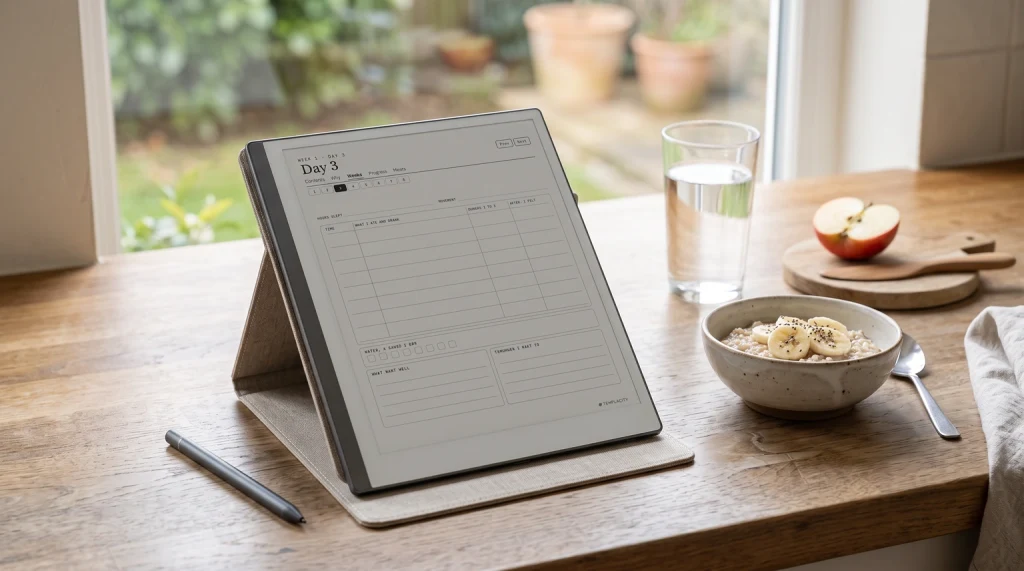
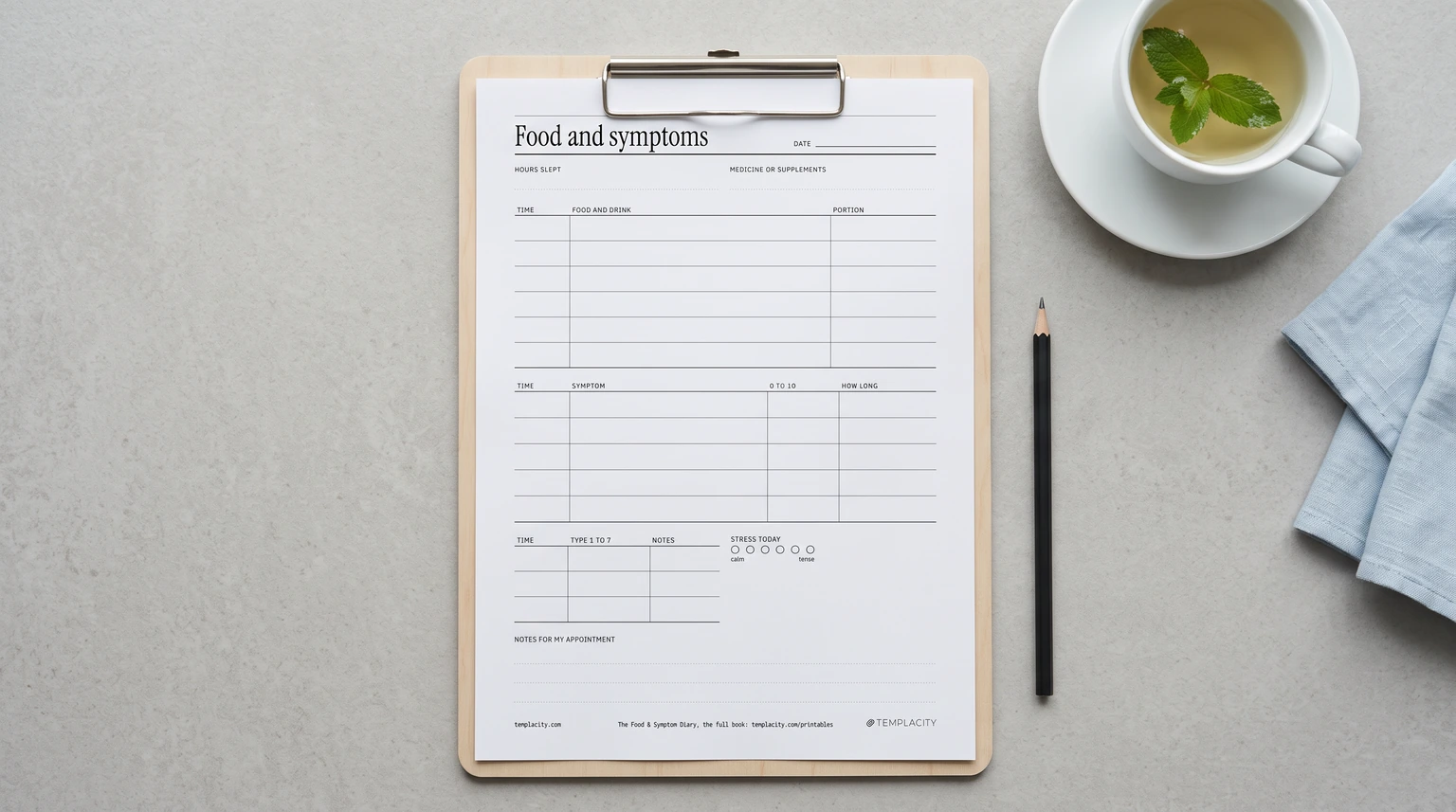
Our free IBS food diary is three pages: a day page with sleep, medicine, food and drink with time and portion, symptoms with a 0 to 10 strength and how long they lasted, stool type, a stress mark and space for notes for your appointment; the 1 to 7 stool type reference; and a weekly summary for patterns, foods to ask about and questions for your doctor or dietitian. It is US Letter, with A4 and A5 versions. Print seven day pages and one summary for each week.
Keep it where you eat: on the fridge, in a folder by the table, or with our other printable journal pages if you already keep a binder. If meals are planned ahead, the printable weekly meal planner makes the diary faster to fill, since half the food column is already decided.
Full disclosure: we sell the bound version. The Food & Symptom Diary is twelve weeks of those day pages, undated, with your own symptom scale set on the first page, the stool type reference, a log that follows a reintroduced food over three days and a page of questions for your appointment. It comes as iPad, e-ink and printable editions in one download. If you are logging food for weight rather than symptoms, our food journal for weight loss guide covers the simpler version.
The appointment
Taking the diary to your appointment
The NIDDK says your doctor may diagnose IBS if you have had symptoms at least once a week in the last 3 months and they first started at least 6 months ago, and that they will ask about your symptoms, history and medicines. A diary turns those questions into something you can show. Before the appointment, spend ten minutes on three things:
- A one-line summary of each week: worst day, best day, any repeat suspects.
- Every medicine and supplement you took, with dates.
- The questions you want answered, written down, because they are easy to forget in the room.
Nothing in this guide is medical advice, and the diary is a record for you and your care team, not a plan to follow on its own. Your doctor or a registered dietitian is the right person to decide what changes, if any, to make.
Living with IBS teaches people small tricks that no leaflet mentions. If a column, a habit or a way of reading your IBS food diary has helped you, share it in the comments; someone starting their first week will find it there.
FAQ
Common questions, answered briefly
What should I write in an IBS food diary?
How long should I keep an IBS food diary?
Can a food diary diagnose IBS?
Do I need a food diary for the low FODMAP diet?
Is there a free IBS food diary to print?
If yours isn’t above, drop the question in the comments and we’ll add it.
People also ask