The page
What a printable budget template has to fit on one page
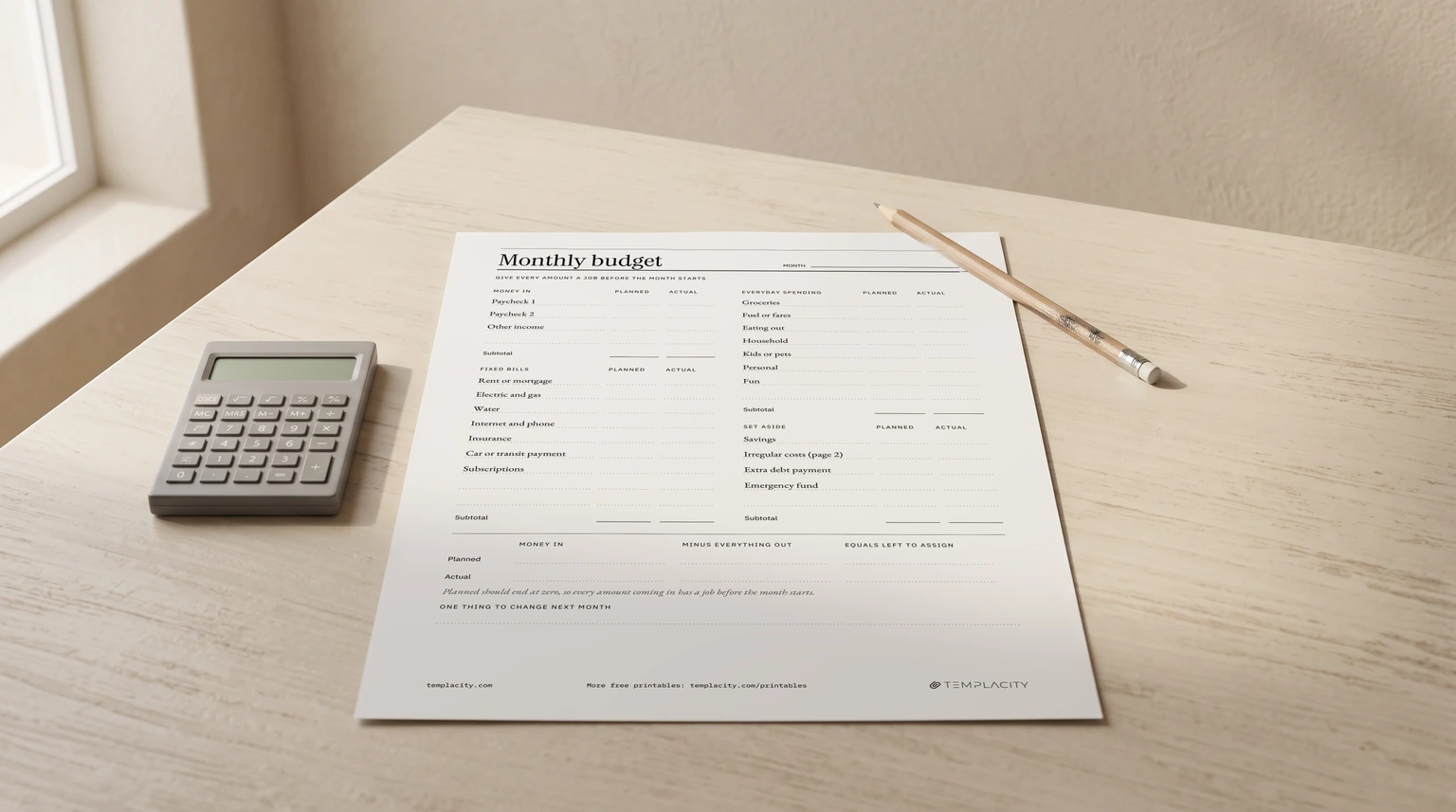
Plenty of budgets stop after the first month, usually for a dull reason: the budget was too much work to reopen. A printable budget template fixes that by being one sheet you can leave on the table. It needs only four blocks of numbers and one sum: what comes in, what is fixed, what you spend day to day, and what you set aside, then money in minus everything out.
Ours is built that way. Download it in US Letter or A4, with no email and no sign-up. Common lines such as rent, groceries and savings are already printed, there are blank rows for whatever is particular to your month, and no currency sign is printed, so it works in any currency. Every line is also a fillable field if you would rather type. The fields do not add up by themselves; a sheet of paper does not either, and a calculator takes a minute.
How to fill it in
How to fill in the printable budget, block by block
Do this before the month starts, with last month’s bank statement open. Fill the planned column only; the actual column waits.
- Money in. Take-home pay for each paycheck, plus anything else you can count on. If your income moves around, plan on a low month rather than a good one.
- Fixed bills. Rent or mortgage, utilities, internet, phone, insurance, loan payments, subscriptions. For a bill that changes from month to month, use your average from recent bills.
- Everyday spending. Groceries, fuel or fares, eating out, household, kids or pets, personal, fun. Use what the statement says you spent, not what you wish you spent.
- Set aside. Savings, the irregular costs figure from page two, any extra debt payment and an emergency fund.
- The sum. Money in minus everything out. Planned should end at zero. If it is above zero, give the rest a job; if it is below, cut a line until it balances.
Page two
The page most budgets are missing: irregular costs
A monthly budget breaks on the month the car registration lands. The cost was never a surprise; it just was not on the page. The debt charity StepChange makes the same point in its own budgeting guide: include the things you spend money on less often, then work out what they come to each month.
Page two is where that happens. Write each cost, the month it is due and what it comes to in a year. Divide by twelve, add up the last column and carry that one figure to the Irregular costs line on page one. In our made-up example, 3,000 a year across registration, gifts, a car service, school, the vet and a trip becomes 250 a month. Keep that money in savings until the bills arrive. Our sinking funds guide goes further if you want a separate pot for each cost.
Through the month
Planned against actual: the part that changes next month
The planned column is a guess. The actual column is what teaches you something, and it takes one short sitting at the end of the month with your statement. Copy in what really happened, subtotal each block and do the sum again in the Actual row.
Then write one change on the last line, and only one. In the example on page three, groceries ran 43 over and eating out 31 over, so next month’s plan raises both and takes the difference from somewhere real. A budget that keeps being wrong in the same place is telling you the number is wrong, not that you are. If one month has gone badly and you want a reset, a no-spend challenge is the blunt version, and our bills tracker printable keeps due dates in view if late fees are the leak.
Which format
Paper, a spreadsheet, or the full pack
Paper is good at one thing: you see the page. A spreadsheet is better once you want it to do the arithmetic or show twelve months side by side. Pick by what you will actually keep doing.
| Option | Best when | What you get |
|---|---|---|
| Free printable budget template | You want one page for this month | The monthly budget, irregular costs, an example |
| Printable Budget Pack | You want the whole system on paper | Sixteen undated pages, bills to net worth |
| A spreadsheet | You want the sums done for you | Live totals, a year in one file |
If one page turns out not to be enough, our Printable Budget Pack adds a paycheck plan, bills by month and on a calendar, a spending log, debt payoff pages, savings goals, sinking funds, a no-spend month and net worth, in Letter, A4 and A5 and three designs. If you would rather not do sums at all, there is a free route through our Google Sheets budget template and Excel monthly budget template guides, and the Budget and Money Planner Spreadsheet carries a full year in Google Sheets or Excel.
Printing
How to print a budget page so it stays usable
- Pick your paper size first. Download Letter in North America and A4 almost everywhere else. Each is laid out for its own sheet rather than stretched from the other.
- Print at actual size. Choose 100% or Actual size in the print dialog, so the rows stay tall enough to write on.
- Black and white is fine. The page has thin rules and no shaded areas, so it is light on ink.
- Print page one each month and page two once a year. Twelve copies of page one in a folder gives you a year you can flip through. Our printable weekly planner sits well in the same binder.
FAQ
Common questions, answered briefly
Is this printable budget template free?
Yes. It is a free three-page PDF in US Letter and A4, a direct download with no sign-up.
Can I fill in the budget on my computer?
Yes. Every line is a fillable field, so you can type into the PDF and then print or save it. The fields do not calculate totals; for that, use a spreadsheet.
What should a monthly budget include?
All the money coming in, your fixed bills, everyday spending, and what you set aside for savings, irregular costs and any extra debt payment, with a planned and an actual figure for each.
What goes on the irregular costs page?
Anything that does not come every month, such as car registration, holiday gifts, a car service or annual subscriptions. Divide each one by twelve and carry the sum to the monthly budget.
Does it work outside the US?
Yes. No currency sign is printed, and there is a separate A4 version laid out for that paper size.
Used the page for a month? Tell us in the comments which line was furthest from the plan; it is rarely the one anyone expects.
People also ask