The calendar
Why the hunt for hobonichi alternatives starts in August
This category has one date on it. Hobonichi puts the following year’s lineup on sale on 1 September at 11am Japan time, with preview exhibits opening in Tokyo and Kyoto on 25 August. KOKUYO opened pre-orders for the Jibun Techo 2027 on 7 August and ships from 4 September. Two of the three books most people compare go on sale inside the same fortnight, popular covers go out of stock during it, and everyone who missed one starts looking sideways.
Search behaves exactly the way you would expect. Google’s own keyword volumes put “hobonichi 2026” at 9,900 searches in July 2025 and 90,500 the following month, a ninefold jump in four weeks. The bare brand term went from 33,100 to 110,000 across the same August. Then it happens again in December, when the people who bought one in September realise they are not using it and the gift buyers arrive.
None of that tells you which book to buy. It tells you why the question feels urgent in the third week of August and why it will feel urgent again around the middle of December. If you are reading this in either window, you have time. The books that matter here restock annually, and two of them are undated.
What you are replacing
A Hobonichi is four books, and you probably want a different one
The word covers a lineup, not a product, and the first useful move is to name which part of it let you down. The Techo Original is A6, 105 by 148 mm, 464 pages, one page for every day, printed on Tomoe River paper with a 3.7 mm graph. It sells as a book on its own at ¥2,860 and expects you to buy a cover for it separately. The Cousin is the A5 version at 148 by 210 mm and 544 pages, ¥4,620, and it adds vertical weekly spreads with a 24 hour timeline that the Original does not have. If the word itself is still doing too much work, our explainer on what a Hobonichi is goes through all six books and where they came from.
Then there are the two that quietly solve the most common complaint. Weeks is wallet-shaped, a week to the left page and a blank memo page to the right, from ¥2,860 to ¥5,060 depending on the cover. Day-Free drops the daily pages entirely and gives you a monthly calendar plus a graph notebook, at ¥2,420 in A6 and ¥3,520 in A5. There is also a five year book at ¥4,620 in A6, and the HON line, which comes with its own hardcover attached instead of expecting you to buy one.
Read the complaints that send people looking for a hobonichi dupe and most of them are not about the brand or the money. They are about 365 printed pages that stopped being filled in some time in March, and the low guilt that comes from paying for a year and using ten weeks of it. Day-Free exists for that reader. So does Weeks. Leaving the lineup because the daily pages went unused is buying a different daily book to leave unused.
The roster
Five hobonichi alternatives, and what each one fixes
Five answers cover almost everyone, and they are sorted by the problem rather than by price. Prices below come from each maker’s own store, read on 12 August 2026, and the pages are linked at the foot of this post. Where a figure is in yen or euro, that is the currency the maker publishes.
| Book | Format | What it costs | Reach for it if |
|---|---|---|---|
| KOKUYO Jibun Techo DAYs | One page per day, 24 hour timeline down the middle | $70.80 in A5 Slim, $62.30 to $68.00 in B6 Slim | You wanted the day scheduled, not just written up |
| Leuchtturm1917 Daily Planner | A full page for every day, weekends included, 464 numbered pages | From 25.50 EUR including VAT | You want a hardcover with no separate cover to buy |
| Stalogy 018 365Days | 368 pages, grid or lined, no printed daily layout | Sold through stationery retailers, not direct | The printed furniture is what annoyed you |
| Hobonichi Weeks or Day-Free | Weekly plus memo, or monthly plus a graph notebook | ¥2,860 to ¥5,060, or ¥2,420 in A6 | The daily pages went unused after March |
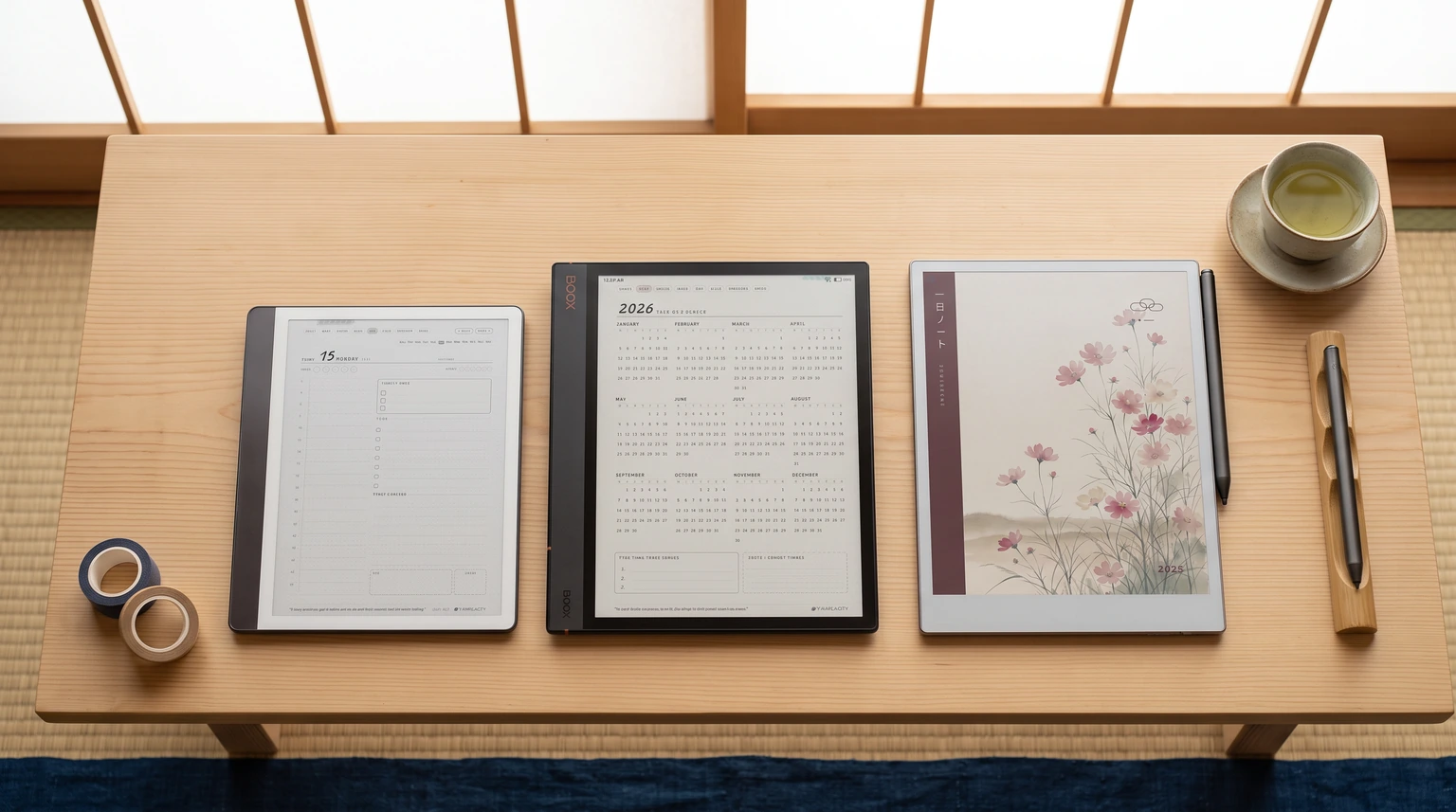
| A dated file on an e-ink tablet | Page per day as a hyperlinked PDF, on hardware you own | The file, on a tablet you already have | You resent re-buying the same book every autumn |
The KOKUYO Jibun Techo DAYs is the closest like-for-like on the list. It is a Japanese page-a-day book on thin paper, and KOKUYO sells it in A5 Slim at 217 by 136 mm for $70.80 and B6 Slim at 190 by 120 mm from $62.30 to $68.00. What separates it from the Original is the 24 hour timeline running down the centre of every day, so the page schedules time instead of leaving an open field. If your daily entries were mostly logs of when things happened, this is a better book than the one you have. The 2027 pre-order window ran from 7 August and shipping starts 4 September, so it is on the same clock as everything else here.
The Leuchtturm1917 Daily Planner is the answer for anyone who does not want to import anything. It gives a full page to each day of the week including Saturday and Sunday, runs to 464 numbered pages, and comes in three sizes: Master at 225 by 315 mm on 100 gsm paper, Medium at 145 by 210 mm and Pocket at 90 by 150 mm, both on 80 gsm. It starts at 25.50 EUR including VAT. The page count is the same 464 as the Original, which is a nice accident, and the hardcover is part of the book rather than a second purchase.
The Stalogy 018 Editor’s Series 365Days notebook takes the opposite approach: 368 pages with a grid, a row of dates and a row of hours printed faintly at the top, and no daily layout imposed on you at all. There is a half year version at 192 pages for anyone who wants to test the habit before committing to twelve months. It is a notebook that will hold a page-a-day practice rather than a planner that insists on one, which is the right trade for people whose complaint was that the printed boxes never matched how they write.
Staying inside the lineup deserves more consideration than the dupe lists give it. If the daily pages were the problem, Day-Free at ¥2,420 is a cheaper book than the Original and removes the exact thing that failed. If the A6 page was too small, the Cousin is the same idea with 544 pages of room. Neither is a workaround. They are the two books Hobonichi built for the readers who did not get on with the Original, and both cost less than the Jibun Techo. The wider category, and why every book in it is built on thin paper and an hourly timeline, is in our Japanese planner guide. If the choice is between the two page-a-day books rather than out of them, we worked Original against Cousin through on page area, the weekly spread and the cover you have to buy with each.
A dated file on a tablet is the fifth answer and the one no page-one result addresses, so it gets its own section further down. The short version: the layout is the easy part to copy, the annual purchase is the part that changes.
The gap
The part a dupe cannot copy
Two things about the Original survive every attempt to reproduce it cheaply, and they are what separates the hobonichi alternatives worth buying from the ones that only photograph well. The first is the paper. Hobonichi prints on Tomoe River, which is thin enough to fit 464 pages into a book you can hold in one hand and still takes fountain pen ink without the page giving up. Thin paper is the hard engineering problem in this category, and it is where a cheaper book usually reveals itself.
The second is that the book and the cover are sold apart on purpose. It reads as an upsell until you have replaced the book for a third year running and kept the same cover, at which point the ¥2,860 refill starts to look like the whole point. A dupe that copies the layout and not the paper is a different product wearing the same grid, and a dupe that copies both but has no cover to slot into is a notebook you will replace entirely next September.
A dupe that copies the layout and not the paper is a different product wearing the same grid.On what actually transfers
What does not survive the copy is worth naming too, because it cuts the other way. Nothing about the daily quotes, the specific cover art or the community around the book is load bearing for your year. Those are the reasons people stay, not the reasons the format works. The format works because a page has a date on it and the date arrives whether or not you are ready.
The file
What changes when the page a day is a file
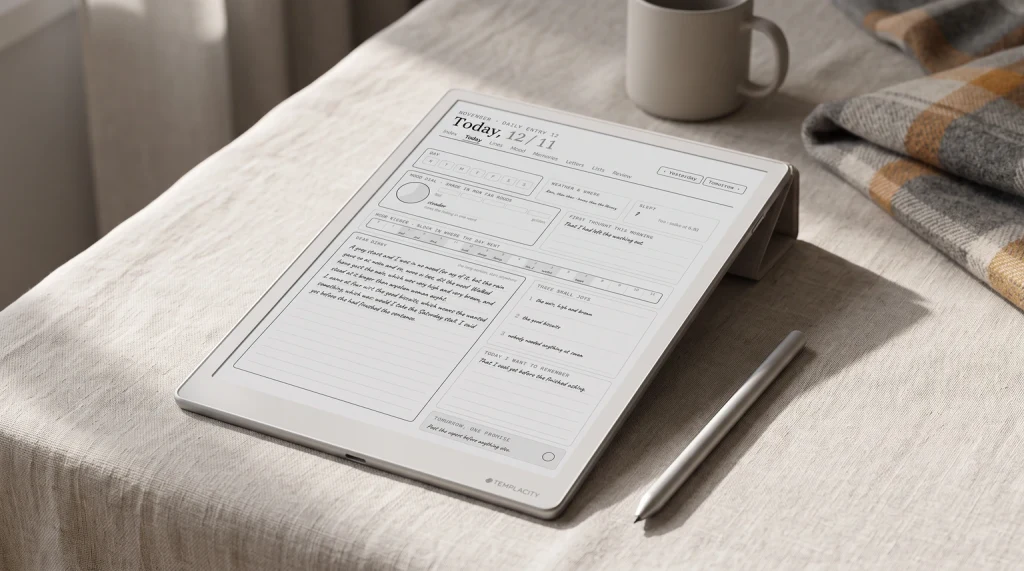
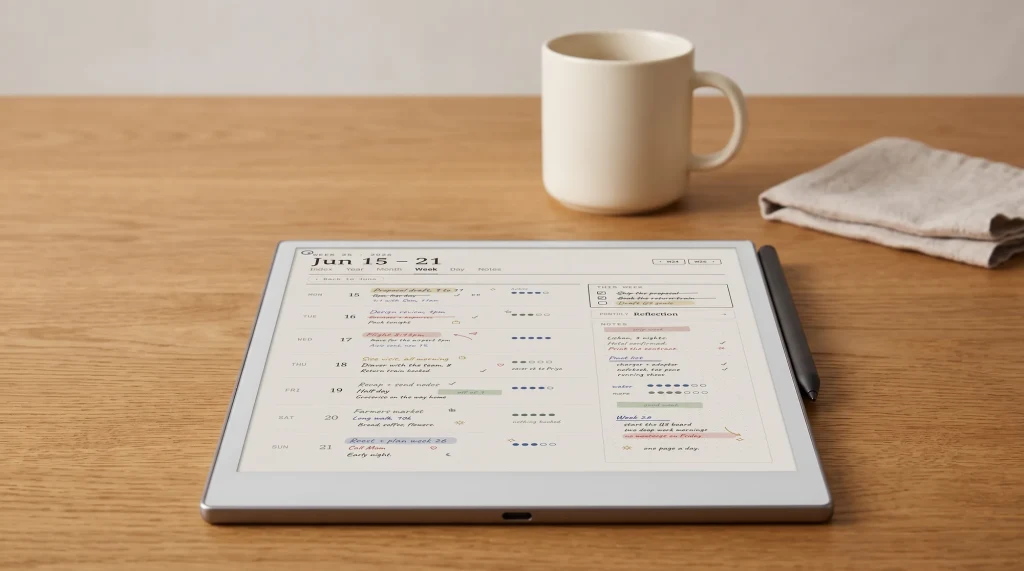
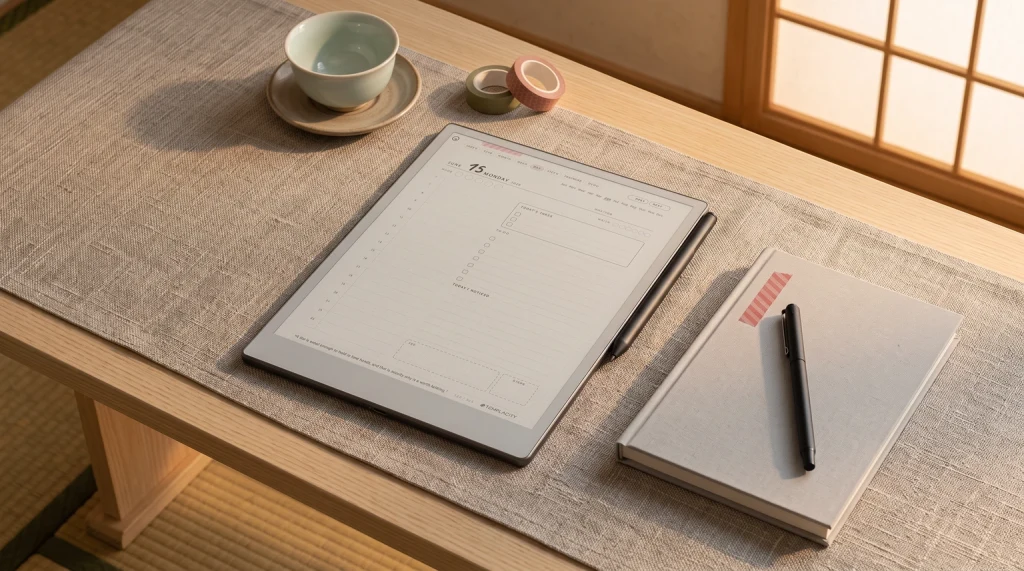
Put the same format on an e-ink tablet and three things change, two of them in your favour. Page count stops costing anything, so a book can carry a page for every day and a memo section that never runs out without getting thicker. Search arrives, which matters more than it sounds like it should once you are two years in and trying to remember which week something happened. And the pages are hyperlinked, so moving from a month to a day is a tap rather than a thumb through.
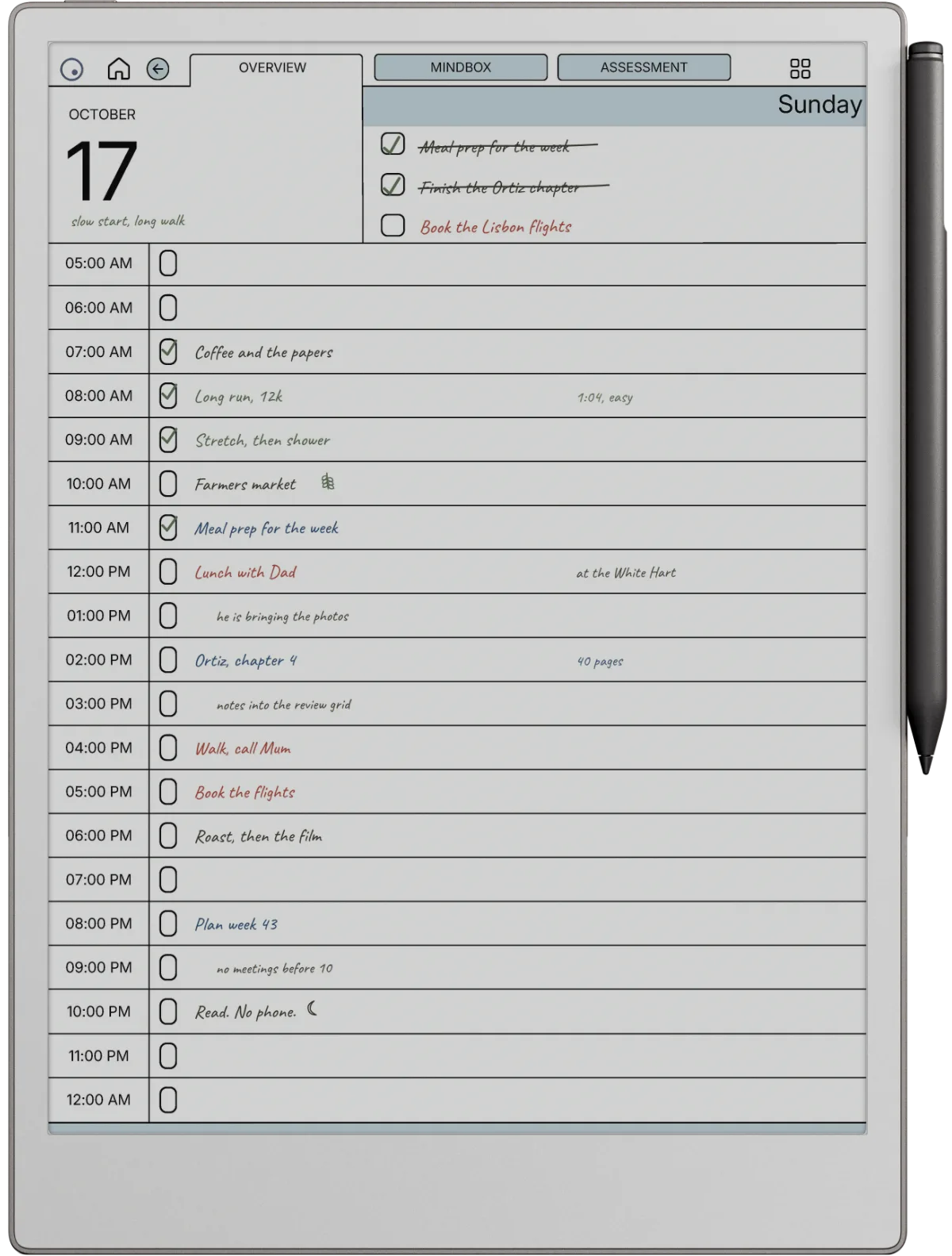
The thing that does not change is the expiry. A dated file runs out on 31 December exactly the way a printed book does, so anyone selling a digital planner as a purchase you make once is selling something else. What changes is what the annual purchase costs and how much of it is shipping. If you want the wider version of that argument, our digital planner guide works through the formats, and our roundup of the best digital planners for e-ink tablets covers which files actually behave on which hardware.
The honest trade goes the other way on feel. Writing on glass-free e-ink is closer to paper than any screen has a right to be and is still not paper, and no file reproduces what Tomoe River does under a wet nib. We publish one ourselves. Ichinichi is a 466 page dated book with a page for every day, drawn separately for the reMarkable Paper Pro, the Kindle Scribe, the Boox Note Air 4C and the Paper Pro Move, in six languages. If you want the same one-day-one-page idea in a smaller book, our daily planner layout for Kindle Scribe is the nearest thing.
Choosing
Which one to buy, by what went wrong last year
Every list of hobonichi alternatives stalls at the same place, which is that all five books are good and the differences only matter against your own failure. So sort by the failure. If you stopped writing in March, buy Day-Free or Weeks and stop paying for pages you do not fill. If the A6 page ran out of room by lunchtime, the Cousin or the Leuchtturm Master are the two with space. If your entries were mostly times, the Jibun Techo DAYs schedules the day for you. If the printed layout was the irritant, the Stalogy hands you a grid and gets out of the way. And if what you actually resent is buying the same object every autumn, the answer is not another book.
One caution on timing, since 2027 is the year in question and it is not a leap year, so every dated book on this page carries 365 daily pages rather than 366. The books go on sale within a fortnight of each other and the popular covers do sell out, but the paper stock behind them does not vanish. Buying in a hurry on 1 September is how people end up with their fourth unused daily planner.
FAQ
Common questions, answered briefly
What is the closest thing to a Hobonichi Techo?
Is there a cheaper alternative to the Hobonichi Techo?
When does the Hobonichi 2027 lineup go on sale?
Is there a digital version of the page-a-day format?
Most lists of hobonichi alternatives end at the buy button. If you have switched away from a daily book and it stuck, tell us which one and what month you would have quit the old one. The failed years are easy to find in any planner thread; the switches that held are the interesting cases.
People also ask