What it is
What the Viwoods AiPaper Reader is
The name suggests a smaller AiPaper, so it is easy to assume a pen comes with it. It does not. The Viwoods AiPaper Reader is a reading device and nothing else: a 6.13-inch E Ink screen in a body the size of a phone, running Android 16, with a SIM slot for 4G data and a dedicated AI key. Viwoods’ own FAQ is plain about it: neither the Reader nor the Reader C includes or supports a stylus, so handwriting is off the table. Viwoods launched the Reader on 10 November 2025 and the colour Reader C on 4 December 2025, and both are sold on its own US store.
There is one configuration of the mono Reader, and the product page lists a USB-C cable and a dark grey protective case as included, at a regular price of $279. When we checked on 17 November 2026, a Black Friday sale had it at $199, and the Reader C, which Viwoods sells as the AiPaper Reader Colour, at $289 against a regular $349. A sale is a sale, so every comparison in this review uses the regular prices. Viwoods takes returns within 60 days and the warranty runs 14 months. Every Viwoods spec below comes from Viwoods’ own pages, read that day; where Viwoods publishes nothing, we say so rather than borrow a figure from a forum.
Specs
Viwoods AiPaper Reader and Reader C specs
Viwoods publishes a full spec sheet for each Reader on its Specification and Compare page, and the two models share almost everything: the same 159.39 x 80.27 mm body, the same chip, memory, battery and software. The differences are the screen, the light and two grams.
| Spec | AiPaper Reader | AiPaper Reader C |
|---|---|---|
| Screen | 6.13-inch Carta 1300, mono | 6.13-inch Kaleido 3, colour |
| Sharpness | 300 ppi | 150 ppi colour, 300 ppi mono |
| Front light | Cool only | Warm and cool |
| Body | 138 g, 6.7 mm | 140 g, 6.7 mm |
| Chip and memory | 6 nm octa-core, 4 GB + 128 GB | 6 nm octa-core, 4 GB + 128 GB |
| Battery | 2,580 mAh | 2,580 mAh |
| Software | Android 16 | Android 16 |
| Connectivity | 4G, Wi-Fi 2.4 and 5 GHz, Bluetooth 5.0 | 4G, Wi-Fi 2.4 and 5 GHz, Bluetooth 5.0 |
| Pen | Not supported | Not supported |
| US price | $279 | $349 |
Both sheets list the same files: PDF, EPUB, EPUB3, MOBI and AZW3 for books and documents, and PNG, JPG, BMP and TIFF for images. Both have a G-sensor, and the FAQ says the Reader series supports system-wide screen rotation, which the AiPaper writing tablets cannot do without a third-party app. The launch post adds that the Carta 1300 sits under anti-reflective glass, and Viwoods’ product page describes an aluminium frame.
Reader or Reader C
Reader or Reader C: the screen and the light decide
Choosing between the two Viwoods Readers comes down to what you read and when you read it. The mono Reader’s Carta 1300 panel is the sharper page for text: 300 ppi, and in Viwoods’ own words in the FAQ, “sharper text and a whiter-looking screen”. The Reader C’s Kaleido 3 panel shows colour at 150 ppi, and Viwoods says it runs at 300 ppi when you switch it to black-and-white mode, which the Reader C’s manual describes as a one-tap change. On Viwoods’ compare page the trade-off has a name: with the light off, the Reader’s screen is rated “brighter” and the Reader C’s “darker”.
The light is the second difference, and for some readers the bigger one. The mono Reader has a cool-toned front light only; its product page describes it as “designed to mimic daylight”, and there is no warm setting. The Reader C has warm and cool front lights that its manual says adjust independently, so you can warm the page up at night. If you mostly read in bed with the light on, that is a reason to look at the Reader C, or at a rival with a warm light, before the mono Reader.
Everything else is a wash. The Reader C weighs 140 g against 138 g, has the same body, chip, battery, storage and Android 16, and costs $70 more at regular prices. Viwoods pitches it at comics, graphic novels and charts, which is where colour earns its keep; for novels and long articles, the mono Reader is the better page for less money. One practical note on stock: on 17 November the Reader C’s product page read “back in stock” for US orders only, as a pre-order that Viwoods expected to ship in late November, with an extra $10 off at checkout for Black Friday.
Software
Android 16, 4G and the AI key on the AiPaper Reader
Android 16 is the part that makes the AiPaper Reader more than a small Kindle. You can install the reading apps you already use, from Viwoods’ own App Market or from Google Play, and the Play Store needs one extra step: Google services are off by default, and the FAQ’s route to turn them on is Settings, then Play Store, then Google Service, followed by Google’s own authorization prompts. Viwoods’ Learning app handles books and documents on its own, and the Reader’s English manual lists PDF, EPUB, MOBI, AZW, PNG and JPG as formats it imports. Files arrive over a local Wi-Fi transfer page in your computer’s browser, through Viwoods’ file transfer station once you log in, or by Bluetooth.
The 4G is what the AiPaper and the Mini do not have. The FAQ says the Reader series takes a physical SIM card and uses 4G mobile data for online reading, AI questions, cloud access, browsing and apps, and that with a SIM inside and Bluetooth headphones connected it can make and receive calls. A phone hotspot works instead if you would rather not pay for a second line. None of the Viwoods pages we read lists the 4G bands or names US carriers, so check that your carrier will activate the SIM before you count on it.
The AI key is what Viwoods leads with. A short press opens a text box; a long press, per the manual, records up to 60 seconds of voice and sends it when you let go. Answers appear beside the passage you are reading, and you can save them with the excerpt to a built-in Knowledge Base. The Reader’s spec sheet names ChatGPT, Gemini and DeepSeek models, and the product page says there is no subscription fee and that your data does not pass through Viwoods’ servers; those are Viwoods’ claims, and the FAQ adds that every AI feature needs an internet connection. If you have no use for AI, the key is simply a button you leave alone.
What is missing
What the AiPaper Reader leaves out
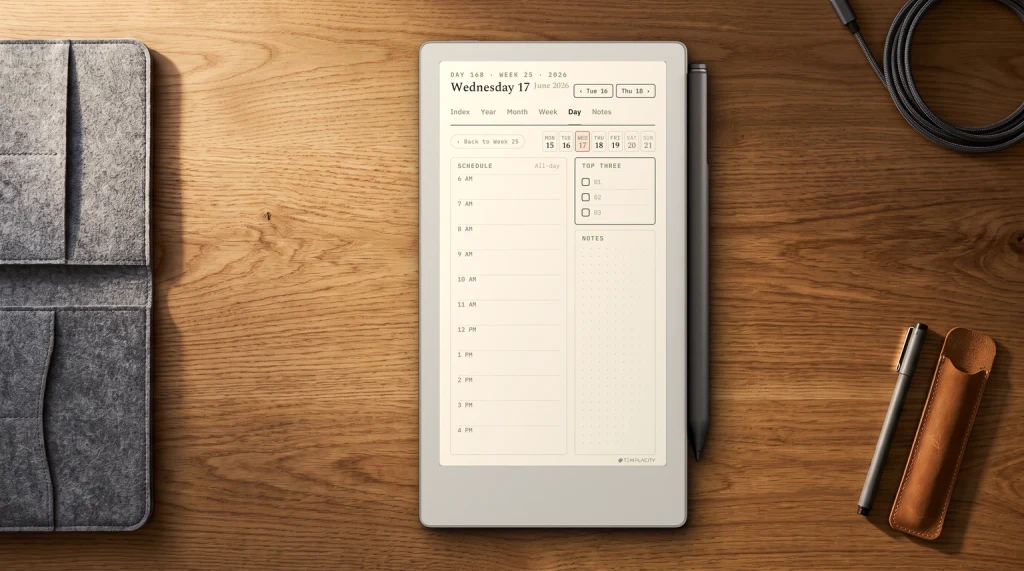
The missing pen matters most to the people who read our site, because it changes what a PDF planner is on this device. A planner opens in Learning and you can turn its pages, but you cannot write on it. You can long-press text to highlight it, add an AI query or a dictionary lookup, and export your highlights as PDF or TXT, which suits study reading well. Daily planning does not fit. If writing on the page is part of the plan, the Viwoods AiPaper Mini is the small Viwoods with a pen and a light.
A planner opens in Learning and you can turn its pages, but you cannot write on it.What the AiPaper Reader leaves out
Three hardware gaps are worth knowing before you order. There is no speaker: the FAQ says the AiPaper and Reader series have no built-in speakers, so audiobooks go to Bluetooth headphones or to wired ones on the USB-C port, which the manual lists for charging, headphones and accessories. There is no memory card slot on the spec sheet, so 128 GB is what you get. And the 2,580 mAh battery is small next to the Palma line’s 3,950 mAh, with no battery life published for the Reader on its own. The FAQ’s only figure is a general one for “the Viwoods device”, up to a week of daily use at two hours a day or four weeks on standby, and it does not say which device or whether 4G was on.
The buttons, at least, are generous. The manual shows a power button, a fingerprint sensor, volume keys that double as page-turn buttons, the AI key and the SIM slot, so you can turn pages without touching the screen.
The Viwoods range
How the Reader differs from the AiPaper and AiPaper Mini
Viwoods now sells two writing tablets and two readers, and the split is clean: the tablets have pens, the readers have 4G. Prices below are Viwoods’ regular US prices on 17 November 2026; all four were on sale that day.
| Model | Screen | Pen and light | Price |
|---|---|---|---|
| AiPaper | 10.65-inch mono | Pen in the box, no light | $549 |
| AiPaper Mini | 8.2-inch mono | Pen in the box, front light | $429 |
| AiPaper Reader | 6.13-inch mono | No pen, cool light | $279 |
| AiPaper Reader C | 6.13-inch colour | No pen, warm and cool light | $349 |
The two families also sit on different software. The AiPaper and the Mini run Android 13, according to Viwoods’ AiPaper and Mini compare page, and they are built around Viwoods’ notebook apps; the Readers run Android 16 and are built around reading and the AI key. The full-size AiPaper has no front light at all, which makes the Readers and the Mini the only lit Viwoods devices. Our Viwoods AiPaper review covers the flagship, and Viwoods vs reMarkable sets both writing tablets against reMarkable’s. If you want both writing and pocket reading, Viwoods’ answer is two devices, not one.
The rivals
Viwoods AiPaper Reader vs Boox Palma 3 and Palma 2 Pro
The obvious comparison is Boox’s Palma line: the Viwoods AiPaper Reader is built to the same 6.13-inch, 824 x 1648 screen as the Palma 3 and the colour Palma 2 Pro. Boox prices below are from its US store listing on 17 November 2026, both in stock.
| Spec | AiPaper Reader | Boox Palma 3 | Palma 2 Pro |
|---|---|---|---|
| Screen | Mono, 300 ppi | Mono, 300 ppi | Colour, 150 ppi |
| Front light | Cool only | Warm and cold | Warm and cold |
| Pen | Not supported | Optional InkSense Plus | Optional InkSense Plus |
| Mobile data | 4G SIM | Wi-Fi only | Data SIM, up to 5G |
| Speaker and card | No speaker, no card slot listed | Speaker, microSD | Speaker, hybrid slot |
| Software | Android 16 | Android 16 | Android 15 |
| Battery | 2,580 mAh | 3,950 mAh | 3,950 mAh |
| Body | 138 g, 6.7 mm | 185 g, 7.8 mm | 175 g, 8.8 mm |
| US price | $279 | $339.99 | $399.99 |
Against the Palma 3, the Reader wins on what you feel in a pocket and pay at the till: 47 g lighter, 1.1 mm thinner and about $61 cheaper, with 4G the Palma 3 does not have. The Palma 3 wins on almost everything else. It has a warm and cold front light, a built-in speaker for audiobooks, a microSD slot, 6 GB of memory against 4, a battery half as big again, and support for Boox’s InkSense Plus pen, sold separately or as a $372.99 bundle. If you want to jot a note on your reader now and then, that settles it.
- Viwoods AiPaper Mini, 8.2" screen: 4.9 x 6.6 in (12.5 x 16.7 cm)
- Viwoods AiPaper Reader, 6.13" screen: 2.7 x 5.5 in (7 x 13.9 cm)
- Boox Palma 3, 6.13" screen: 2.7 x 5.5 in (7 x 13.9 cm)
- Boox Palma 2 Pro, 6.13" screen: 2.7 x 5.5 in (7 x 13.9 cm)
Screen area only, drawn to scale from each maker’s stated diagonal and pixel count (or aspect ratio where no pixel count is published). Bodies and bezels are larger. Dashed outlines: A5 5.8 x 8.3 in (14.8 x 21 cm), US Letter 8.5 x 11 in (21.6 x 27.9 cm).
The colour pair splits the same way. The Reader C, at $349 and 140 g, is $50.99 cheaper than the Palma 2 Pro, 35 g lighter, 2.1 mm thinner, and a version of Android newer. The Palma 2 Pro has twice the memory at 8 GB, a speaker, a hybrid slot that takes two SIMs or one SIM and a microSD card, data up to 5G, and the same optional pen. Both have warm and cold light and both show colour at 150 ppi. Our Boox Palma buying guide covers the whole Boox line, and the Palma 2 Pro review covers the colour model in depth.
If you would rather have a plain e-reader than an Android one, our guide to the best small e-reader covers the Kindle and Kobo side, and the e-ink tablet comparison chart lines up every current model from the makers’ own pages.
Verdict
Verdict on the Viwoods AiPaper Reader
Put the published numbers side by side and the Reader lands in a narrow, real spot: lighter than either Palma, with its own mobile data, at a lower price than the Palma it will be compared with. What it gives up is everything that is not reading, and a warm light.
What the spec sheet gets right
- 138 g and 6.7 mm, lighter and thinner than either Palma.
- A 4G SIM slot, so books, apps and the AI key work away from Wi-Fi.
- Android 16 with Google Play once enabled, and 128 GB on board.
- Physical page-turn buttons and a case in the box at $279.
What gives us pause
- No pen, ever: planners open but cannot be written on.
- A cool-only light on the mono model.
- No speaker, no memory card slot listed, and a 2,580 mAh battery with no published life.
- No 4G band or US carrier list on Viwoods’ pages.
If you own a Viwoods Reader, you know what no spec sheet covers yet: how long the battery lasts with 4G on, which reading apps behave best, whether your carrier took the SIM. Tell us in the comments, or tell us which pocket reader you chose instead and why. We fold what readers report back into this review, and the rest of our e-ink coverage lives on the reMarkable hub.
FAQ
Common questions, answered briefly
Does the Viwoods AiPaper Reader support a stylus?
Does the Viwoods AiPaper Reader have a warm light?
How much does the Viwoods AiPaper Reader cost?
Does the Viwoods AiPaper Reader have 4G?
Does the Viwoods AiPaper Reader have Google Play?
Viwoods AiPaper Reader or Boox Palma 3?
If yours isn’t above, drop the question in the comments and we’ll add it.
People also ask