The job
What a homeschool schedule has to hold
Search for a homeschool schedule and most of what comes back is one family’s day, timed to the quarter hour: breakfast at 7:30, morning time at 9:00, math at 10:00. Those pages are generous and often lovely, and they are hard to copy, because the family that wrote them has different children, a different curriculum and a different Tuesday.
What transfers is the shape underneath. A homeschool schedule has three jobs: to say which subjects happen this week, to say what order they happen in on a given day, and to tell you what to do when a day is lost. Notice what is missing from that list. Clock times help some families, but they are optional, and they are the first thing a sick child, a long phone call or a good conversation will break.
So the useful question is not “what time should math start” but “which kind of schedule fits the way our weeks actually go”. The answer decides everything else, including what you print.
Samples
Four homeschool schedule shapes, with sample weeks
Every sample homeschool schedule we have read is one of four shapes, or a blend. They differ in one thing: what happens to the work when a day goes wrong.
| Shape | How it works | When a day is lost | Suits |
|---|---|---|---|
| Fixed days (block) | Each subject has set days, like a school timetable | That day’s lessons are skipped or squeezed in later | Families with co-op, sport or lessons on fixed days |
| Loop | Subjects in a list, worked through in order whatever the day | Nothing is skipped; the loop resumes where it stopped | Interrupted weeks and subjects that need not be daily |
| Weekly checklist | A list of what must be done by Friday; order and day are free | The work moves to any other day that week | Older, independent children |
| Daily rhythm | The day runs in a fixed order of blocks, without clock times | The day shortens; the order stays | Young children and families who dislike the clock |
Fixed days. Math, reading and writing every weekday; history on Monday and Wednesday; science on Tuesday and Thursday; art and music on Friday, with the afternoon kept for the library. It is the easiest homeschool weekly schedule to explain to a child and the easiest to check at a glance. Its weakness is the lost day: miss a Tuesday and science waits a week.
A loop. Keep math and reading daily, then list the rest in order: history, science, art, history, science, music, nature study. Each day you take the next two or three from the list. Lose a day to the dentist and Wednesday simply picks up where Monday stopped. A loop schedule is how many homeschool families keep subjects that matter but do not need to be daily, such as poetry, a composer study or a handicraft.
A weekly checklist. Five math lessons, three writing assignments, two science chapters, one book report: done by Friday, in any order the child chooses. It builds responsibility and suits a teenager with outside classes. It needs a Wednesday check, or the whole list lands on Thursday night.
A daily rhythm. Breakfast and chores, then a shared morning time, then the core lessons, then lunch and a quiet hour, then outside time or projects. No clock times, only an order. It is gentle on young children and on parents who stop reading a schedule the moment it shows 9:15. Families who follow Charlotte Mason’s approach often pair a rhythm with her preference for short lessons and focused attention.
Most families end up with a blend: the daily subjects on fixed days, everything else on a short loop, and the whole day held in a rhythm rather than to the clock. If you are not sure where to start, that blend is a safe first homeschool schedule.
Daily
A sample homeschool daily schedule
Here is one homeschool daily schedule built on that blend, written as blocks rather than times. The order matters more than the length of any block, and each block has a reason for sitting where it does.
- Breakfast and chores. A predictable start, and the house is tidy before the books come out.
- Morning time, together. Read-aloud, a poem, memory work, the loop subject of the day. Everyone at one table, all ages at once.
- Math, while minds are fresh. The subject that needs the most focus goes first after the shared block.
- Language arts. Reading, writing and spelling at each child’s level.
- Lunch and a quiet hour. Rest for the youngest, independent reading for the rest, and a pause for the parent.
- Afternoon: projects, outside time or errands. Science experiments, art, nature walks, the library. This is the block that absorbs whatever the morning could not finish.
The afternoon is the spare. When the morning runs long, the afternoon shrinks, and nothing in the core lessons is lost. That one design choice is what keeps a daily schedule from collapsing by October.
How many hours this takes depends on the ages of your children and on where you live. Homeschooling is legal in every US state, and each state sets its own rules, so check your own state’s requirements rather than any schedule’s printed number. We deliberately print none on our pages.
Children
Scheduling more than one child
A schedule for one child is a list. A schedule for three is a problem of one adult being needed in three places, and that is the part sample schedules rarely show.
The fix is to sort the day’s work into three kinds. Together work is everything all ages can do at once: morning time, history, science, art, read-aloud. Taught work needs you beside one child: early reading, new math concepts, a writing conference. Independent work a child can do alone: copywork, practice pages, reading, a math worksheet already explained.
The more children you teach, the more of the week should be together work.
Then stagger. While you teach the youngest to read, the middle child does independent math and the oldest works through a checklist. Twenty minutes later, rotate. Put the together work first, so every child starts the day with you, and give each child one taught slot that is theirs alone. On a weekly grid, that means one row per subject per child, side by side, so a clash is visible on Sunday instead of on Tuesday morning.
The more children you teach, the more of the week should be together work. A family of four that combines history, science and art for everyone has three fewer subjects to schedule four times over.
Build
How to build your homeschool schedule in an afternoon
One sitting, in this order, gets a first homeschool schedule onto paper. It borrows the order Simply Charlotte Mason teaches in its weekly schedule guide, outside commitments first, then daily subjects, then the variety subjects, and adds the loop and the spare.
- Write in the fixed commitments first: co-op, lessons, sport, appointments, the library day. They are the walls the rest of the week fits inside.
- Place the daily subjects on every remaining school day, usually math and reading, and decide their order in the day.
- Mark the together subjects that all children share, and give them the first block.
- Put the rest on a loop and write the loop as a numbered list you can tick.
- Leave one block a day empty. It is not wasted time; it is where the week recovers.
- Run it for two weeks before changing anything, then change one thing at a time.
If the schedule still fights you after a month, the mismatch is almost always the shape, not the effort. A family on fixed days that keeps losing Tuesdays wants a loop; a family on a loop whose oldest drifts wants a checklist.
Template
Free homeschool schedule template: weekly and daily
Our free homeschool schedule template is two pages, and it works for any of the four shapes because it prints no subjects and no times.
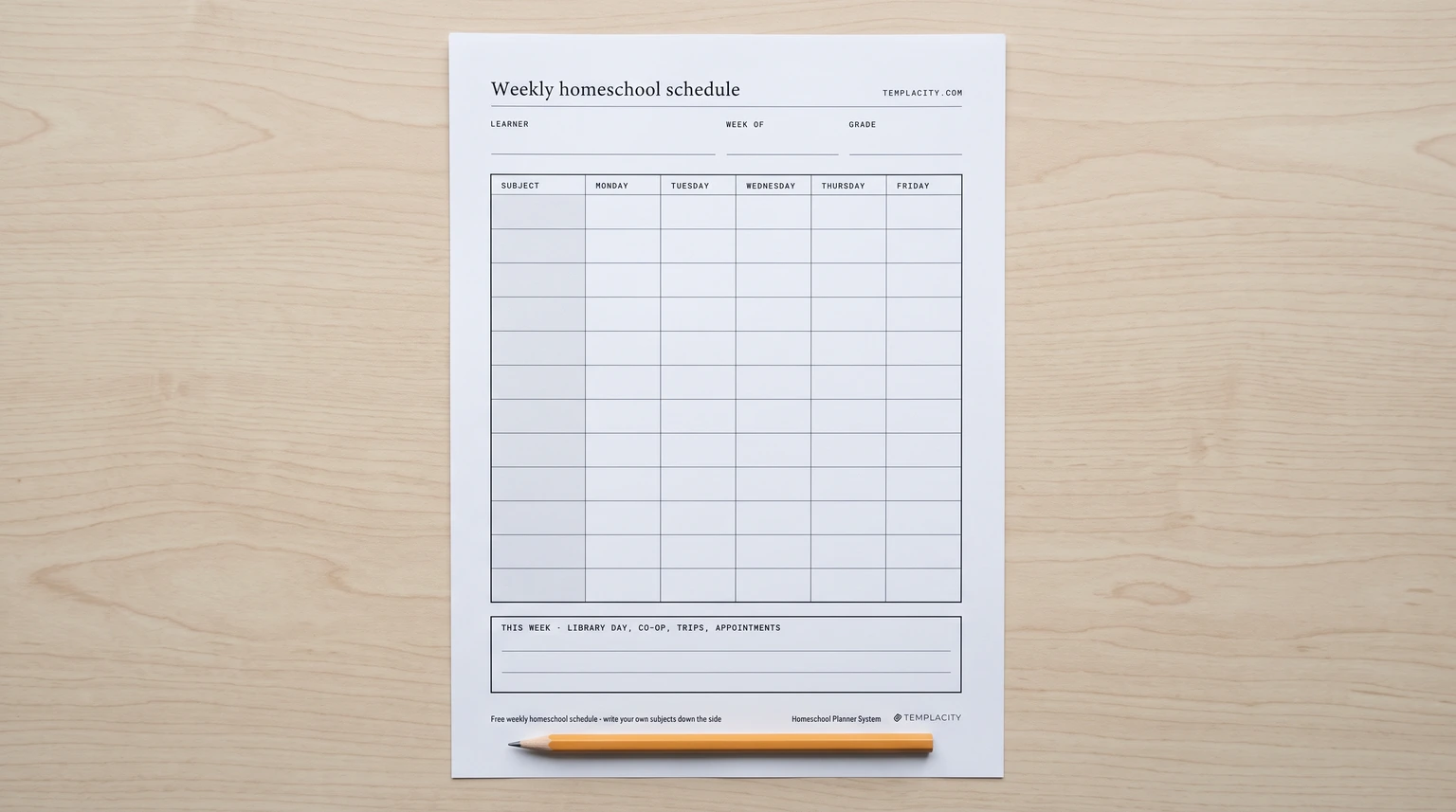
The weekly page has a line for the learner, the week and the grade, then a grid with a subject column down the side and Monday to Friday across, twelve rows deep. Below it, a “this week” box holds the library day, co-op, trips and appointments. Write your subjects down the side once, and the grid works as fixed days or as a loop: on a loop, write the subject in the day you actually did it.
The daily page has fourteen rows with a time, a subject, what needs to be done and a done box, and a notes box at the foot for what to carry into tomorrow. The time column is there if you want it and blank if you do not, so the same page holds a rhythm or a clock.
Download the homeschool schedule PDF on US Letter or on A4, or the weekly page as a Word file if you would rather type your subjects in before printing. Print one daily page per child per day, or one weekly page per child per week. Our homeschool planner printable guide covers which other pages are worth printing alongside it.
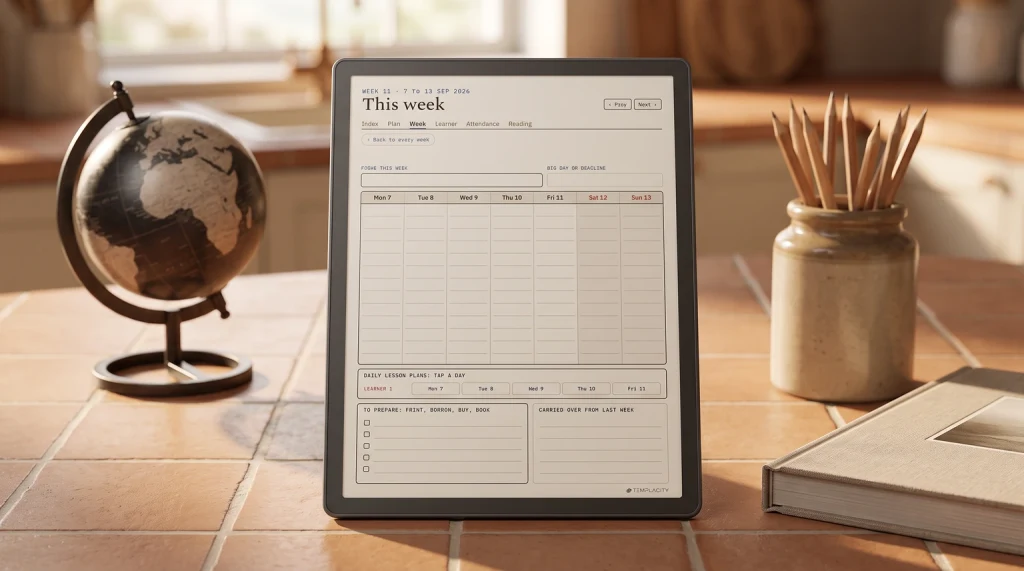
When loose pages stop being enough, there are two dated options. Our Printable Homeschool Planner ($29) prints two school years, 2026-27 and 2027-28, with dated lesson weeks and attendance with hours for up to five students, on Letter, A4 or A5. If your family plans on an e-ink tablet, our Homeschool Planner System (from $49) is the digital version for one to four children, with a family week that opens a daily lesson plan for each child, and a loop schedule page built in.
Still choosing between a printed book, an app and a tablet? Our homeschool planner guide compares them by family size and by the shape of your week. More guides collect under homeschool.
Does your family run on fixed days, a loop or a rhythm, and what broke the first schedule you tried? Tell us in the comments; the answers shape the next pages we draw.
FAQ
Common questions, answered briefly
What is a good homeschool schedule?
What is a loop schedule in homeschooling?
How do you make a homeschool schedule for multiple kids?
How many hours a day should homeschool take?
Is there a free homeschool schedule template?
If yours isn’t above, drop the question in the comments and we’ll add it.
People also ask