The point of it
What an open house sign in sheet is actually for
Ask ten agents what an open house sign in sheet is for and most will say security, or a record for the seller. Both are true and neither is the reason it earns a place on the console table. The sheet exists so that on Monday morning you know which four people to call, in what order, and what to say when they pick up. Every field either serves that or it is decoration.
This is why so many sheets underperform. The common template asks for a name, an email address, and a phone number, which is exactly the information you need to contact someone and none of the information you need to decide whether contacting them is worth the hour. Forty names collected on a Sunday afternoon with nothing to sort them by is not forty leads. It is a list.
The second failure is quieter. A sheet that asks too much gets filled in badly or not at all. People are standing up, holding a flyer, and half looking at the living room. Anything that reads like a form gets a squiggle in the email field and a phone number with nine digits. So the design problem is genuinely narrow: the smallest number of fields that still lets you rank the list, written large enough to be filled standing up.
The seven fields
The fields that earn their place on an open house sign in sheet
Seven columns cover it. Three identify the person, three sort them, and one decides how you make contact. Anything beyond these belongs in your notes after they leave, not on the clipboard while they are standing there.
| Field | What it decides |
|---|---|
| Name | How you open the call. Nothing else. |
| Phone | Whether you can reach them at all. The single field worth chasing if it is illegible. |
| The follow-up that does not interrupt. Slower, and far more likely to be answered. | |
| Working with an agent | Which conversation you are allowed to have next. See the section below. |
| Financing | Pre-approved, not yet, or cash. Sorts the list faster than any other answer. |
| Interest in this home | Yes, maybe, or just looking. Separates a buyer from a neighbour. |
| Best way to follow up | Call, text, or email. The difference between a reply and a blocked number. |
Financing and interest are the two that turn a list into a queue. A visitor who is pre-approved and says yes to this house is a call on Monday at nine. A visitor who is not yet financed and says maybe is a call in three weeks, and a note in your calendar rather than a name you feel vaguely guilty about. Neighbours who came to see the kitchen are neither, and knowing that saves you the hour.
The field nobody prints
Why “are you working with an agent” is the field that matters most
Most free sheets leave this one off, and it is the field that changes what you are permitted to do, not just what you would prefer to do. Since the National Association of REALTORS practice changes took effect on 17 August 2024, an MLS Participant working with a buyer needs a written agreement in place before touring a home with them. Open houses sit in a specific carve-out: NAR’s settlement FAQ addresses hosting an open house on behalf of the seller only, and an agreement is not required with an unrepresented buyer who tours the property in that situation.
Read practically rather than legally, that means the answer in this column tells you which of two very different Mondays you are looking at. A visitor who already has an agent is somebody you pass along, politely and quickly. A visitor who does not is somebody you can talk to about representation, and the paperwork that conversation needs is a conversation of its own. Getting that wrong in either direction costs you time or goodwill, and the sheet is the only place you will remember which was which.
Forty names collected on a Sunday afternoon with nothing to sort them by is not forty leads. It is a list.
Two caveats worth stating plainly. Rules vary by state and by brokerage, and yours may be stricter than the national picture, so treat this as the reason the column exists rather than as advice about your own transactions. And a tick in a box is not a verified fact: people say no because they think saying yes means being sold to. The column tells you which conversation to open, not which one to close.
Paper or a tablet
Paper or a tablet, and what the free apps are really selling
The digital sign-in apps are genuinely good at two things paper cannot do. They deduplicate a repeat visitor across three of your listings, and they export straight into whatever you use to follow up, which removes the transcription step where most sheets go to die. If you run open houses every weekend, that matters.
What is worth knowing before you commit is where the free tier ends. Open House App, which sits at the top of the search results for this exact term, offers unlimited free sign-ins with no card required, and then charges $29 a month for its Pro tier or $19 a month billed annually, and $79 a month for Elite or $59 billed annually (checked September 2026). The upsell is virtual staging and neighbourhood insights rather than the sheet itself. The sign-in is free because the sign-in is the door.
That is not a criticism, it is a pricing model, and for a busy agent the paid tiers may well be worth it. But it is the reason a printed sheet keeps its place in the bag. Paper works when the WiFi in an empty house does not, it never asks a visitor to hand over a phone or accept an app, and an older visitor will fill in a paper line without hesitating in a way they will not with a tablet. Most agents who run open houses regularly end up carrying both, and using the paper one when the house is busy.
Monday morning
What to do with the sheet before Tuesday
The sheet is not the work. Almost every open house sign in sheet that fails does so after the open house, sitting in a folder while the weekend’s momentum drains out of it. Two habits fix it, and neither takes long.
The first is to write your own note in the margin before you leave the house, while you still remember which name goes with which face. Two words is enough. The second is to transcribe the sheet the same evening, sorted rather than in the order people arrived: pre-approved and interested at the top, everyone else underneath, neighbours at the bottom. A simple sheet is more than enough for this, and the sorting is the entire value. You are not building a database, you are building a call order.
Then call the top of the list on Monday and email the middle. The people at the bottom get nothing, which is the part most agents find hardest and which protects the hours that make the top of the list worth having.
On the clipboard
Laying it out so it survives a busy hour
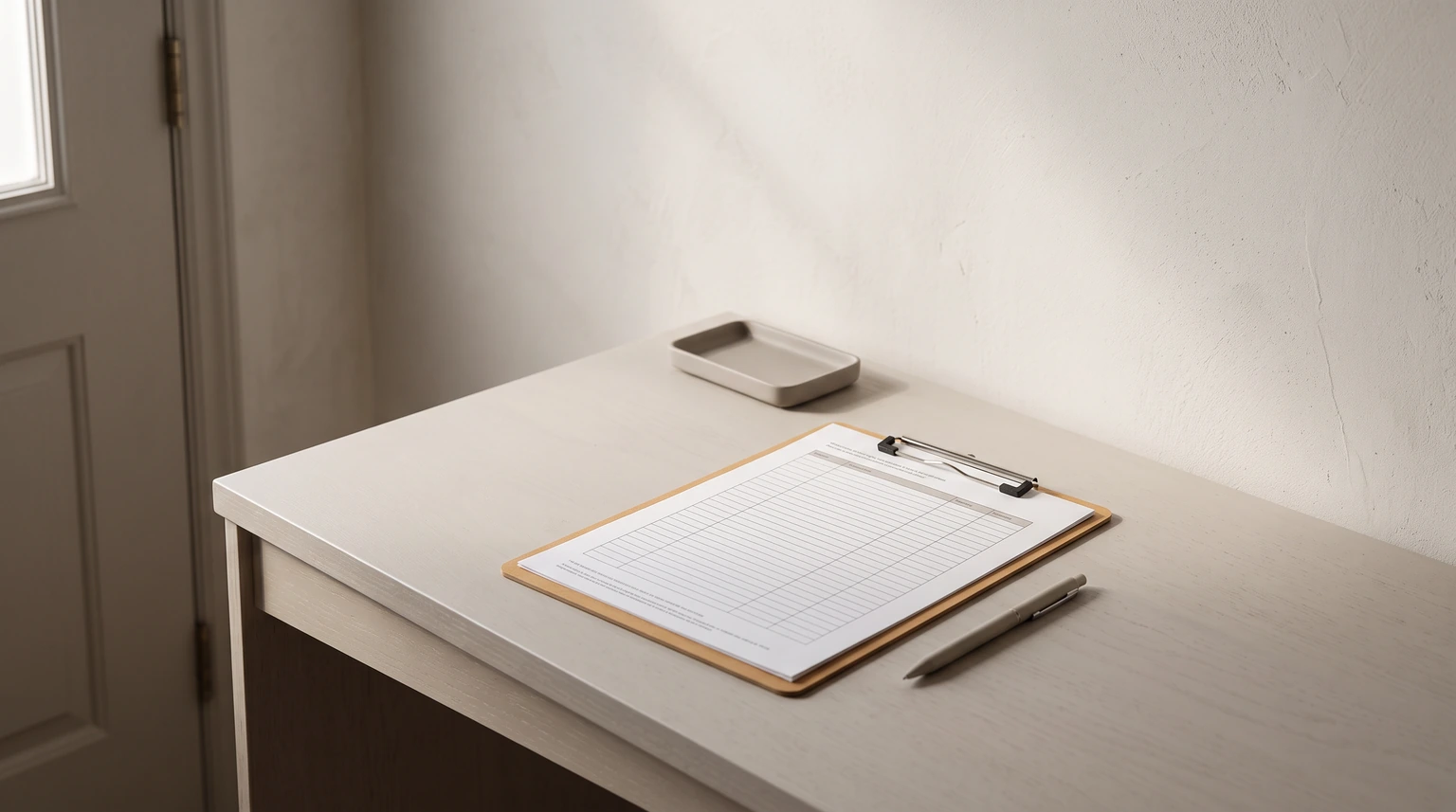
Layout decides whether the fields above get answered honestly or scribbled over. Print two versions and take both. A twelve-row page for a listing you expect to be busy, and a six-row page with deeper rows for a quiet one, where people will write more if there is room to.
Make the three sorting fields tick boxes rather than blank space. Nobody standing in a hallway writes “pre-approved” longhand, but everybody ticks a box. Keep the rows at least a centimetre deep, because handwriting on a clipboard is larger than handwriting at a desk. Put the property address and the date at the top, printed, not written, so the sheet is still identifiable in a folder four listings later. And leave a narrow unlabelled column on the right for your own note, which is the one column your visitors should never be invited to fill in.
Letter and A4 both work, and the only thing that matters is that it fits your clipboard without folding, since a folded sheet loses its right-hand column first. If you keep printable operating documents for other property work, the same discipline applies: our notes on building a printable property checklist cover the same argument about tick boxes and row depth.
We are building out the real estate hub from here, and the sign-in sheet is deliberately the first thing in it. If you run open houses, tell us in the comments which column you would cut and which one you have added yourself, because the seven above are a starting point and the useful eighth is usually specific to a market.
FAQ
Common questions, answered briefly
What should an open house sign in sheet include?
Do visitors have to sign in at an open house?
Does a buyer need an agreement to attend an open house?
Is a paper sign-in sheet better than an app?
People also ask