The change
What happened to the Airbnb security deposit
If you are looking for how to set an Airbnb security deposit on your listing, the honest answer is that for most hosts the setting is not there to find. Airbnb’s help page on the subject opens by saying that “most hosts are not allowed to charge security deposits, either through our Resolution Center or outside the Airbnb platform”. That is the whole of it, and a good deal of the advice still circulating was written before it was true.
This trips up guests in the other direction. A guest who has rented through other platforms arrives expecting a hold on their card, watches for it, and does not see one. Nothing has gone wrong. On most Airbnb bookings there is no deposit to place, and the money that would have been held is simply not held.
What matters for a host is that removing the deposit did not remove the exposure. It moved it. The recovery now happens after the fact rather than before it, which changes what you need to have in your hands on the day.
The exception
Who can still charge one, and how it has to be shown
The rule has edges. Airbnb notes that “some hosts, including select software-connected hosts, may collect a security deposit off of the Airbnb platform”, and that where deposits are permitted “they must be shown in the appropriate fee field so that it’s properly disclosed to guests”. Hotels are handled separately again: they may ask for a credit card at check-in to cover incidentals or a deposit, and that has to be disclosed in the listing.
Two things follow. If you are an ordinary host running one or two listings from the Airbnb app, you are not in the exception, and inventing a deposit by asking for a bank transfer before arrival is not a workaround. And if you are a guest who does see a deposit on an Airbnb booking, it should be visible in the listing’s fees rather than appearing as a surprise in a message thread.
For the vast majority of hosts reading this, the practical position is straightforward: there is no deposit, there is a claims process, and the two are not interchangeable.
Not every claim on your payout comes from honest damage. Our guide to Airbnb scams aimed at hosts covers the late-night refund complaint and the review threat, and the record that answers each one.
The replacement
What replaced it, and how differently it behaves
Airbnb points hosts at AirCover for Hosts instead. Its two headline parts are $3M Host damage protection and $1M Host liability insurance. Damage protection is for a guest damaging your place or belongings, and it includes specialised cleaning in specific cases, naming stains left by guests or their invitees, pet accidents, and smoke odour removal. Liability insurance is for the different situation where you are found legally responsible for a guest being hurt or their property being damaged or stolen.
The headline numbers are large and they are also the least useful part, because the constraint was never the ceiling. It is the process. Set the two mechanisms side by side and the difference is obvious.
Neither column is simply better. The ceiling moved up by orders of magnitude, and the deterrent went away. What a host loses in the swap is the quiet effect a visible deposit had on how carefully somebody treated a place; what a host gains is that a serious incident is no longer capped at the few hundred pounds they thought to ask for.
The clock
The 14-day clock, and the habit that runs it out
The part of the process worth committing to memory is the timing. Airbnb’s page on making a claim says to file a reimbursement request in the Resolution Center within 14 days of the responsible guest’s checkout, documented with photos or videos, repair or cleaning estimates, or receipts. The guest then has 24 hours to respond. If they do not respond, pay partially or decline, the request can be submitted under Host damage protection and Airbnb Support reviews it.
-
1
Photograph before you clean
The single highest-value habit in the whole process, and the one most often missed. Once the room is turned over, the evidence has been mopped up.
-
2
Get the estimate or the receipt
A repair or cleaning quote, or the receipt for the replacement. A number you have written yourself is not documentation.
-
3
Message the guest through the Resolution Center
Inside 14 days of their checkout. Describe what was damaged, attach the documentation, and request reimbursement.
-
4
Wait out the 24 hours
If the guest declines, pays partially or says nothing, the request moves on to Host damage protection and Airbnb Support reviews it.
The habit that runs the clock out is not laziness, it is sequence. A cleaner finds a stain, treats it well, and mentions it in a message a week later. By then the photograph does not exist, the damage does not exist, and the fortnight is half gone. Standing instructions to the cleaner solve it, which is why this belongs on the turnover sheet rather than in your head. Our Airbnb checklist template guide covers where that instruction sits.
The gaps
What is not covered, stated plainly
Airbnb lists exclusions and the important ones are ordinary rather than exotic. Damage from normal wear and tear is not covered. Nor is currency loss, nor damage from natural disasters, nor standard checkout cleaning tasks. Guest injuries and damage to a guest’s own property fall under the liability side rather than the damage side.
The wear-and-tear exclusion is where most disappointment lives, because wear and tear is exactly what a busy listing produces.
A sofa that looks tired after two hundred stays is not a claim, and treating the protection as a replacement fund for furnishings is the fastest route to being annoyed with it. Budget for wear separately, as a running cost of the listing, and keep the claims process for the things that are genuinely somebody’s fault. There are also carve-outs worth knowing: Airbnb states the cover does not apply to hosts offering stays through Airbnb Travel, LLC, or to stays and Experiences in Japan.
In practice
What to do instead of asking for a deposit
Three things replace the deposit’s job, and none of them is a payment. Write the expectations down where the guest actually reads them, which is the house rules rather than a message on arrival day. Photograph every turnover as a matter of routine, so that a claim starts from a record rather than from an argument. And price the ordinary wear into the nightly rate, because it is a cost of the business rather than an event.
The first of those does more than it looks. Clear, specific rules give you something to point at, they are visible before booking, and they filter at the enquiry stage in a way no deposit ever did. Our Airbnb house rules template guide covers how to write them so they read as hospitality rather than as a warning notice, and Airbnb host fees covers what you can and cannot charge for.


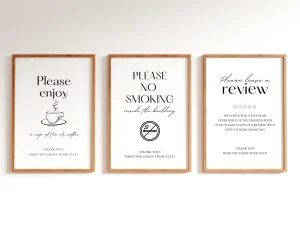
Everything you hand a guest, matched and priced to move together.
For guests, the summary is short: on most Airbnb stays nobody is holding your money, and if a host asks you to send a deposit outside the platform, that is not how the permitted version works. For hosts, the protection is real and the ceiling is high, but it starts with a photograph taken before the cleaner arrives. Tell us in the comments whether you have ever run the 14 days out, because almost everyone who has says it happened the same way.
FAQ
Common questions, answered briefly
Does Airbnb take a security deposit?
How long does a host have to claim for damage?
How much does AirCover for Hosts cover?
Can I ask a guest to send a deposit before arrival?
People also ask