This anchors our Supernote hub. If you are cross-shopping, see how it stacks up in Supernote vs reMarkable and the best Supernote alternatives.
The device
What the Supernote Manta is
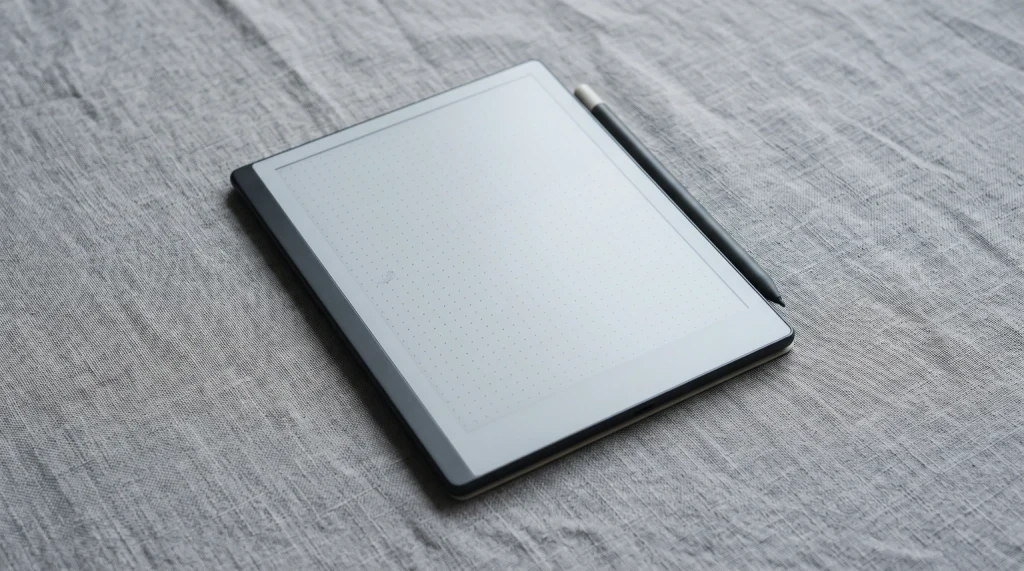
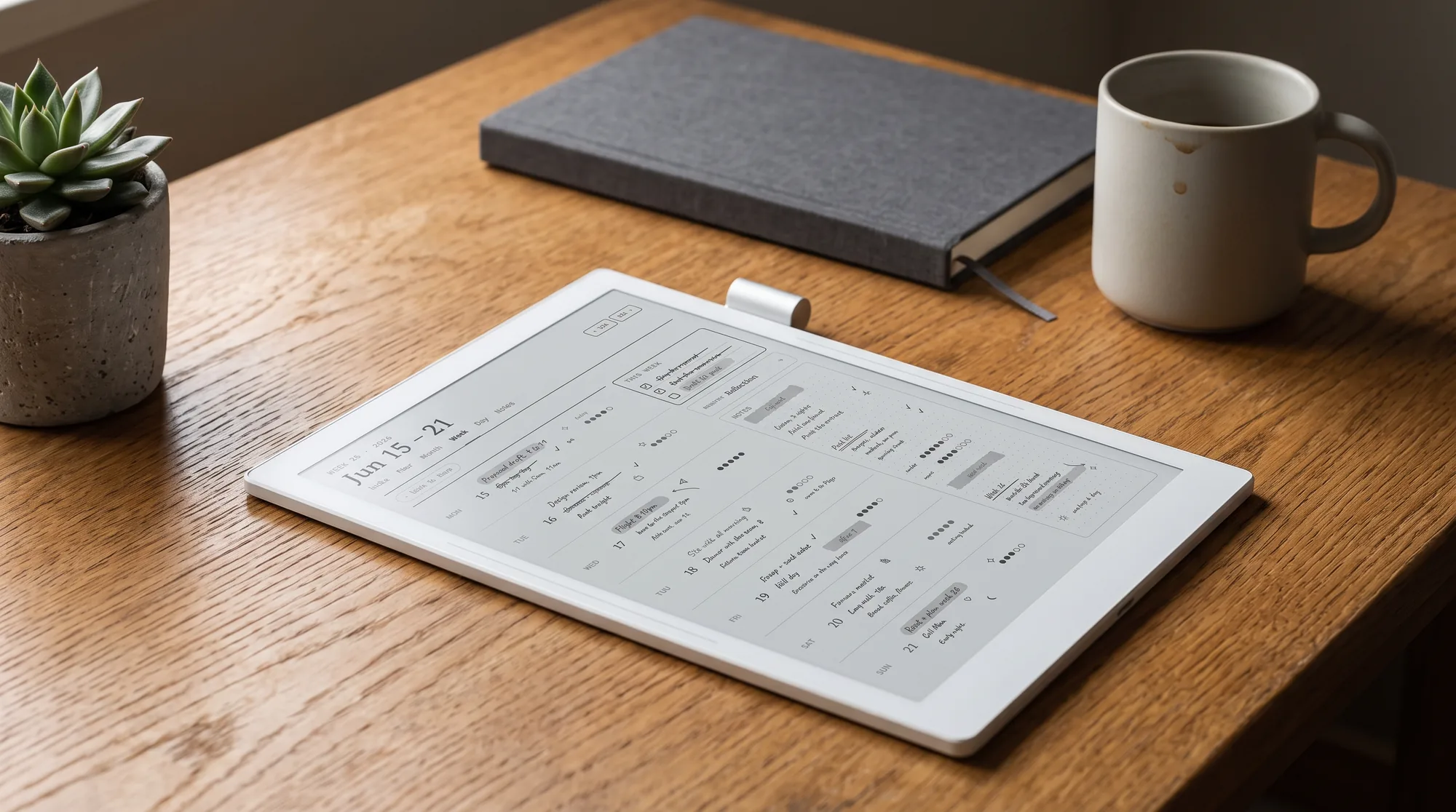
Supernote, made by Ratta, has a small but devoted following, and the Manta (the A5 X2) is its flagship. This Supernote Manta review starts where the device does: writing. Where most e-ink tablets chase features, the Manta chases feel, and builds everything else around protecting it. It is a 10.7-inch monochrome slab with a flexible E Ink Carta 1300 panel at 1920 by 2560, a sharp 300 ppi, and, notably, no frontlight at all.
It runs Chauvet, Supernote’s own Android-based but locked-down operating system, on a quad-core Rockchip RK3566 with 4GB of memory and 32GB of storage expandable by microSD. It weighs 375 grams in a body 6mm thick that tapers to 3.6mm at the edge. The price is $505, with the pen sold separately from about $65. Those are the numbers; the rest of this review is what they add up to, and who should care.
| Spec | Supernote A5 X2 Manta |
|---|---|
| Price | $505, pen sold separately (from $65) |
| Display | 10.7″ mono E Ink Carta 1300, 1920×2560, 300 ppi, no light |
| Size / weight | 251 × 182 × 6 mm (3.6 mm edge), 375 g |
| Operating system | Chauvet (Android-based, locked, no Play by default) |
| Chip / memory | Rockchip RK3566, 4 GB RAM, 32 GB (microSD to 2 TB) |
| Battery | 3600 mAh, weeks of use |
| Build | Modular, replaceable battery and motherboard |
| Pen | Ceramic nib, no tip replacement needed |
Writing
The writing experience, the whole point
Everything good about the Manta starts with the pen on the screen. The ceramic-nib stylus writes on a lightly textured film that reviewers consistently rate among the very best in e-ink, with one calling the Manta the pinnacle of writing pleasure. The ceramic nib is also practical: it barely wears, so you are not replacing felt tips every few weeks, which is a quiet long-term saving. We have not tested a unit ourselves, so treat feel notes as third-party impressions, but the Manta’s reputation here is unusually consistent.
The lack of a frontlight is part of the same philosophy and worth flagging plainly, because it splits buyers. Supernote leaves the light out to keep the writing surface as paper-like and low-glare as possible, and many owners prefer it. But it also means you cannot write or read in the dark or in a dim room without external light, which some people consider a dealbreaker. Know which camp you are in before you buy, because it is a fixed choice, not a setting.
The OS
Chauvet OS: focused by design, closed by design
The Manta runs Chauvet, which is Android-based but deliberately walled off. There is no Google Play by default, and while you can sideload a handful of apps through stores like F-Droid or Aurora, it is far less permissive than a Boox or an iFLYTEK AINOTE. There is no color and no on-device AI transcription. If you have read our AINOTE 2 vs Supernote Manta comparison, this is the fork: the AINOTE 2 is an open AI computer, the Manta is a closed notebook, on purpose.
What Chauvet does well is the writing software itself: fast, deep handwriting features, real-time keyword search of your handwritten notes, document linking, and a genuinely thoughtful navigation system built around the side of the screen. Supernote also runs InkHub, a community platform where owners browse and share templates, stickers, and notes. So the ecosystem is narrow but deep: less breadth than Android, more care in the one thing the device is for.
Longevity
Repairability and longevity
This is the Manta’s quiet superpower and the thing almost no rival matches. The device is modular: the battery and the motherboard can be replaced, so when the battery ages after a few years, you swap it instead of the whole tablet, and the motherboard can be upgraded rather than orphaned. In a category where most devices are sealed slabs destined for a drawer once the battery fades, that design is both a real cost saving and a genuine reduction in e-waste.
It also reframes the price. A $505 device you keep and repair for five or six years is cheaper per year than a thinner, sealed tablet you replace in three. If you buy tools to keep them, the Manta’s repairable build is worth as much as any spec on the sheet.
If $505 is more than you want to spend new, Supernote also sells open-box units at a discount with a longer return window; our Supernote open box guide explains what you give up and when they sell out.
In the line
Where the Manta sits in the Supernote line
The Manta is the full-size flagship, but it is not the only Supernote. If 10.7 inches sounds large, the compact 7.8-inch Nomad runs the same software and pen for less, and our Nomad vs Manta comparison lays out which size fits which use. If you have been offered an older A5 X, that is the discontinued predecessor, and the Manta is its successor and the better buy new. Whichever you land on, the writing feel is the constant, and the pen you pick shapes it as much as the device does.
Templates
Templates and workflow
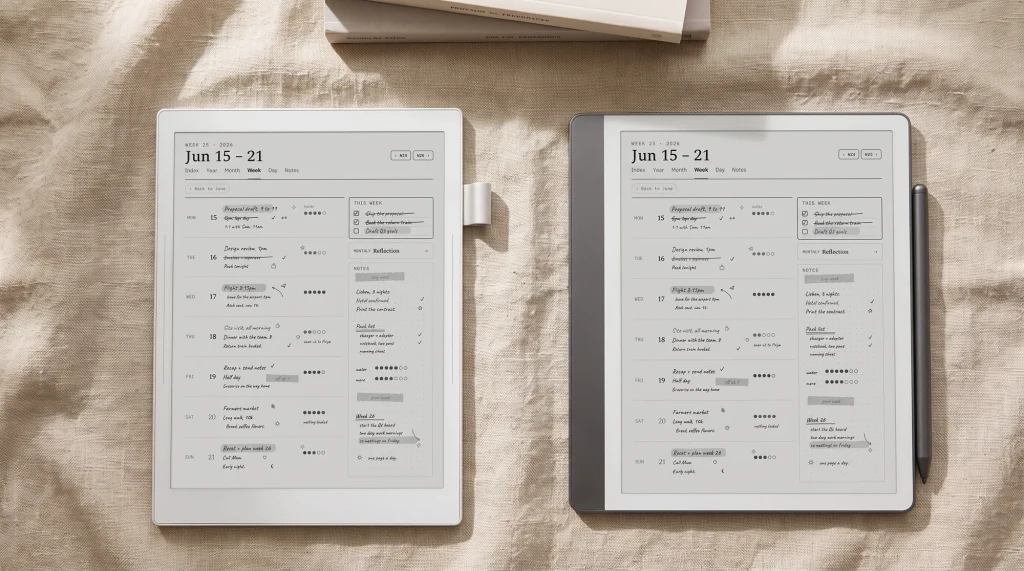
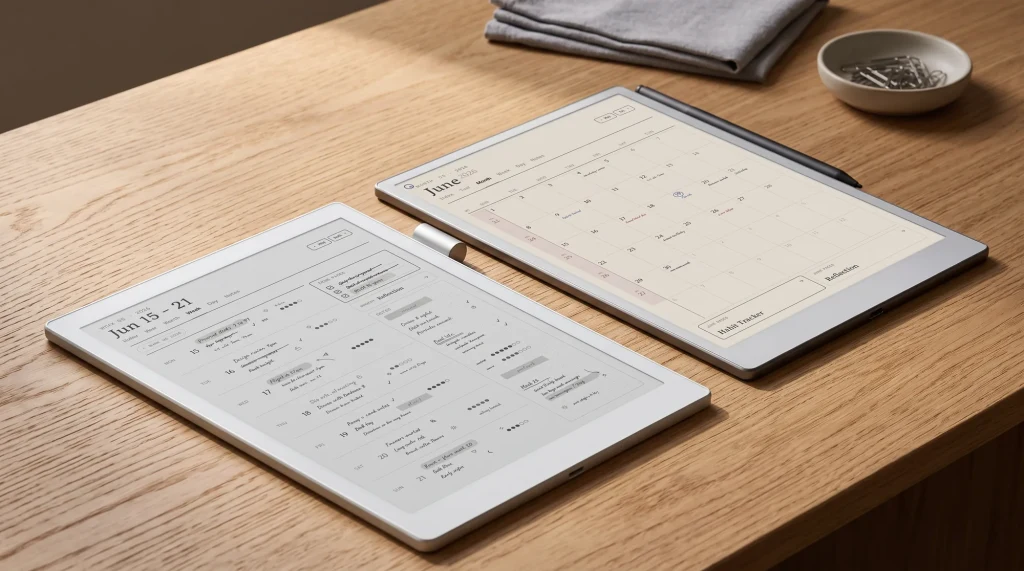
The Manta ships with a solid set of built-in templates (dotted, ruled, lined, Cornell, agendas), and you can add your own: PNG files for simple templates and PDF files for more structured planners. Combined with InkHub’s shared library, that makes the Manta genuinely flexible for planning, even without an app store. The one thing to get right is sizing, because a template designed for the wrong dimensions wastes screen or renders soft. Our Supernote templates guide walks through sizing and installing them, and with cloud sync turned on, new pages drop onto the device without a cable.
Scorecard
The Manta, scored
One way to sum up a focused device is to score what it is actually for, not a generic feature checklist. Here is how the Manta lands on the things that matter to the buyer it was built for.
Supernote Manta, scored out of 10
The shape tells the story: near the top where the Manta tries, on writing, repairability, and longevity, and deliberately low where it does not, on apps and openness. Buy it for the tall bars, and skip it if the short one is a dealbreaker.
Verdict
The verdict on this Supernote Manta review
FAQ
Common questions, answered briefly
How much is the Supernote Manta?
Does the Supernote Manta have a frontlight?
Can the Supernote Manta run Android apps?
Is the Supernote Manta good for writing?
Is the Supernote Manta repairable?
People also ask
Other questions, briefly answered
If you write on a Manta every day, tell us in the comments what made you choose it over the open Android crowd, and whether the missing frontlight ever bit you. We keep this review current as Chauvet updates and new accessories land.