The worksheet
A free goal-setting worksheet, one goal at a time
Most goals fail long before anything goes wrong, at the moment they are written down too vaguely to act on. “Get fit” and “save more” are wishes. A goal-setting worksheet turns a wish into something you can do on Monday by asking the questions you would otherwise skip: how will you know, by when, and what will you do when it gets hard.
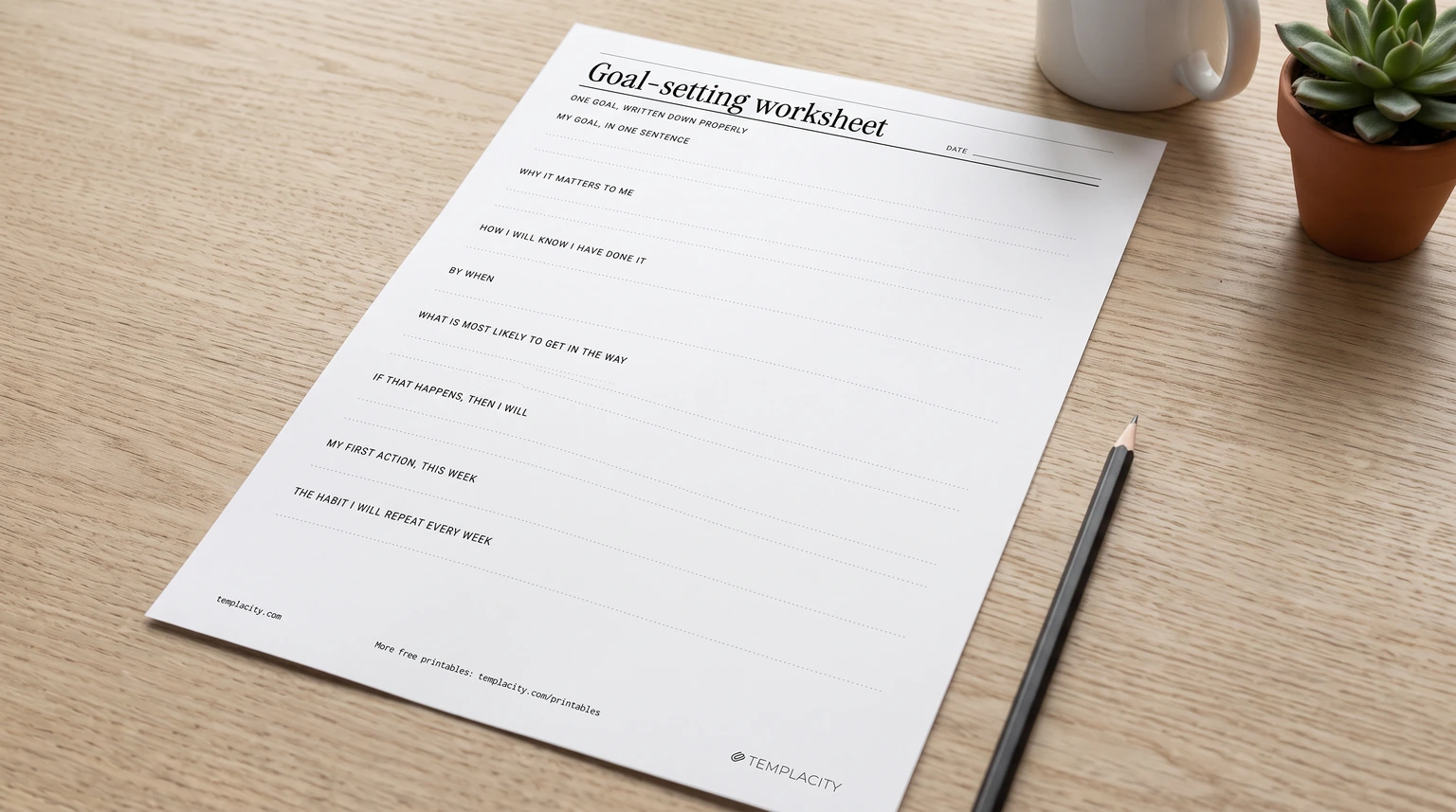
Ours is built for one goal at a time, because a sheet with ten goals on it gets ten half-answers. Download it in US Letter or A4. Every writing line is a fillable field, so you can type straight into it in any PDF reader, or print it and use a pen.
How to fill it in
How to fill in a goal-setting worksheet
- My goal, in one sentence. Make it specific enough that a stranger could tell whether you did it. “Run a 5K without stopping” beats “get fit”.
- Why it matters to me. The reason you will reread on a bad week. Be honest; it does not have to be noble.
- How I will know I have done it. One measurable finish line.
- By when. A real date. Without one, a goal is a someday.
- What is most likely to get in the way. Name the obstacle inside you, not only the outside ones: tiredness, a habit, a time of day you always give up.
- If that happens, then I will. One concrete plan for that exact obstacle.
- My first action, this week. Small enough to do in the next seven days.
- The habit I will repeat every week. The regular thing that moves the goal, with a day or trigger attached.
Why the obstacle
Why this worksheet asks about obstacles
Many goal-setting worksheets follow the SMART pattern: specific, measurable, achievable, relevant, time-bound. Ours covers those in its first four lines, then adds the part SMART leaves out. The psychologist Gabriele Oettingen’s research on motivation, summarised on the WOOP science page, rests on the idea that the obstacles we think most impede us can help us reach a wish, once we picture them and plan around them. Her method, WOOP, runs wish, outcome, obstacle, plan, and the worksheet’s obstacle and if-then lines are that last half.
“Get fit” and “save more” are wishes. A goal-setting worksheet turns a wish into something you can do on Monday.Goal-setting worksheet
Milestones
Milestones and the 12-week check-in
Page two splits the goal into three milestones, each with its own date, so a goal months away has something to aim at this month. Below them sit three check-ins, at weeks 4, 8 and 12, each asking the same three questions: am I on track, what helped, and what should change. Twelve weeks is long enough to see real progress and short enough that a goal that is not working gets fixed instead of quietly dropped.
Example
A filled-in goal-setting worksheet example
Page three of the PDF is a made-up example, to show how short each answer can be:
- Goal: run a 5K without stopping by the end of March.
- Why: to feel fit again, and to do the spring park run with a sister.
- How to know: finish a timed 5K at the park without walking.
- Obstacle: dark, cold evenings after work.
- If-then: run before work on Tuesday and Thursday, with kit laid out the night before.
- First action: book the park run for the last Saturday in March.
- Weekly habit: three short runs, adding a minute of running each week.
More than one goal
When you have more than one goal
Print one worksheet per goal, and keep it to three goals at most; each needs attention every week. If you want to plan a whole year of goals and track the habits behind them, our Printable Habit and Goals Pack ($12) is the full version: a goals-for-the-year page across six life areas, a goal plan, a 90-day plan, twelve monthly habit trackers, a 30 day habit page and four quarterly reviews, undated, in Letter, A4 and A5. For a single habit, our free printable habit tracker pairs with this worksheet’s last line.
If you are setting goals for the new year, our new year resolution ideas pair each resolution with a habit, and a vision board keeps the why in view. For a dated year to hang it all on, see the Printable Planner 2027 ($39), and the planning hub for more.
FAQ
Common questions, answered briefly
What should a goal-setting worksheet include?
Is the goal-setting worksheet free?
Is this a SMART goals worksheet?
How many goals should I set at once?
Filled one in? Tell us in the comments which line was hardest to answer; it is usually the obstacle, and that is the one worth the time.
People also ask