The job
What a homeschool planner has to do
A homeschool planner does two jobs that a school splits between a timetable and an office. It plans: which lessons happen this week, for which child, in what order. And it remembers: what was actually done, how many days you taught, which books were read, and the marks or notes you may need at the end of the year. A planner that only plans leaves you rebuilding the year from memory in June. A planner that only records never tells you what Tuesday looks like.
Most of the homeschool planners on the first page of this search are good products. They differ less in quality than in the family they were built for. A planner drawn for one child and a fixed Monday to Friday timetable fights a family of four children working through a loop schedule, and the reverse is just as true. So the useful question is not which homeschool planner is best, but which one matches the shape of your home.
Three questions decide almost everything: how many children you plan for, whether your lessons are tied to days or rotate in order, and how much record keeping you need. Format comes after that. Paper, printables, apps and tablets all handle those three questions, but not all of them handle all three well.
Formats
The four kinds of homeschool planner
There are four formats on the market, and each one is a trade between effort, flexibility and cost. We checked one real example of each on its maker’s own page in September 2026, so you can see what the format costs in practice rather than in theory.
| Format | Example (checked Sept 2026) | Cost | Best for |
|---|---|---|---|
| Printed book | Erin Condren Homeschool Planner, undated, attendance for up to four students | $48.50 list | Families who plan on paper and want it bound |
| Printable PDF | The Peaceful Press Homeschool Planner | $12 | Families who print only the pages they use |
| Subscription app | Homeschool Planet, grades, attendance and transcripts | $9.95 a month or $84.95 a year | Families who plan on a phone or computer and want records automated |
| E-ink tablet PDF | Our Homeschool Planner System, dated, one to four children | $49 for one child to $79 for four, two school years | Families who plan with a pen but want links and no reprinting |
A printed book is the easiest to start: it arrives bound, it sits on the table, and nobody needs a charger. Erin Condren’s Homeschool Planner lists at $48.50, is undated so you can start it in any month, and carries attendance for up to four students. The Well Ordered Homeschool sells a dated printed edition for the 2025 to 2026 school year with loop scheduling, record keeping and tabbed student sections; its undated edition was out of stock when we checked, with a new edition announced for October. The cost of a printed book is rigidity: the page layout is fixed, and a fifth child or a subject that does not fit the grid means writing in the margins.
A printable PDF is the cheap, flexible middle. The Peaceful Press sells its Homeschool Planner as a $12 PDF download, with an optional discounted printed bundle through a third-party printer. You print the weekly pages you actually use, in the quantity you need, and bind them in a binder. The effort is yours: printing, punching and refilling. If paper is your format, our printable weekly planner guide covers the layouts and the paper-size traps.
A subscription app does the arithmetic for you. Homeschool Planet costs $9.95 a month or $84.95 a year after a 30-day free trial, runs on a phone or computer, and handles grades, attendance and transcripts. Apps win when records matter most, for example a high schooler heading for college applications, because the transcript builds itself from what you log. The cost is a screen at the table, a bill every year, and a planner that disappears if you stop paying.
An e-ink tablet PDF is the newest format. You write on it with a pen like paper, but the pages are linked, so tapping a child’s name on the week page opens that child’s day. Nothing needs reprinting, and the whole year fits on one device. The cost is the tablet itself if you do not own one already.
Children
A homeschool planner for multiple children
One child is easy to plan in almost anything. The planner earns its price with the second and third child, because the hard part of a homeschool week is not any single child’s lessons; it is one parent being needed in three places at once.
Look for a planner that shows the family week on one page before it shows each child’s. The subjects everyone does together, such as read-alouds, history, science, art and nature study, go on a shared line. The subjects that have to be at each child’s level, usually maths, reading and writing, go on a row per child. Put those rows side by side and you see the clash on paper: two children who both need you for maths at ten o’clock. Move one of them to the afternoon and the problem is solved before anyone sits down.
The hard part of a homeschool week is not any single child’s lessons; it is one parent being needed in three places at once.
Then check how the planner scales. A printed book has a fixed number of student sections, so count them against your family, now and in two years. A printable scales by printing more. An app adds a student in a menu. A tablet PDF is usually built for a set number of children, so buy the version that matches your family rather than one child’s copy per child, or you are back to three planners and no family view.
Children also plan better when they can see their own part. Older children can tick their own boxes on a weekly grid, and a child who can see that maths is done and only copywork is left works differently from one waiting to be told what comes next.
Scheduling
Fixed days or a loop schedule
The second question is how your lessons are tied to time. A fixed schedule puts each subject on set days: maths every weekday, history on Tuesdays and Thursdays, art on Friday. It is how a school timetable works, and it suits families with outside commitments on fixed days, such as a co-op morning or a sport.
A loop schedule lists subjects in an order and works through them whatever the day. If Monday covers history and art and Tuesday is lost to a dentist appointment, Wednesday picks up with the next subject on the loop instead of skipping it. Loops suit families whose weeks are interrupted often, and subjects that matter but do not need to happen daily: poetry, music, an artist study, a handicraft.
Most families end up with both: daily subjects on a fixed grid, and a short loop for everything else. A homeschool planner that forces one model will fight you. Before you buy, look for a loop page or a blank list you can use as one, and a weekly grid that does not print days or subjects you cannot change.
Records
The records worth keeping, and free pages for them
The third question is records. What you are required to keep depends on where you live, since homeschool rules differ by state and country, so check your own rather than trusting any planner’s printed rule. Beyond what is required, three records are worth keeping for almost every family, because they are painful to rebuild later.
Attendance. A count of the days you taught, month by month. Even where nobody asks for it, it tells you whether the year is on track. Our free homeschool attendance tracker has a numbered 180-day grid and a month-by-month count, on US Letter or A4.
What was done each week. A weekly grid with a done column turns the plan into the record, with no second book to fill in. Our free weekly homeschool schedule is a week grid and a daily page, with no subject names printed so it fits any curriculum, also in A4.
A transcript, from the start of high school. Courses, credits and grades per year, kept as you go rather than reconstructed in the last year. Our free homeschool transcript template comes as a PDF and as a Google Sheet that calculates a weighted GPA, with Honors at +0.5 and AP or dual enrollment at +1.0.
A reading log and a few portfolio samples per term round it out. A reading journal kept by an older child doubles as both.
Planning
Plan the year, the term, then the week
Whatever homeschool planner you choose, the planning works best in three passes, from the top down, and each pass takes less time than the one before it.
The year, once. Mark the term dates, holidays and known interruptions on a year page, and write down each child’s subjects and the curriculum or books for each. This is the only time you write the subject list out in full; a good planner carries it forward from there.
The term, a few times a year. Divide each book or unit by the weeks in the term, so you know roughly how much each week has to cover. Twelve weeks and a 120-page maths book is ten pages a week. That one division stops the end-of-term panic.
The week, every weekend. Fill the family week first, then each child’s row, then look for clashes. Fifteen minutes on Sunday evening is enough once the year and term are done. During the week you only tick, note and move things, and on Friday the page is already the record.
Teachers planning a classroom rather than a kitchen table work the same way at a different scale; our weekly lesson plan template and the best teacher planner guide cover that side.
Digital
A digital homeschool planner you write in with a pen
Many homeschool parents want paper’s feel without paper’s refills, and a screen at the table is the thing they are trying to avoid. An e-ink tablet sits between the two: it looks like paper, you write with a pen, there are no notifications, and a year of pages weighs the same as one.
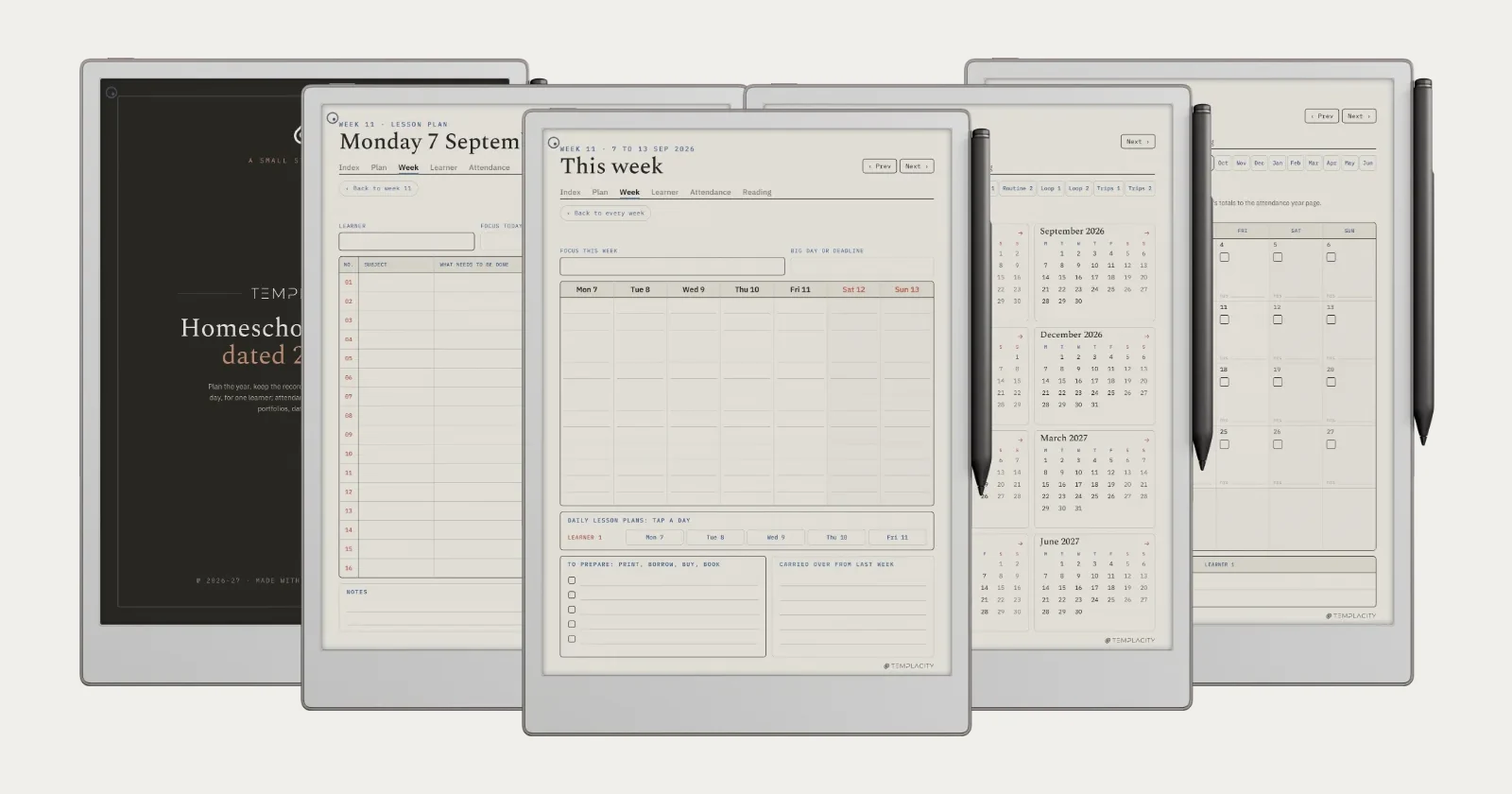
That is why we built our Homeschool Planner System for reMarkable, Kindle Scribe and Boox. It is a hyperlinked PDF, dated July to June, and you pick the number of children you teach, one to four, so every page is built for that many learners. Each of the 53 weeks opens on a family “This week” page with a button to every child’s day, and each school day has a dated lesson plan per child: the subject, what needs to be done, a done box and notes. Per child there are subjects and curriculum, term progress, report cards, portfolio pages and a year summary. The year carries a year at a glance, term dates, a daily routine, a loop schedule, field trips, attendance by month with year totals, and a reading log.
Nothing is preset: you write each child’s subjects once and every page uses them, so it fits any curriculum. Both school years, 2026 to 2027 and 2027 to 2028, are included, each with a Monday and a Sunday start, from $49 for one child to $79 for four. It runs 375 pages for one child and 1,209 for four, which is the point of the links: you never page through them, you tap from the week to the child to the day. If you are still choosing a device, our Kindle planner guide covers how linked planners behave on the Scribe.
Setup
Setting up a homeschool planner in one afternoon
A new planner is most useful in its first week and most abandoned in its third. One sitting of setup, in this order, is what keeps it going.
- List each child’s subjects and the curriculum or books for each, once.
- Mark the year: term dates, holidays, and the weeks you already know will be broken.
- Split the shared subjects from the individual ones, and decide which go on a fixed day and which on the loop.
- Divide each book by the term’s weeks so every week knows its share.
- Fill the first two weeks only. Planning further ahead is wasted the first time a week goes sideways.
- Decide where the records live: attendance, the done column, and the transcript if you have a high schooler.
Then give it a month before judging it. Every planner feels wrong in week one, because the family is learning the page. If it still fights you in week four, the mismatch is in one of the three questions above, and that tells you exactly what the next planner has to do differently.
More homeschool guides collect under homeschool. How many children do you plan for, and does your week run on a loop or fixed days? Tell us in the comments; the answers shape the next pages we draw.
FAQ
Common questions, answered briefly
What is the best homeschool planner?
How do I plan homeschool for multiple children?
What is a loop schedule in homeschooling?
Is there a free homeschool planner?
Should a homeschool planner be dated or undated?
If yours isn’t above, drop the question in the comments and we’ll add it.
People also ask