The answer
What is Hobonichi, in one paragraph
Hobonichi is a Japanese company that runs a website, and the planner is something the website made. The site is Hobo Nikkan Itoi Shinbun, started by the copywriter Shigesato Itoi in 1998 and updated every day since. In 2002 the team asked their readers whether they would want a planner, more than 700 people said yes, and the first Hobonichi Techo went out that year in 12,000 copies. “Techo” is simply the Japanese word for a pocket notebook or planner, so the full name means something close to “the Hobonichi planner”.
That origin explains most of what people find strange about it. It was not designed by a stationery brand working out a product line. It was designed by people who write things every day for readers who write things every day, which is why the daily page is mostly empty space and why the book carries a quote at the bottom of each page rather than a productivity framework. The conventions it shares with the rest of the category are in our Japanese planner guide.
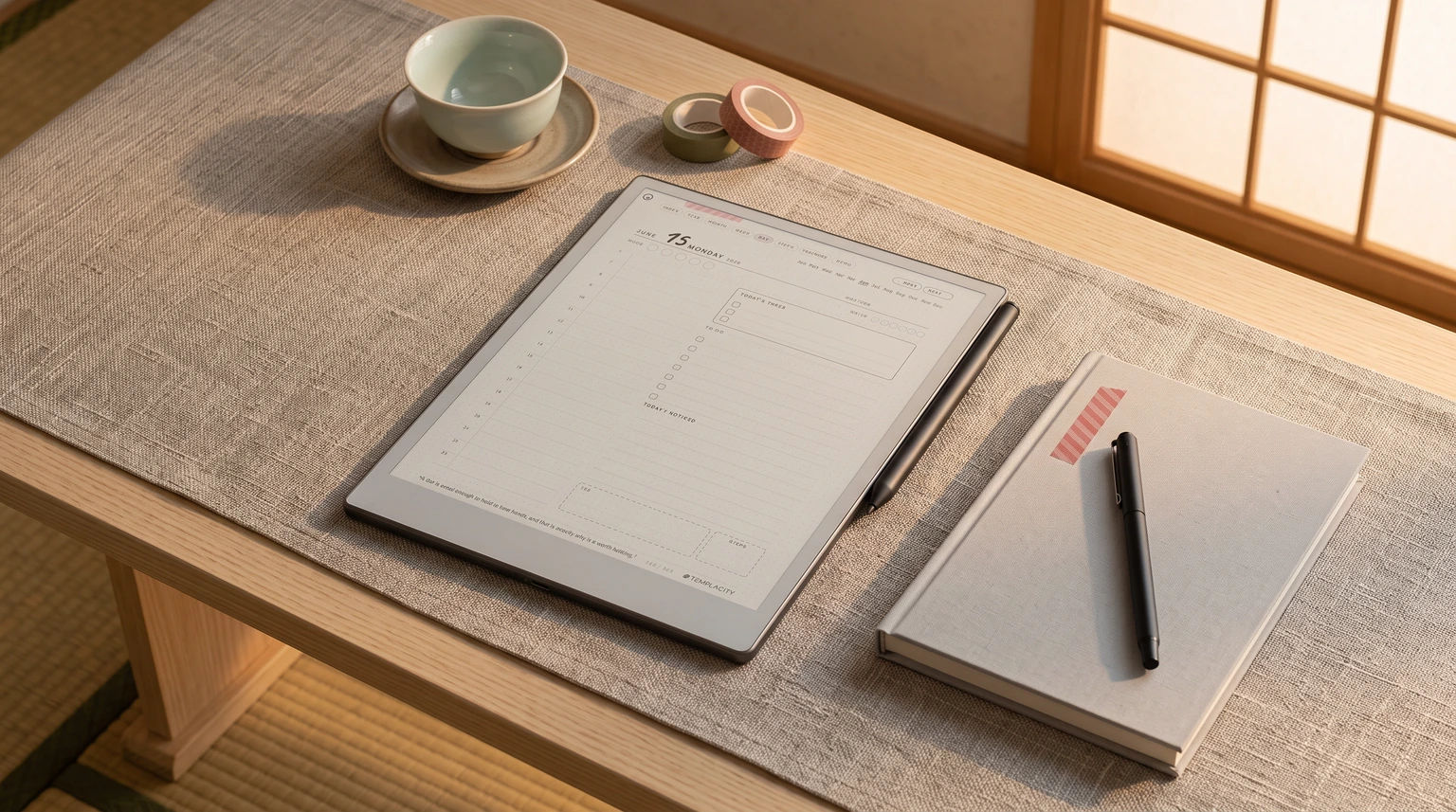
Anyone asking what is Hobonichi has usually run into it as a photograph rather than a product: a small fabric-covered book, open flat, with a day of handwriting and a strip of washi tape on it. The book underneath those photographs is unglamorous and specific, so it is worth going through what is actually on the page.
The page
What is actually printed on a daily page
The Techo Original is A6, 105 by 148 mm, and runs to 464 pages in the full-year book. Every day gets one of them. The paper is Tomoe River, which is thin enough to fit a year into something you can hold in one hand and still absorbs fountain pen ink rather than letting it through.
- Size
- A6, 105 by 148 mm
- Pages
- 464, one per day plus extras
- Paper
- Tomoe River, 3.7 mm grid
- Cover
- Sold separately
- Book price
- ¥2,860
On the day page itself: a 3.7 mm graph across the whole sheet, a 24 hour timetable running down one side with hourly markers, a small to-do list with checkboxes, a mini monthly calendar, the day-of-year number, the phase of the moon, the date in the old Japanese lunisolar calendar, and a vertical rule Hobonichi calls the Secret Line that separates the schedule from the memo space. The Japanese edition adds the national holidays. It is a lot of furniture described in a list and almost invisible in use, because all of it is printed light.
The line at the foot of each page is the part people remember. Hobonichi pulls those from their own website: interviews, columns, reader submissions and their Hobonichi School material, selected one per day. It is the only part of the book that is not a grid, and it is the reason the planner reads as something made by a publisher rather than a manufacturer.
The lineup
Which book the word actually refers to
“A Hobonichi” is six books, and most confusion between two people talking about one is that they own different ones. The Original is the A6 page-a-day book at ¥2,860. The Cousin is the A5 version, 148 by 210 mm and 544 pages, at ¥4,620, and it adds vertical weekly spreads with a 24 hour timeline, which is the single feature most of the Original against Cousin decision turns on. Avec splits the same year into two thinner books so you carry six months at a time.
Then the three that are not page-a-day at all. Weeks is wallet-shaped with a week to the left page and a blank memo page to the right, from ¥2,860 to ¥5,060 depending on the cover. Day-Free is a monthly calendar plus a graph notebook with no daily pages, at ¥2,420 in A6. The 5-Year book puts the same date across five years on one page, ¥4,620 in A6. There is also the HON line, which has its hardcover attached rather than expecting you to buy one.
That split is deliberate and it is the reason the price looks odd at first. You buy a cover once, in leather or fabric or clear plastic, and then you buy a ¥2,860 book into it every year. Read as a one-off purchase it is an expensive small notebook. Read as a system with an annual refill it is a cover you keep and a book that costs about as much as a decent paperback.
The growth
How it went from 12,000 copies to 900,000
The fullest answer to what is Hobonichi is the one the company writes itself. They publish their own history of the book, and it is unusually specific about circulation. The numbers are worth reading as a record of when the lineup answered a complaint rather than as a growth chart.
First edition, 12,000 copies
An A6 page-a-day book on Tomoe River paper, made after more than 700 readers of the website said they wanted one.
30,000 copies, leather covers arrive
The butterfly clasp pen holder had landed the year before. The cover stops being packaging and starts being the thing you keep.
The Cousin joins the Original
An A5 answer to the oldest complaint about the book, which is that the A6 page runs out by lunchtime.
Weeks launches
Wallet-sized and weekly, for people who wanted the system at work without a page to fill every day.
The English edition
Called the Planner. Circulation had passed 350,000 three years earlier, almost all of it in Japan.
900,000 copies
Up from 500,000 in 2014 and 850,000 in 2019, across a lineup that now includes Avec, the 5-Year book and HON.
What that record shows is a company that kept the daily book unchanged and built around the people who could not use it. Weeks and Day-Free are not lesser versions of the Original. They are the two books that made it possible to stay when the daily page did not work, and between them they are why the answer to a bad year is often another Hobonichi rather than a different brand.
The friction
Why people bounce off it
Three things, in order of how often they come up. The first is the daily page itself: 365 printed sheets is a commitment nobody can honestly assess in a shop, and a large share of buyers stop filling them somewhere around March. The second is the cover, which arrives as an unexpected second purchase at checkout. The third is the calendar. The next year’s lineup opens on 1 September at 11am Japan time, the covers people want go out of stock, and the whole decision gets made in a fortnight under mild time pressure.
365 printed sheets is a commitment nobody can honestly assess in a shop.On the daily page
None of those are reasons not to buy one. They are reasons to buy the right book out of the six, and the honest version of that decision usually starts from what you actually filled in last year rather than what you meant to. We worked it through in our guide to hobonichi alternatives, which covers the two books inside the lineup that solve this and the three outside it that are genuinely comparable.
Worth it
Whether it is worth the money
At ¥2,860 for the book, the Original is not expensive for what it is. What makes it feel expensive is the shipping, the cover, and the fact that you are buying a year of something you have not tried. Anyone who already writes daily will get their money back inside a month. Anyone buying it to become a person who writes daily is buying the wrong end of the problem, and the 5-Year book or Weeks is a cheaper way to find out.
The format itself is not owned by anyone, which is why one page per day now exists as a printed book from several makers and as a hyperlinked file for people who write on an e-ink tablet. If you are weighing the file route, our digital planner guide covers what actually transfers, and our roundup of the best digital planners for e-ink tablets covers which files behave on which hardware. The paper is the part that does not transfer, and for a lot of people that is the whole purchase.
FAQ
Common questions, answered briefly
What does Hobonichi mean?
What is so special about a Hobonichi planner?
How much does a Hobonichi cost?
When can you buy the next year’s Hobonichi?
Most of the internet answers what is Hobonichi with a photograph of a first week. If you have kept one going for more than two years, tell us which book and what you write in it. The first year is well documented everywhere; the third year is the one nobody photographs.
People also ask