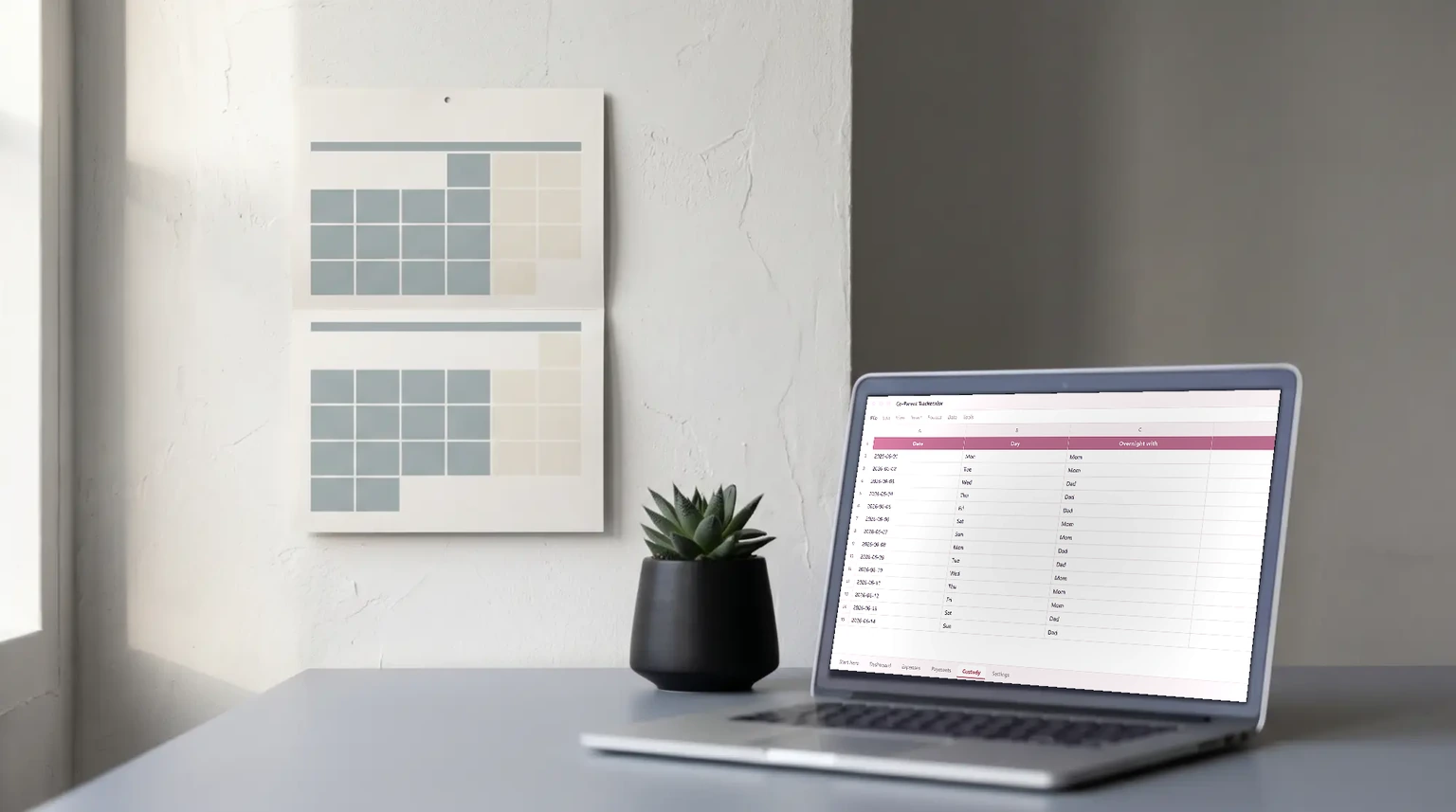
What it shows
What a custody schedule template needs to show
A custody schedule template needs to answer one question at a glance: where is the child tonight, and who moves them tomorrow. Everything else is detail. The good ones show a repeating pattern over one or two weeks, colour-coded by parent, with the exchange times and places marked, and a separate handling for holidays and special days. The ones that fail try to be a wall planner, a to-do list, and a diary at once, and end up too busy for anyone to read at a glance. Clarity is the whole point; a child and two adults should each be able to look at it and know the week.
Before the template, the pattern. A schedule template does not decide your split; it displays the one you and the other parent have agreed, or that a court has ordered. So the useful work is choosing a pattern that fits your children’s ages and the distance between your homes, then mapping it into a calendar both homes trust. We will walk through the common patterns, how to choose, and how to build the template, with one rule running through all of it: the schedule that matters is the one in your parenting plan. This guide is organizational, not legal advice, and custody arrangements vary by jurisdiction.
The 50/50 patterns
The common 50/50 schedules compared
Most parents looking for an even split land on one of four patterns. They all give each parent roughly half the time across a fortnight; they differ in how often the child changes homes, which is the variable that matters most to a child. More exchanges mean shorter stretches away from each parent, which younger children tend to need. Fewer exchanges mean longer settled blocks, which older children and longer commutes tend to prefer. The table compares them on rotation and the number of handoffs, because handoffs are where the friction and the logistics live.
| Pattern | How it runs | Exchanges / 2 weeks | Best for |
|---|---|---|---|
| 2-2-3 | 2 days A, 2 days B, 3 days A, then swap | Frequent (about 6) | Younger children, close homes |
| 2-2-5-5 | 2 days A, 2 days B, 5 days A, 5 days B | Moderate (about 4) | School-age children, fixed weekdays |
| 3-4-4-3 | 3 days A, 4 days B, 4 days A, 3 days B | Moderate (about 4) | Even split with a steady weekly rhythm |
| Week on, week off | 7 days A, then 7 days B | Fewest (2) | Older children, longer commutes |
The 2-2-3 is the most popular for young children because no stretch away from either parent lasts more than a few days, which suits how small children experience time. The cost is the busiest handoff schedule of the four. Week on, week off is its mirror: only two exchanges a fortnight, long settled weeks, and far less back-and-forth, at the cost of a long gap from each parent that younger children can find hard. The 2-2-5-5 and 3-4-4-3 sit in between, giving predictable weekdays while keeping exchanges moderate. None is “best”; the right one depends on the child in front of you, not the pattern that sounds fairest on paper.
Other patterns
Non-50/50 and long-distance patterns
Not every family splits time evenly, and an uneven split is not a lesser arrangement. The common non-50/50 pattern is one primary home with the other parent having alternate weekends plus a weeknight, often written as an 80/20 or 70/30 split. It suits situations where one parent travels for work, where the child’s school and friends anchor one home, or where the parents simply agree it fits better. A custody schedule template handles this the same way: pick the pattern, colour it across the grid, and mark the exchanges.
Distance changes everything. When parents live far apart, frequent exchanges stop being practical, and schedules shift toward longer blocks: most of the school holidays with one parent, term time with the other, plus regular video calls written into the plan so the distant parent stays part of daily life. The principle holds across all of these: the template shows the pattern, and the pattern follows the child’s needs and your agreement. If your situation is genuinely unusual, that is a conversation for a family mediator or lawyer, not a template.
Choosing
How to choose by child age and distance
Two questions settle most of the decision. First, how old is the child? Toddlers and preschoolers generally cope better with frequent contact and short stretches, because a week is a very long time at that age; 2-2-3 is the common starting point. Primary-age children often manage 2-2-5-5 or 3-4-4-3, which keep weekdays predictable for school. Teenagers frequently prefer week on, week off, partly for fewer disruptions and partly because they value settling in rather than packing a bag every few days. These are tendencies, not rules; some children are the exception, and a child old enough to have a view is worth listening to.
Second, how far apart do you live, and where is school? If both homes are within an easy school run, almost any pattern works. If they are an hour apart, frequent exchanges become a daily grind that wears on everyone, and longer blocks win even for younger children. Map the actual commute, including who does drop-off and pickup on a normal week, before you commit to a pattern. A schedule that looks balanced on paper but means ninety minutes of driving on a school night will not survive the term.
Build it
Build your custody schedule template in 20 minutes
Here is the free build in Google Sheets. A spreadsheet beats a paper planner for this because it repeats cleanly, colour-codes at a glance, and can be shared live with the other parent and, in an age-appropriate view, the child. The steps below produce a two-week grid you can extend across the year.
Make a two-week grid: days across, weeks down.
Fourteen columns (or a 7-by-2 block) covering a full fortnight, which is the smallest unit that repeats for every 50/50 pattern. Label the dates so the grid maps to real calendar days.
Pick two colours, one per parent.
Use conditional formatting or simple cell fills. Two clear colours are all you need; a child should be able to read whose day it is from across the room without reading a word.
Apply your chosen pattern across the grid.
Fill the days for the pattern you picked (for example 2-2-3 or week on, week off). Because it repeats every fortnight, you colour it once and copy it forward across the year.
Mark exchange times and places.
On each handoff day, note the time and location (school gate, one parent’s home). Most missed pickups come from a vague exchange, not a wrong day, so be specific here.
Add a holidays row or tab.
List the dates that override the normal pattern (school breaks, birthdays, key holidays) and how they are split or alternated. Holidays cause more disputes than ordinary weeks, so give them their own space.
Share it, and keep a child-friendly view.
Share the sheet with the other parent so there is one source of truth. For the child, a simplified colour view on the fridge or a tablet helps them know the week without seeing the adult logistics.
The schedule that looks balanced on paper but means ninety minutes of driving on a school night will not survive the term.How to choose
The forgotten parts
Holidays, handoffs, and the parts schedules forget
The regular pattern is the easy part; the disputes cluster around the exceptions. Holidays are first: decide early whether you alternate them year by year (one parent has the winter holiday in even years, the other in odd) or split each one, and write it down before the date is close enough to fight over. Birthdays, the child’s and each parent’s, deserve their own line. So do the small logistics that derail an otherwise good schedule: who keeps the passport, who holds the school uniform, what happens when a child is ill on an exchange day.
The other forgotten part is change itself. A schedule will need adjusting as children grow, schools change, and work shifts, so agree how you will request a change (in writing, with notice) before you need to. A schedule that cannot bend gets broken instead. Pairing the schedule with an expense tracker and a communication log keeps the whole picture in one place; our co-parenting spreadsheet guide shows how the tabs fit together, and the co-parenting hub covers the rest.
Whatever pattern you choose, the goal is the same: a week the child can predict and two adults can run without a standoff at the door. Start with the pattern that fits your children’s ages and your commute, write down the holidays and the change rule, and adjust as you learn. If you have a schedule that genuinely worked for your family, share it in the comments; the patterns that survive real life are worth more than the ones that look neat in a guide.
FAQ
Common questions, answered briefly
What is the best 50/50 custody schedule?
What is a 2-2-3 schedule?
Is there a free custody schedule template?
How do you schedule holidays in a custody plan?
What custody schedule is best for toddlers?
If yours isn’t above, drop the question in the comments and we’ll add it.
People also ask