How it works
How a 2-2-3 custody schedule works
A 2-2-3 custody schedule is an equal-time arrangement where the fortnight is divided into short blocks of two, two, and three days. You will also see the same pattern called a 2-2-3 parenting schedule or a 2-2-3 parenting time schedule, which is the language many family courts now prefer over the word custody; it describes the identical rotation. In the first week one parent has the child for the first two days, the other parent takes the next two days, and the first parent has the final three-day block. The second week is the mirror image: whoever had the short start now takes the longer end, so over the full two-week cycle each home gets seven nights and the weekends alternate evenly. The defining feature of a 2-2-3 custody schedule is frequency. The child never spends more than three days away from either parent, which is the whole reason families choose it.
One honest caveat runs through this guide: a custody schedule is an organisational tool, not legal advice, and what is ordered or allowed depends on your state and your court. Equal-time arrangements are also not automatically right for every child; courts weigh the child’s age, the distance between homes, and how well the parents cooperate. Read what follows as the common, workable shape that other families use, then fit it to your own order and your own child, with a family lawyer if anything is contested.
The rotation
The 2-2-3 rotation, week by week
| Week | Mon | Tue | Wed | Thu | Fri | Sat | Sun |
|---|---|---|---|---|---|---|---|
| Week 1 | Parent A | Parent A | Parent B | Parent B | Parent A | Parent A | Parent A |
| Week 2 | Parent B | Parent B | Parent A | Parent A | Parent B | Parent B | Parent B |
Read the grid as two blocks of two and one block of three, then flipped. In week one, Parent A has Monday and Tuesday, Parent B takes Wednesday and Thursday, and Parent A keeps the Friday-to-Sunday weekend. In week two everything swaps, so Parent B now opens the week and takes the weekend. Counted across the fortnight, each parent has seven nights and one full weekend, which is what makes it a true equal-time pattern rather than an every-other-weekend arrangement dressed up. The handoff days stay fixed (Wednesday, Friday, and the Sunday or Monday return), so once the rhythm settles, everyone knows which days are theirs.

Who it suits
Who the 2-2-3 schedule suits best
The 2-2-3 pattern is most often recommended for younger children, and the reason is developmental rather than logistical. Small children measure time in days, not weeks, and tend to cope better with short separations than long ones, so the frequent contact of a 2-2-3 schedule keeps both parents present in the everyday rather than becoming a weekend visitor. The guidance from child-development bodies such as the American Academy of Pediatrics and the American Psychological Association leans the same way: for toddlers and preschoolers, regular contact with both parents usually matters more than long uninterrupted stretches with one.
It also depends on two practical conditions holding true. The first is distance: because the child moves between homes every two or three days, the two households need to be close enough that the constant shuttling, and the shared school run, is not a daily strain. The second is cooperation. Three handoffs a week is three chances a week for a tense exchange, so 2-2-3 works best where the parents can hand over calmly and adjust the odd day without a standoff. Where both of those hold, the frequent-contact pattern is hard to beat for a young child. Where they do not, a longer-block schedule is usually kinder to everyone.
Trade-offs
The trade-offs: handoffs and living out of a bag
The frequency that makes 2-2-3 good for young children is also its main cost. Three handoffs a week means more logistics, more chances for a misread day, and a child who is regularly packing a bag. Forgotten shoes, the homework left at the other house, and the soft toy that lives in the wrong bedroom on the wrong night are the everyday friction of a short-rotation schedule. Older children in particular often start to resent the constant moving, which is one reason families tend to lengthen the blocks as the child grows, shifting toward a 3-4-4-3 or week-on-week-off pattern that gives a settled stretch in each home.
There is a coordination cost too. A pattern that flips every week is easy to miscount, and the most common cause of a missed pickup is not bad faith but two people running the rotation from memory and landing on different days. That risk is manageable, but only if the schedule lives somewhere both homes can see it rather than in two separate heads. We come back to that below.
Versus the alternatives
2-2-3 versus the longer-block patterns
2-2-3 is one of several equal-time rotations, and the choice between them is really a choice about block length. A 2-2-5-5 schedule keeps the same two fixed weekdays with each parent but stretches the back half into five-day blocks, trading some of 2-2-3’s churn for a steadier weekday routine. A 3-4-4-3 gives each parent a three-day and a four-day block over the fortnight, so the child never goes more than four days from either home but does far fewer handoffs. Week on week off is the longest common pattern, with a single changeover and a full week in each house, which suits older children and teenagers. If you want these compared side by side, our guide to the 50/50 custody schedule patterns lays all four out on the things that decide the fit. The short version: pick 2-2-3 for frequent contact with a young child, and lengthen the blocks as the child gets older and longer separations stop being hard.
The point of a 2-2-3 schedule is not balance on paper. It is contact frequency: a young child is never more than three days from either parent.Why the blocks are short
Tracking it
Keep the 2-2-3 rotation where both homes can see it
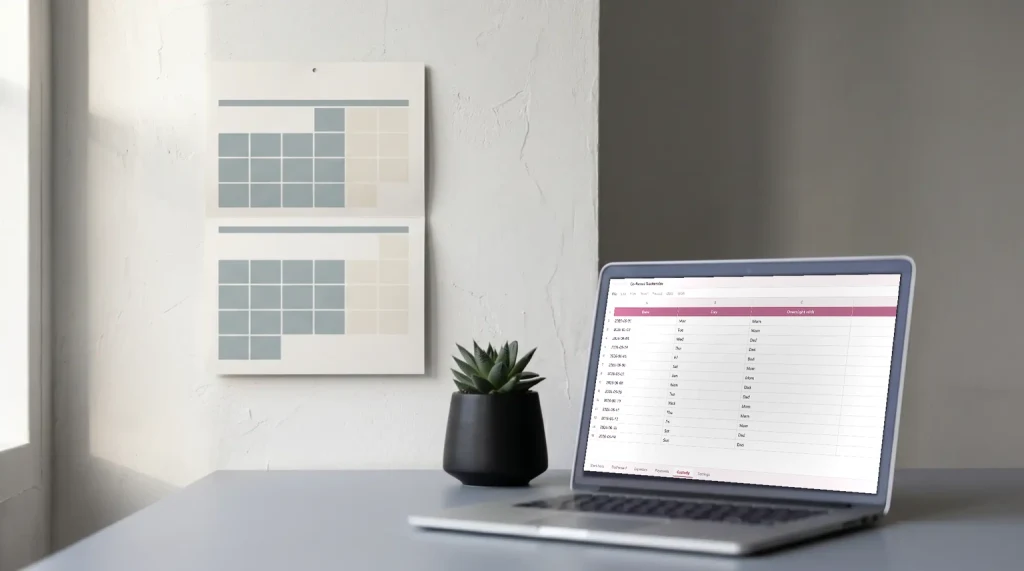
Because a 2-2-3 schedule flips every week and turns on three handoffs, it is the pattern that benefits most from being written down and shared rather than remembered. Mapping the rotation out for months ahead, with the weekly flip already worked through and the holidays slotted in, removes almost all of the day-to-day counting that causes missed pickups. Our custody schedule template sets up the common rotations so you can drop 2-2-3 onto the calendar and see exactly whose day each one is, and it sits alongside the expense and documentation tabs in the wider co-parenting spreadsheet if you want schedule and money in one file. If you ever adjust the pattern, note the change in writing; a co-parenting communication log keeps the agreed dates clear and out of dispute.
When it is not right
When a 2-2-3 schedule is not the right call
2-2-3 is a strong default for a young child in a cooperative, close-together set-up, but it is the wrong tool in a few common situations, and it helps to be honest about them. If the two homes are far apart, the every-few-days movement turns into long commutes and disrupted school days that cost the child more than the frequent contact gains. If one parent travels for work or runs shifts, a pattern that flips weekly may simply not be realistic, and an unequal arrangement can fit the week better; our guide to 60/40 and 70/30 custody schedules covers those. As children move into their school years and teens, the constant packing tends to wear thin, and a longer-block pattern usually serves them better. And where there are safety concerns or a serious imbalance in caregiving, equal time may not be in the child’s interest at all, which is a matter for a court and a lawyer rather than a template. None of this is legal advice; custody is governed by your state and your order. The schedule is the logistics layer, and whether 2-2-3 is right for your child sits above it, worth taking proper advice on if it is in any doubt.
The calendar is the easy part of co-parenting; the steady bit is two adults keeping a child’s week predictable through everything else. If a 2-2-3 schedule has worked for your family, or quietly stopped working as your child got older, tell us in the comments. The real experience of parents running these rotations helps the next person choose better than any grid can.
FAQ
Common questions, answered briefly
What is a 2-2-3 custody schedule?
Is a 2-2-3 parenting schedule the same as a 2-2-3 custody schedule?
How does the 2-2-3 rotation work week to week?
Who is a 2-2-3 schedule best for?
What are the downsides of a 2-2-3 schedule?
Is 2-2-3 better than week on week off?
How do you set up a 2-2-3 schedule?
If yours isn’t above, drop the question in the comments and we’ll add it.
People also ask