Why rules
Why house rules earn their space
House rules do two jobs, and only one of them is about guest behavior. The visible job is setting expectations: quiet hours, guest counts, where the car goes. The structural job is standing: when a dispute reaches the platform’s resolution process, what matters is whether the rule was written in the listing before the guest booked. Rules published up front are the difference between a covered claim and a he-said-she-said. Airbnb’s hosting resources are blunt about this: the listing is the contract surface.
The craft is in the restraint. Guests scan rules while deciding whether your place feels welcoming or policed, which means every rule has to buy more protection than it costs in warmth. The template below is eight rules long on purpose; the section after it covers what to leave out.
The template
The Airbnb house rules template, rule by rule
Copy the labels as your rules list, swap the bracketed specifics, and keep the phrasing factual rather than scolding. The reasoning under each rule is for you, not the listing.
-
i.
Maximum [N] guests overnight; visitors by prior message
Most disputedOccupancy is the rule most often broken and the one platforms enforce most cleanly when written. “By prior message” keeps you flexible without making the cap meaningless.
-
ii.
No parties or events
Platform policy already bans disruptive parties; restating it in your rules gives you local standing and signals the listing is watched.
-
iii.
Quiet hours [10pm] to [7am]
Pick the hours your walls and neighbors actually require. This rule protects your relationship with the neighborhood, which outlasts any single guest.
-
iv.
No smoking anywhere on the property
“Anywhere on the property” closes the balcony loophole. Smoke remediation is one of the few costs that can exceed a deposit, so this rule earns its bluntness.
-
v.
Pets: [your policy, stated plainly]
Whichever way you go, say it explicitly; silence reads as maybe. If you allow pets, name the count and where they sleep. Service animals follow platform policy regardless, so write the rule knowing that boundary exists.
-
vi.
Check-out by [time]: [two tasks maximum]
Two tasks, no more. The seven-chore checkout list is the most-mocked host habit on the internet and it shows up in reviews. Everything else belongs on your cleaner’s checklist.
-
vii.
Amenities are for registered guests at the property
Covers the pool-party cousin problem and the unattended-hot-tub problem in one neutral sentence, without naming either.
-
viii.
Something breaks? Message us first; accidents are fine, surprises are not
The only warm rule on the list, and the one that pays back most: it converts damage from a checkout discovery into a mid-stay message, which is cheaper for everyone and better for the review.
The cuts
What not to put in your house rules
Three categories of rule cost more than they protect. Micromanagement rules (thermostat settings, which mugs to use, how to load the dishwasher) read as hostile and are unenforceable anyway; put preferences in the house manual as friendly notes instead. Fee rules (“$50 if you check out late”) do not belong in the rules text because charges run through the platform’s resolution process, not your prose; state the boundary, handle money in the proper channel. And redundant platform policy (no unregistered cameras, no discrimination) is already binding; restating the whole terms of service makes the list long and the listing anxious.
Placement
Where the rules live
The same eight rules appear in four places, each doing different work. The listing’s house rules field is the binding copy; guests accept it at booking (the setup flow has a dedicated section for it). Your pre-booking message quotes the two rules that cause most disputes, as a polite screen. The welcome book restates them in their friendliest phrasing, surrounded by the good stuff. And a small framed print near the door carries the three rules guests forget mid-stay: quiet hours, smoking, checkout time. Same rules, four registers, zero surprises.
Eight firm rules outperform twenty fussy ones, and the twenty-rule listing gets screenshotted for the wrong reasons.The cuts

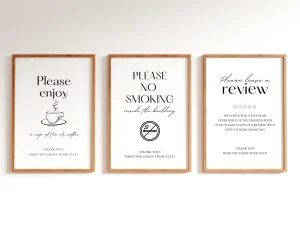
Everything you hand a guest, matched and priced to move together.
Edit the brackets tonight, paste the list into your listing, and the next booking arrives pre-screened by your own text. If a rule on your list has actually saved you from a dispute, or caused one, tell us in the comments; reader rule stories are how this template gets sharper. For the friendlier documents that surround the rules, the printable checklist guide and welcome book post round out the set.
FAQ
Common questions, answered briefly
What should Airbnb house rules include?
Are Airbnb house rules enforceable?
How many house rules is too many?
Can hosts charge fees through house rules?
If yours isn’t above, drop the question in the comments and we’ll fold it in.
People also ask