Why this matters
What a reading challenge tracker is for
A reading challenge tracker is the structure around a year’s reading. Pick a shape (bingo, count, or prompts), and the reading challenge tracker tells you how you’re doing against that shape. The honest reason most readers set a challenge is that the bare reading log doesn’t push them to read outside the genre they already read; the challenge introduces friction, in a useful direction. The honest reason most challenges fail by March is that the friction is too high and the reader stops opening the tracker.
The three challenge formats that survive in the wild are the 5×5 bingo card, the count-based goal (52 books a year, 100 books, or whatever number), and Bookopoly-style prompted reading. Each suits a different reader. The bingo grid suits readers who like loose prompts and a visual record. The count suits readers who motivate from a streak or a number. Bookopoly suits readers who want a more elaborate game; you roll dice, you move around the board, the board’s squares are reading prompts.
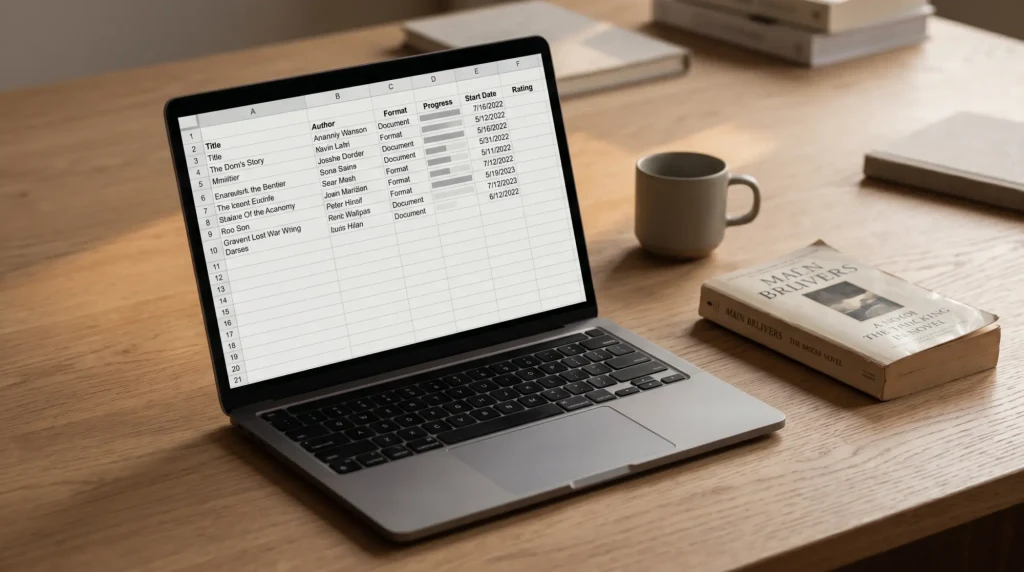
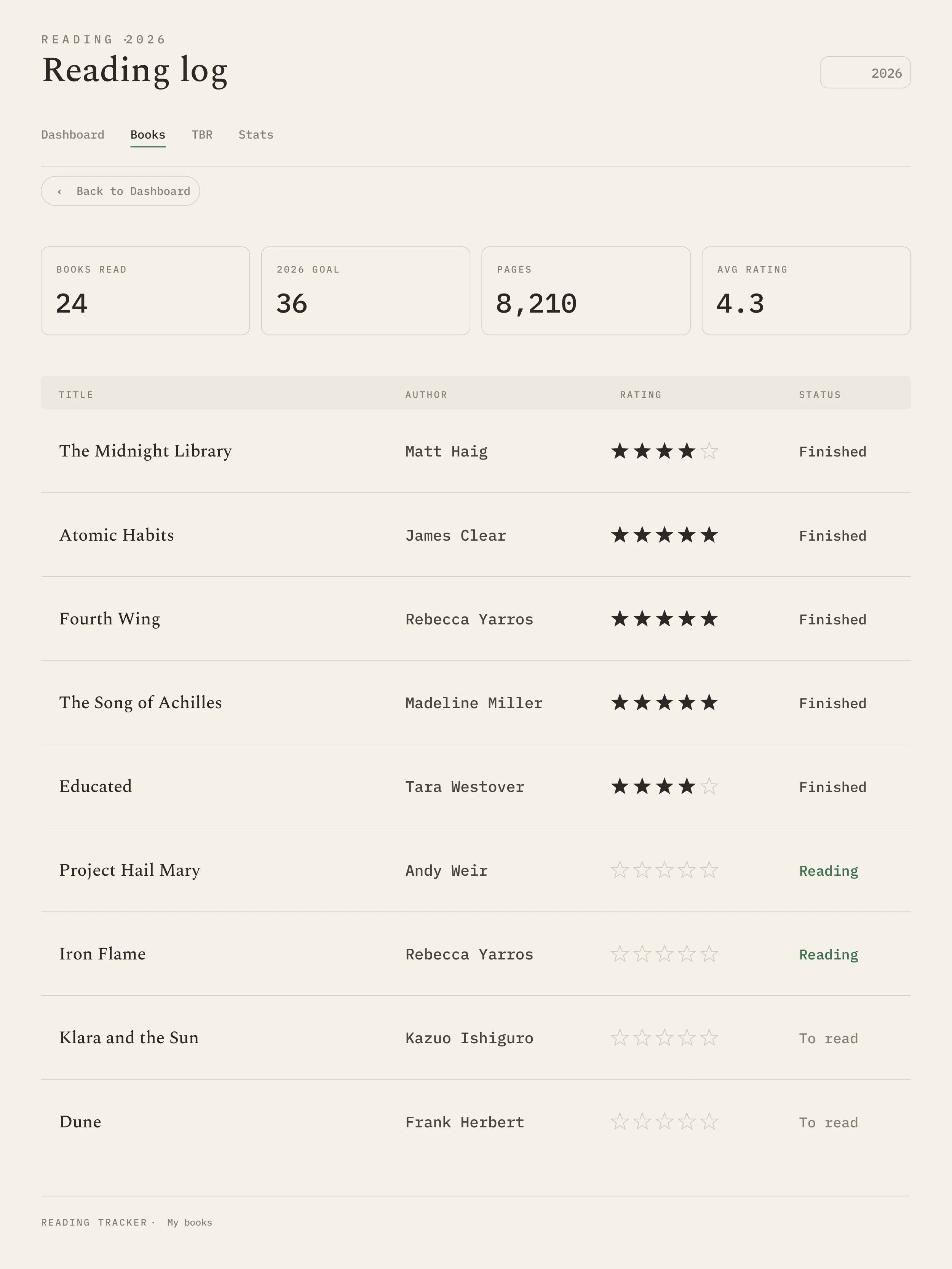
Whichever you pick, the tracker for the challenge should live inside or beside your reading log, not in a separate file. Two trackers means two acts of logging per finished book; that’s the failure mode. Our reading tracker spreadsheet pillar covers the log itself; this piece is the challenge layer on top of it. Both should ideally be in the same workbook.
Bingo
Reading bingo: the lightest challenge format
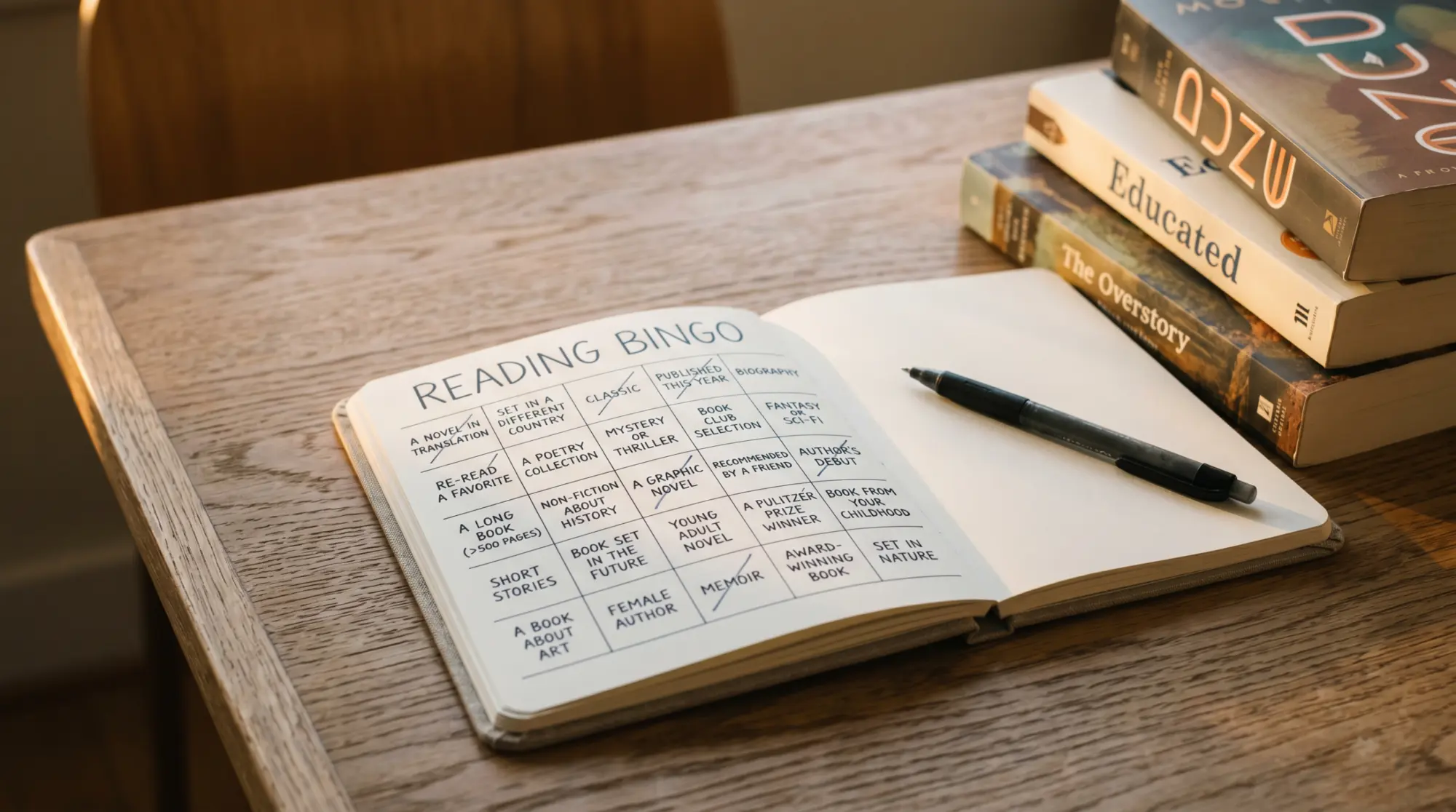
A reading bingo card is a 5×5 grid of prompts. The prompts are loose, the goal is to fill the grid, and one book can count for at most one square. Variants include the 5×5 single-row (any row, column, or diagonal earns you a bingo), the blackout (fill the whole card), and the open-fill (any 24 squares, with the centre as a free space). The reason bingo survives where stricter challenges fail is that the prompts are interpreted generously, and the visual record is satisfying without being demanding.

Good bingo prompts share three qualities. First, they’re loose enough that several books on your TBR list might fit each square. “A book with a one-word title” is a good prompt; “a book set in Wales in the 1860s by a debut author” is a bad one. Second, the prompts skew toward shape, not topic; “a book under 250 pages”, “a book you DNF’d before”, “a book your friend recommended”. Third, the card has at most one square that’s deliberately a stretch (the “challenge” within the challenge). Twenty-four loose squares and one stretch is the right mix.
Build the tracker inside your reading log. Add a 25th column to the workbook (or 24 if you skip the free space) named “bingo squares”, and write the square number(s) the book fills. Some readers prefer a separate tab with a 5×5 grid that updates by formula from the column; that works too. The point is the bingo lives in the same workbook as the log, so logging a book and updating the bingo are one act, not two.
52-book
The 52-book challenge: count-based, with caveats
The 52-book challenge is the simplest format. Read one book a week for a year. The tracker is the count, the chart is books-per-month, and the goal is binary (you hit 52 or you didn’t). Variants include the 100-book version, the 25-book version (for slower or denser readers), and the “books I read” without a number. Goodreads’ annual reading challenge is the 52-book format with a customisable target; StoryGraph offers the same shape with their own annual challenge.
The 52-book challenge motivates some readers and distorts others. The motivating reader uses the count to maintain a habit, and the count rises naturally from steady reading. The distorting reader picks shorter books to keep the count moving, and ends up reading more novellas and fewer of the dense books they actually wanted to read. If you find yourself eyeing a 250-page book over a 600-page one because the count is closer, the challenge is shaping your choices in a way you didn’t want.
The alternative we recommend for readers who like the count motivation but don’t want the book-length distortion is to track minutes per day instead. A daily 30-minute reading habit produces more reading over a year than a 52-book goal that pushes you toward novellas. Track minutes in the reading log as a per-book column; the dashboard line chart shows steadiness without distorting your book choices. Goodreads and StoryGraph both support custom annual challenge shapes if you’d rather use an app than a sheet.
Bookopoly
Bookopoly: the Monopoly-board variant
Bookopoly is the game-board challenge format Elaine Howlin popularised in her late-2025 spreadsheet variant. Her rules are short: start at Go, roll a die, move forward that many spaces, and read a book that fits the prompt you land on, then roll again. The prompts are the kind any reader can meet, from “Over 500 pages” and “Debut author” to “Translated” and “Set in your home country”. She also says you can simply tick off the prompts that appeal, no dice, which turns the board into a list.
The audience for Bookopoly is real. It suits readers who get tired of the same shape of reading and want a randomiser to break ruts; it suits readers who play tabletop games and like the carry-over feeling; it suits book clubs that want a shared structure. The trade-off is the friction. Bookopoly asks you to track the board state (which square you’re on), the dice rolls and which prompts you’ve completed, plus the reading log itself. That is three layers of tracking for one game, and the board state is the layer that is easiest to lose track of once the year gets busy.
If Bookopoly appeals, the cleanest implementation is Elaine Howlin’s spreadsheet, which encodes the board into a Google Sheet. The alternative is to skip the board and use the prompts as a flat list (her 2027 board carries 39 prompts; pick any 12 for the year), which her own rules allow; you lose the game element but keep the prompt variety. Pick the full board if you want the game; pick the flat list if you want the prompts.
App-based
App-based challenges: Goodreads and StoryGraph
Both Goodreads and StoryGraph run annual reading challenges with customisable targets. Goodreads’ is the more visible (the annual recap is a yearly social ritual for the platform’s user base); StoryGraph’s is the cleaner UI with more honest analytics around what you actually read. Both are free, both let you set a custom number, both auto-count from your “finished” shelf.
The app-based challenge wins when you already log inside the app; doubling up with a spreadsheet challenge tracker adds friction. If you log in Goodreads or StoryGraph, just use their annual challenge feature. If you log in a spreadsheet, build the challenge into the same workbook. Two systems is the failure mode. Any of our spreadsheet templates can carry a challenge tab alongside the log for that reason.
The friction of two trackers is what kills most reading challenges by March. The challenge has to live where the log already lives.Why this matters
The verdict
Which challenge to pick

Three quick branches. If you want the lightest challenge with a visual reward, build a 5×5 bingo grid into your reading-log workbook with 24 loose prompts and one stretch. If you want a count goal and can resist the novella temptation, the 52-book (or 30, or 100) challenge in Goodreads, StoryGraph, or your own sheet. If you want the game element, Bookopoly via Elaine Howlin’s spreadsheet (full board) or as a flat prompt list (lighter).
Reading challenges work when the friction is low and the prompts are loose enough that you can find a book to fit them without leaving the shape of reading you already wanted. If yours has died by March three years running, the challenge is the wrong shape for you, not your fault. Try a lighter format; the goal isn’t to finish the challenge, it’s to read more of what you wanted to read.
FAQ
Common questions, answered briefly
What is a reading challenge tracker?
What is reading bingo?
What is Bookopoly?
Does the 52-book challenge work?
Can you do a reading challenge in Goodreads or StoryGraph?
What makes a reading challenge tracker survive past March?
If yours isn’t above, drop the question in the comments and we’ll add it.
People also ask