For our broader Kindle Scribe review covering hardware, writing, reading, planner workflow, and the alternatives, see the Kindle Scribe review pillar.
What it does
What Kindle Scribe OneNote integration actually does
The Kindle Scribe OneNote integration is the cleanest way to get your handwritten notes off the Scribe and into a place where you can search, edit, and combine them with the rest of your work. OneNote is one of three connections Amazon offers on the Scribe, alongside Google Drive and Microsoft OneDrive, and it is the only one of the three that receives your handwriting as notebook content rather than as a file.
Start with the requirement, because it decides whether the rest of this page applies to you. Amazon’s own help pages state the connections need a Kindle Scribe released in 2025 or later, registered to an Amazon account and online, plus a Google or Microsoft account. That is a hardware line, not a firmware one. If you are holding a 2022 Scribe or the 2024 refresh, no update will surface the OneNote option, and any guide telling you to hunt for a firmware version is sending you after something that isn’t there.
Given an eligible device, the shape of the integration is narrower than most readers expect. It is a one-way export: notebooks you create on the Scribe get uploaded into a OneNote notebook called “Kindle Scribe”, and you choose the format on the way out, either handwriting kept as a PNG image or converted to text. Choose both and Amazon puts them side by side on the page. Once it lands you can edit, search, tag and file it like anything else in OneNote, but nothing you do there travels back to the Scribe.
The piece that surprises people: Amazon says plainly that Kindle Scribe does not support sharing personal documents with Microsoft OneNote. Kindle books you have annotated, Send-to-Kindle PDFs and imported ePubs are all personal documents, and the OneNote destination simply is not offered for them. What you can do with those is upload an annotated PDF copy to Google Drive or OneDrive. We’ll cover that route below, but it’s the single piece of context that decides whether this integration fits your workflow at all.
Setup
How to set up the Kindle Scribe to OneNote connection
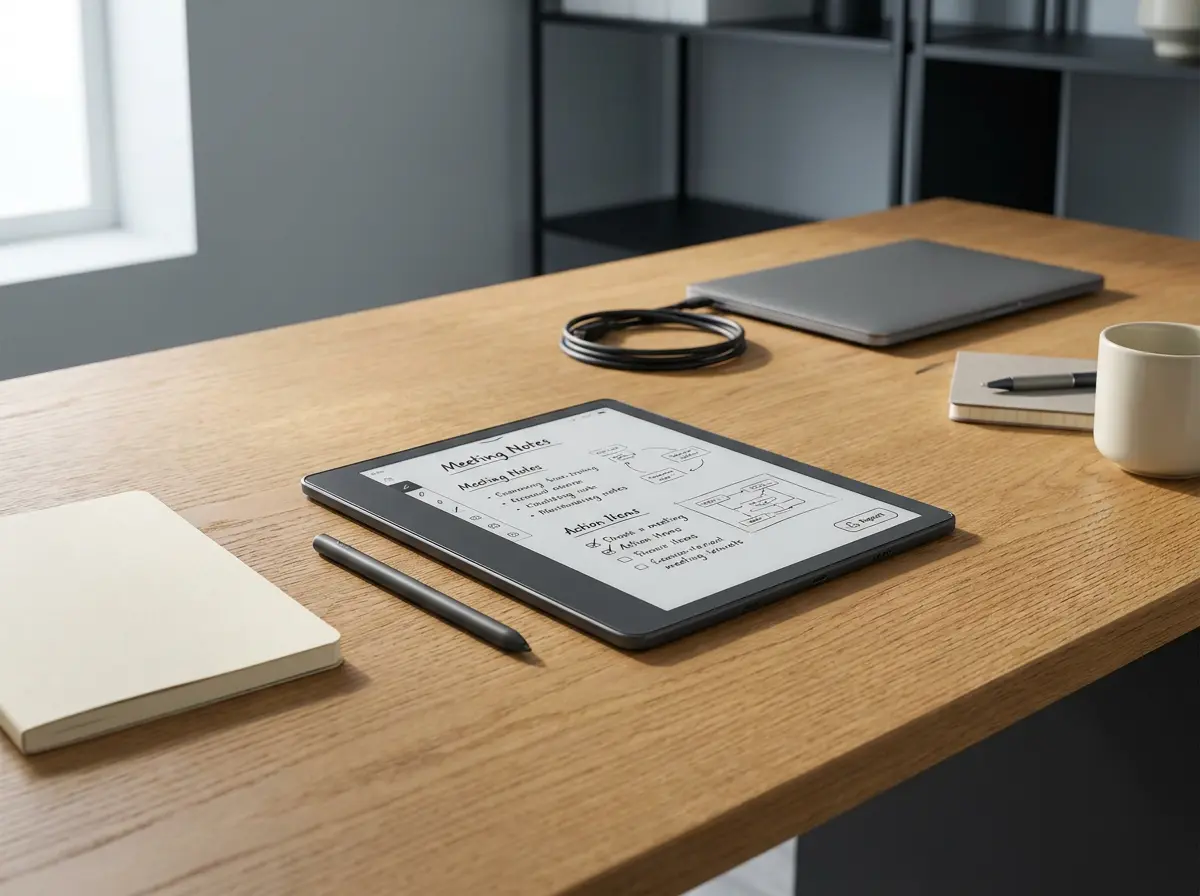
Setup is a one-time job and takes about two minutes, but it is worth knowing the shape before you start: you do not type your Microsoft password into the Scribe. The sign-in happens on your phone, and the Kindle just shows you a code. Have the Scribe registered and on Wi-Fi, and your phone in your hand.
- On the Scribe, either tap the connections icon next to the search bar on the Home, Library or Workspace tab and choose Add connections, then Microsoft OneNote, or go the long way through Settings, then Connections.
- Tap Connect next to Microsoft OneNote. The Scribe shows a QR code, a short URL and a code.
- On your phone, scan the QR code or open the URL, then enter the code from the Kindle. Codes expire after 15 minutes; if yours lapses, tap Generate new code on the Scribe and start this step again.
- Sign in to your Microsoft account on the phone and accept the requested permissions, then return to the Scribe to confirm the connection is active.
If Microsoft OneNote is not in the Connections list at all, the answer is almost certainly the device rather than the software. Amazon lists a Kindle Scribe released in 2025 or later as a requirement for the cloud connections, which covers the current Scribe and the Kindle Scribe Colorsoft and leaves earlier models out. Running Update Your Kindle on a 2022 or 2024 unit is a reasonable thing to try once, and then it is time to stop looking.
Exporting
Exporting a notebook to OneNote (image or text)
Once OneNote is connected, exporting is short. There are three ways into it, and you do not have to open the notebook first.
- Either open the notebook and tap the share icon in the toolbar, or from the Home or Workspace tab long-press the notebook cover or title, or tap the menu icon next to the notebook.
- If you opened the notebook, decide the scope: Share current page, Share entire notebook, or tap the multipage icon first to tick the pages you want and share only those.
- Choose Microsoft OneNote from the share menu.
- Choose the format and preview the conversion before you commit: handwriting kept as a PNG image, converted to text, or both.
- Tap Upload. The pages appear in a OneNote notebook called Kindle Scribe within a few minutes.
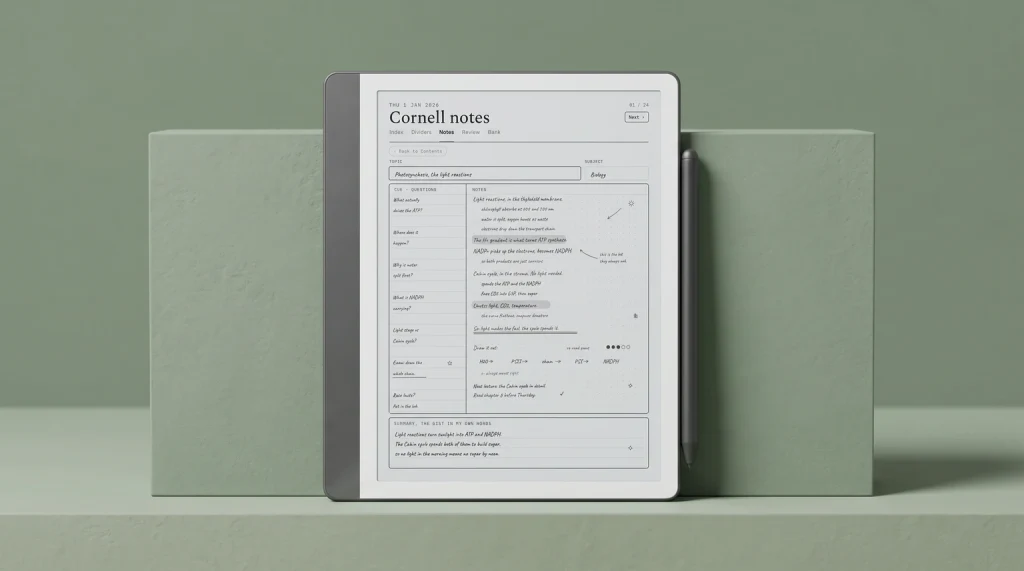
The format choice is the decision worth slowing down for. PNG keeps drawings, sketches and any non-text marks exactly as you drew them, but it is a flat image, so OneNote cannot search inside it and you cannot edit a line. Text is the opposite trade: every word becomes searchable and editable, and anything that was not writing has to be interpreted or dropped. The preview step exists precisely so you can see which way a given page falls before it lands.
You are not forced to pick, which is the part most guides miss. Amazon documents choosing both formats for the same upload, and OneNote then shows the image and the transcription side by side on the page. For a notebook that mixes diagrams with written notes, that is usually the right answer: the picture stays accurate, and the text underneath is what search actually finds.
The limit
The personal-document limit and the OneDrive workaround
The Kindle Scribe OneNote integration only handles notebooks. Personal documents, meaning Kindle books you have annotated, PDFs you sent to the device and ePubs imported through Send to Kindle, have no OneNote option in the share menu. Amazon states the limitation in one line and offers no reason for it, so neither will we; what matters is that it is a stated product limit rather than a setting you have missed.
The route that does work is a cloud drive. Open the document, tap the share icon, pick Google Drive or Microsoft OneDrive, and upload a PDF copy with your annotations in it; the Scribe creates a folder to hold the files it sends. From OneDrive you can then drop that PDF onto a OneNote page by hand if you want everything in one place. What you will not get is searchable OneNote text out of a Kindle book, because the conversion options that produce text are offered on notebooks, not on personal documents. Notebooks sent to a drive rather than to OneNote have a third option worth knowing about: a searchable PDF, which keeps the handwriting visible and puts the recognised text behind it.
Traffic in the other direction exists but stops short of a sync. You can import compatible files from Google Drive or OneDrive onto the Scribe, and Amazon is explicit that notes and highlights you then add do not travel back to the drive: you upload an annotated PDF copy instead. Every one of these paths makes a copy. Nothing on the Scribe stays in step with anything in the cloud, and planning around that is easier than being surprised by it in month three.
Three destinations, two kinds of content, and the answer is different in almost every cell. This is the table we wish had existed before we set any of it up.
Compatibility
Kindle Scribe connections, what goes where
The device is the same in all three columns. What each service accepts from it is not.
Works Partly, see the note Doesn’t
All three connections carry the same hardware requirement: a Kindle Scribe released in 2025 or later, registered and online, plus a Google or Microsoft account. Nothing in this table is available on a 2022 or 2024 Scribe. Uploads to OneNote land in a notebook called Kindle Scribe, which Microsoft stores in OneDrive under My Files, then Documents; on an M365 Business account it is My Files, then Notebooks, and whether it works at all depends on your employer’s security settings.
Checked 31 July 2026 against Amazon’s sharing, OneNote setup and import help pages The capture system
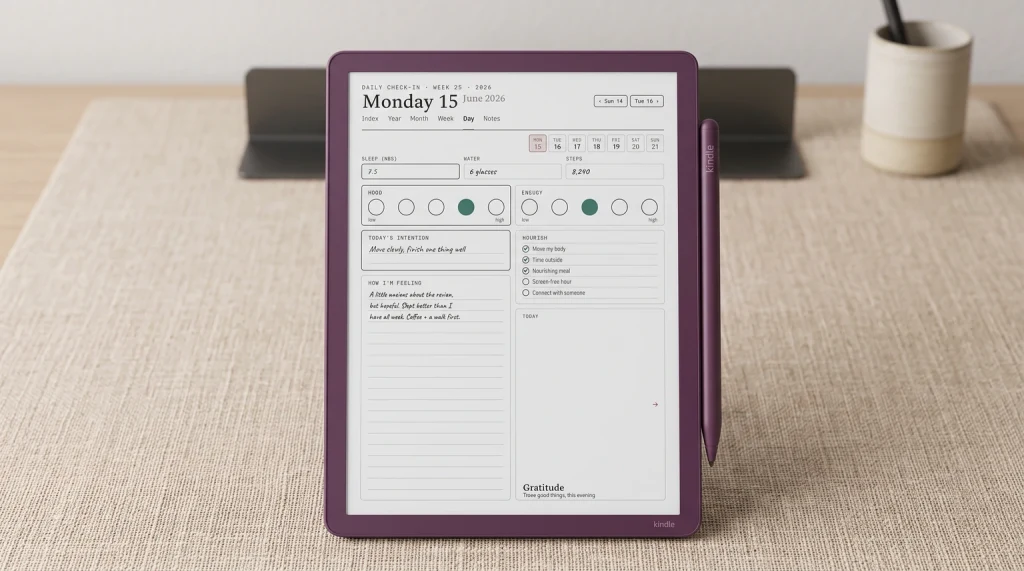
What you write on matters here too. Handwriting recognition reads a clean, well-spaced page far better than notes crammed into a margin, so a page designed with room to write exports more accurately than a blank one filled edge to edge. Our Kindle Scribe template bundle ($39) is drawn at the Scribe’s page size with that in mind: hyperlinked monthly, weekly and daily spreads that land as clean sections when you export as text, and as tidy PNGs when you export as image.
Troubleshooting
Troubleshooting common Kindle Scribe OneNote integration issues
Three issues come up repeatedly with the OneNote connection, and they’re all fixable.
- The upload never finishes. Check the obvious two first: the Scribe has to be online, and the connection has to still be authorised. Reconnecting Wi-Fi, then disconnecting and reconnecting Microsoft OneNote in Settings, Connections, clears most of it, since re-authorising issues a fresh token.
- The transcription is wrong. Handwriting recognition is good and not flawless, and cursive is where it struggles. Use the preview at export time rather than discovering it in OneNote: if the conversion looks poor there, send that notebook as an image instead, or send both and keep the image as the record.
- OneNote is not in the Connections list. Before troubleshooting anything, check the model. Amazon requires a Kindle Scribe released in 2025 or later for these connections, and on an earlier Scribe the option will never appear. On an eligible device, confirm it is registered and online, and if the code on screen has been sitting there a while, generate a new one; they expire after 15 minutes.
For Amazon’s own reference docs, the Microsoft OneNote Connection Quick Start covers the official setup, and the Share Kindle Scribe Notes and Notebooks page has the format-by-format breakdown. We read both while writing this page, and we re-read them when we update it, because Amazon changes the behaviour without announcing it.
Verdict
Is the Kindle Scribe OneNote integration worth using
Yes if your handwritten notes feed into a OneNote workflow you already use. The integration is fast, native, and unintrusive. Searchable text export is the killer feature for anyone who writes meeting notes, journal entries, or research outlines on the Scribe and wants them to be findable later.
It’s worth less if your Scribe use is mostly reading and annotating books. The OneNote integration won’t touch personal-document annotations, and the cloud-drive PDF route is a manual drag rather than a clean integration. If reading-with-annotations is your real workflow, the honest options are to accept a folder of annotated PDFs in a drive, or to accept that note review lives on the device. Neither is the thing the marketing implies, and knowing that before you buy is worth more than a workaround.
For more on what the Kindle Scribe Colorsoft adds beyond the original Scribe (including the deeper OneDrive and OneNote integration), our Colorsoft launch piece is the longer write-up, and the Colorsoft review covers what’s worth knowing for daily use. Templates that export cleanly to OneNote are in our free Kindle Scribe templates and best Kindle Scribe planner pieces, and the Kindle Scribe hub indexes the rest.
After the export
What to do with Scribe notes once they land in OneNote
The export drops everything into a single auto-created notebook called Kindle Scribe, in page order, named by date. That is fine for a week and unusable by month three. Searchable text only pays off if you can narrow the search, and a hundred pages called “Notebook, 14 March” narrows nothing.
Two habits fix most of it. Rename each page the moment it arrives, while you still remember what the meeting was, because the Scribe cannot send a useful title for you. Then tag the lines that matter with OneNote’s built-in tags as you reread: To Do, Important, Question. Find Tags then searches every tagged line across the notebook and returns them in one summary pane. It is a query you run rather than a rollup that keeps itself current, so you re-run it when you want it refreshed, and it calculates nothing. What it does do is answer “what did I commit to this month” in a couple of clicks instead of a scroll through eighty dated pages.
Beyond that, the structure has to already exist for the notes to land somewhere sensible: sections per client or project, a consistent page shape, tags decided in advance rather than invented per meeting. Our OneNote hub collects the setup guides if you want to build that yourself. Either way, decide the structure before you turn the export on, not after three months of dated pages.
FAQ
Common questions, answered briefly
Does Kindle Scribe have OneNote integration?
Can you export Kindle Scribe notes to OneNote as searchable text?
Why doesn’t OneNote appear in your Kindle Scribe Settings?
Can you export Kindle book annotations to OneNote?
Is the Kindle Scribe OneNote sync two-way?
If your OneNote-and-Scribe workflow has a wrinkle this post didn’t cover, drop it in the comments. Amazon changes what these connections do without announcing it, and we’d rather have a current page than a tidy one. We re-read the help pages each time we update this post, and the date on the table above is when we last did.