The question
What a rental property mortgage calculator should answer
Type a loan into most rental property mortgage calculators and you get one number back: the monthly payment. That is the number you already know if you own the rental. The questions a landlord with a loan actually carries are different. Does the rent cover the payment with room to spare? When is the loan gone? And with rates moving, is it worth refinancing, or do the closing costs eat the saving before you sell?
This post works those questions through on one rental, with real arithmetic you can check. The example is a single-family rental bought with a 30-year loan of $307,500 at 6.75%. After 25 payments the balance is $296,400, the payment is $1,994 a month, and the rent is $4,660, so the rent covers the payment 2.3 times. Coverage is the first line worth watching: it is the margin that pays for repairs, vacancy and everything else on the property before you see a dollar.
Now a lender offers 5.75% over 25 years, with $6,500 of closing costs. Should you take it?
The arithmetic
The refinance break-even, worked through for a rental
The break-even is the month the refinance has paid back what it cost to get. The standard formula is short: closing costs divided by the monthly saving.
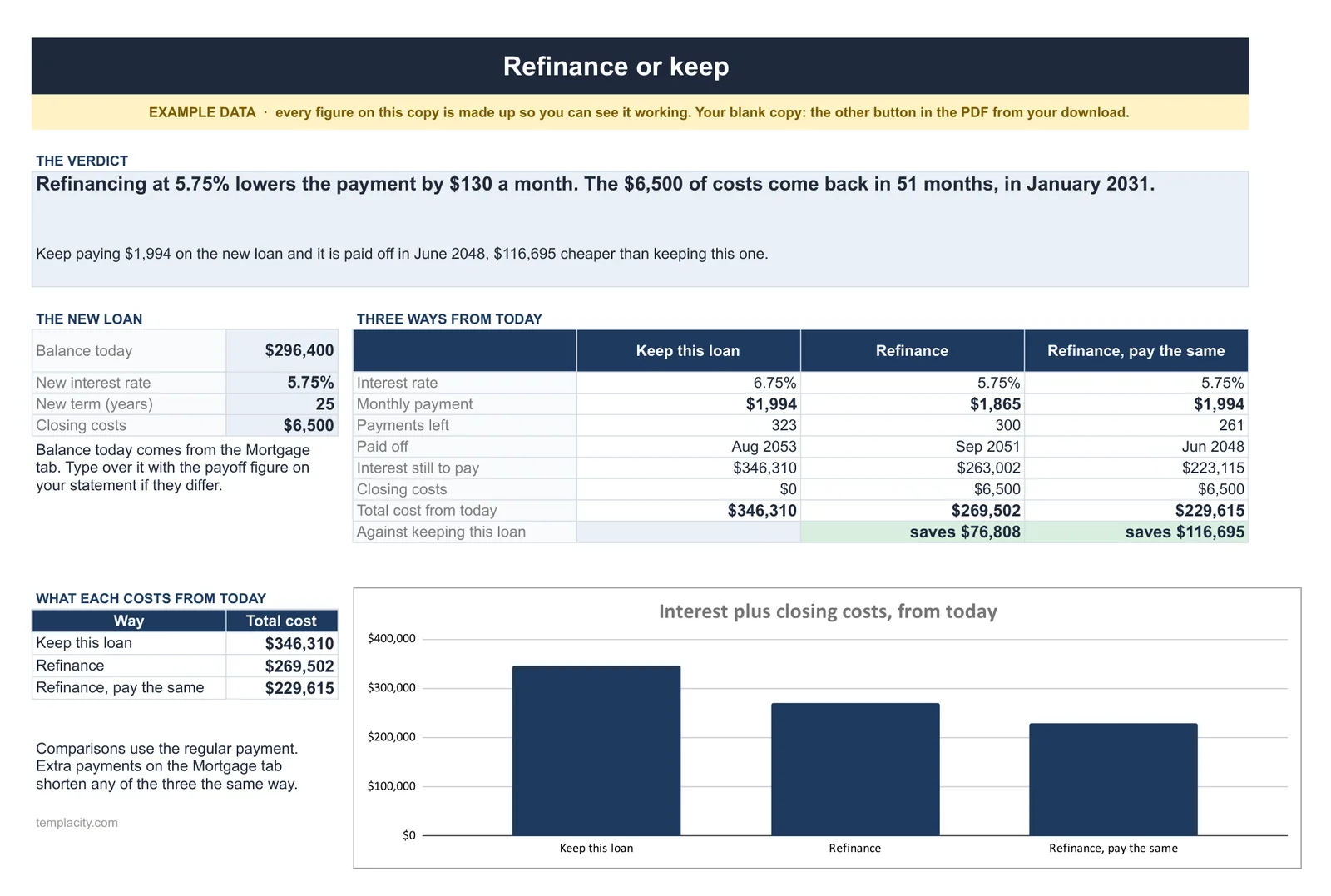
On our rental, the new payment for $296,400 at 5.75% over 25 years is $1,865. Against the current $1,994 that saves $130 a month (the unrounded figure is $129.77). Divide $6,500 by $129.77 and you get 50.1, so the costs are fully back in month 51, a little over four years after closing. Every month after that is money the refinance makes you.
The break-even only means something next to your plans for the property. If you expect to sell or move the loan again within four years, this refinance loses money even though the payment drops. If you plan to hold for ten, it is an easy yes on this test. A refinance break-even calculator that does not ask how long you will keep the rental is answering half the question.
The trap
Why the payment break-even misleads when the term resets
The formula above compares payments. A payment can drop for two reasons: a lower rate, or more years to pay. Refinance the same $296,400 at 5.75% over a fresh 30 years and the payment falls to $1,730, a saving of $265 a month. The break-even drops to month 25. On the payment test, the 30-year option looks twice as good.
It is not. Our rental has 323 payments left on its current loan, about 27 years. A 30-year refinance adds three years of payments back, and stretching the balance over more months means more interest. The fair comparison is what each option costs from today: the interest still to pay plus the closing costs.
| From today | Payment | Payments left | Interest plus costs | Against keeping |
|---|---|---|---|---|
| Keep the 6.75% loan | $1,994 | 323 | $346,310 | n/a |
| Refinance, 5.75% over 25 years | $1,865 | 300 | $269,502 | saves $76,808 |
| Refinance, 5.75% over 30 years | $1,730 | 360 | $332,796 | saves $13,514 |
| Refinance at 5.75%, keep paying $1,994 | $1,994 | 261 | $229,615 | saves $116,695 |
The 30-year reset has the fastest break-even and the smallest saving: $13,514 against keeping the loan, where the 25-year refinance saves $76,808. The last row is the one most calculators never show. Take the lower rate but keep paying the old $1,994, and the loan is gone in 261 payments, 62 payments (about five years) sooner than keeping it, for $116,695 less.
For a rental there is a real argument for the lower payment, because it widens the gap between rent and loan and makes a vacancy easier to carry. That is a cash flow choice, and a fair one. Just make it knowing what it costs over the life of the loan, rather than because the break-even month looked short.
The size of the drop
How big a rate drop a refinance needs
Rules of thumb about how many points a rate must fall are a shortcut for the break-even, and they ignore your balance and your costs. Run the same rental with the same $6,500 of costs and a 25-year term at smaller drops:
- To 6.25% (half a point): the payment is $1,955, saving $39 a month. The costs come back in month 166, almost fourteen years out.
- To 6.00% (three quarters of a point): $1,910, saving $85 a month. Break-even in month 77, about six and a half years.
- To 5.75% (a full point): $1,865, saving $130. Month 51.
Half a point is not worth paying $6,500 for on this loan unless you will hold it until about 2040. The same half point on a larger balance, or with lower closing costs, can clear easily. That is why the test has to run on your own numbers: balance, rate, years left and the costs on the lender’s estimate.
Rental specifics
What changes when the mortgage is on a rental
An investment property mortgage calculator runs the same arithmetic as one for a home, but a few things around it differ.
Rent coverage is part of the verdict. A refinance that lowers the payment raises coverage; a cash-out refinance that raises the balance lowers it. Check rent divided by the new payment before signing, alongside the break-even.
Points are spread over the loan, not deducted at once. IRS Publication 527 says that “because points are prepaid interest, you generally can’t deduct the full amount in the year paid, but must deduct the interest over the term of the loan”. When a refinance ends the old loan, the publication says you may be able to deduct its remaining points that year, but “if the refinancing is with the same lender, the remaining points (OID) generally aren’t deductible in the year in which the refinancing occurs”.
Cash taken out keeps its own label. The same publication says that when you refinance a rental for more than the previous balance, “the portion of the interest allocable to loan proceeds not related to rental use generally can’t be deducted as a rental expense.” Cash out to buy a car is personal borrowing secured on the rental, and the interest on that slice is not a rental cost. These are the IRS’s general rules; how they apply to your return is a question for whoever prepares it.
Because rental interest is a deductible expense, the after-tax saving from a refinance is smaller than the payment saving. The break-even above uses the payment, which is the number lenders and every calculator quote; treat it as the optimistic end.
Building it
A rental mortgage calculator in Google Sheets or Excel
A mortgage calculator spreadsheet needs one function. In Google Sheets and Excel alike, PMT “calculates the periodic payment for an annuity investment based on constant-amount periodic payments and a constant interest rate”. For our refinance that is =PMT(5.75%/12, 25*12, -296400), which returns $1,864.67. Put the current payment in the next cell, subtract, and divide the closing costs by the difference; round up to the next whole month and you have the break-even.
The cost-from-today comparison needs a schedule behind each option, because interest falls as the balance does. Our amortization schedule in Excel guide builds that table in three lines and adds extra payments to it. For the rental as a whole, our rental property spreadsheet guide sets the loan payment against the rent and every other cost, so you can see what is left as cash flow; our rent roll template guide covers the unit-by-unit snapshot of what the rent actually is. If the refinance changes your monthly cash position, our cash flow forecast template guide shows how to carry that forward month by month.
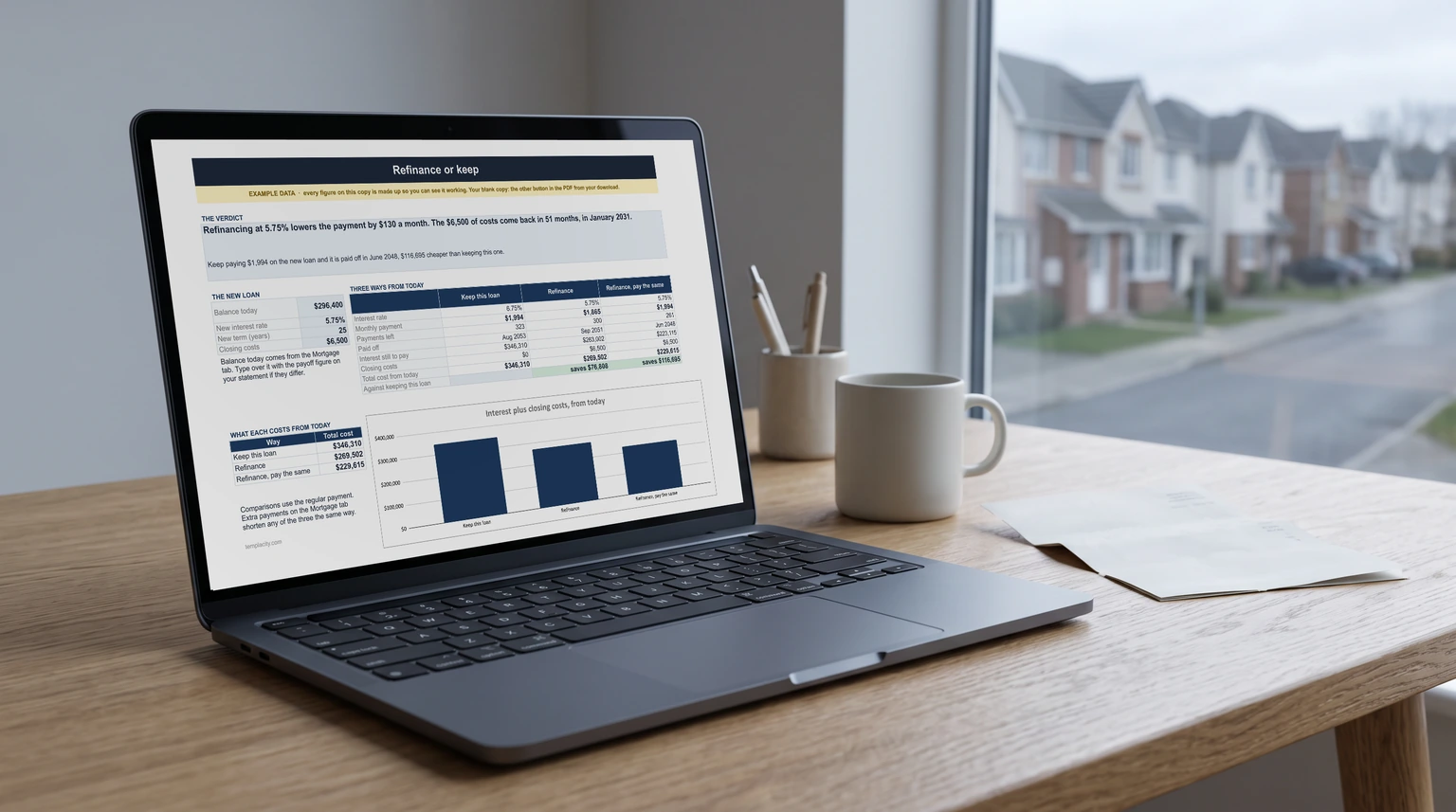
Or start from ours. The Rental Mortgage & Refinance Calculator ($29, Google Sheets and Excel) is built around this post’s question. Enter the loan and the rent once; the Mortgage tab gives the payment, what the rent covers, the balance today, the payoff date and what extra payments save. The Refinance tab sets keep, refinance, and refinance-and-pay-the-same side by side and answers in one sentence, with the month the costs come back. The worked rental above is its example data.
A refinance quote arrives with a payment on it and a deadline. Ten minutes with the break-even and the cost-from-today comparison is enough to know whether the payment is the whole story.
If you have run your own rental through the break-even, tell us in the comments what the month came out at and what you decided. We read every reply, and the questions landlords bring us shape what we build next.
FAQ
Common questions, answered briefly
How do you calculate the break-even on a refinance?
Is refinancing a rental property worth it?
Does a 30-year refinance save money on a rental?
Can you deduct refinance points on a rental property?
People also ask