The job
What an Airbnb bookkeeping spreadsheet has to do
Bookkeeping and tax prep get conflated, and the conflation is why most hosts have neither. Tax prep happens once a year and answers “what do we file.” Bookkeeping happens all year and answers “what actually happened,” one row per event, categorized as it occurs. An Airbnb bookkeeping spreadsheet is the second thing; do it properly and the first thing becomes an afternoon of reading your own records instead of a forensic dig through bank statements.
The host-specific wrinkle is that the platform already does part of the work and none of the rest. Payout statements give you gross, host fee, and net per booking (the fee mechanics are covered in our host fees explainer). What the platform cannot see is everything you spend: cleaners, supplies, utilities, repairs, the mileage to the property. The spreadsheet exists to merge the two halves, because the IRS treats rental income and its expenses as one picture even though your records arrive from two directions.
The structure
The five tabs that make it work
| Tab | One row per | Columns that matter |
|---|---|---|
| 1. Bookings ledger | Booking | Dates, nights, gross, host fee, occupancy tax, net payout |
| 2. Expense log | Purchase | Date, vendor, amount, category, property, receipt link |
| 3. Category summary | Category per month | Auto-summed from tabs 1-2; this is what tax prep reads |
| 4. Per-property view | Property | Income, expenses, margin; skip if you host one place |
| 5. Year dashboard | Month | Income vs expenses vs margin, trending across the year |
The expense categories of an Airbnb bookkeeping spreadsheet deserve one decision up front: name them after the buckets your filing will use (cleaning and maintenance, supplies, utilities, insurance, repairs, fees and commissions, mileage) rather than inventing your own. An airbnb accounting spreadsheet that categorizes the way the return is organized turns April into a copy job. Categories invented from scratch turn it into a translation job, and translation is where deductions get lost.
The routine
The monthly close, in four steps
Copy the month’s payouts into the bookings ledger.
From the platform’s transaction history, not from memory: gross, host fee, occupancy tax, net, one row per booking. Airbnb’s fee documentation explains each line; your job is just to record them as they appear.
Sweep the expense log against your card statement.
Scan the month’s statement for anything property-related you forgot to log in the moment. The forgotten case of paper towels and the hardware-store run are the rows that vanish if this step waits past the 15th of the following month.
Check the category summary for outliers.
One minute of reading: any category double its usual size gets a look. This is bookkeeping earning its keep as management, not just record-keeping; the doubled supplies line is how you find the leak in June rather than the year-end review.
Reconcile net payouts against the bank account.
The sum of the month’s net payout rows should match what actually landed in the bank. When it does, close the month and stop thinking about it. When it does not, the difference is always findable now and rarely findable in April.
Books you keep all year are a deduction list; books you reconstruct in April are a guessing exercise with penalties attached.The routine
The tool question
Excel, Google Sheets, or accounting software
An excel spreadsheet for Airbnb bookkeeping and a Google Sheets version are functionally identical for this job; pick whichever you already open weekly. Sheets has the edge if a cleaner or co-host needs read access, Excel if your receipts workflow lives on the desktop. Dedicated accounting software earns its subscription at roughly the point you cross several properties or bring in a bookkeeper who expects exportable journals; below that, software adds login friction to a ten-minute monthly task that a spreadsheet handles flat.


Everything you hand a guest, matched and priced to move together.
However you build it, an Airbnb bookkeeping spreadsheet is the five tabs plus the four-step close, run monthly. The broader tracking picture (occupancy, pricing, the operational columns) lives in our Airbnb spreadsheet guide, the filing side in the host tax walkthrough, and the margin math in the profit calculator guide. If your close routine has a step ours is missing, tell us in the comments; host bookkeeping habits are exactly the kind of field knowledge that improves this post.
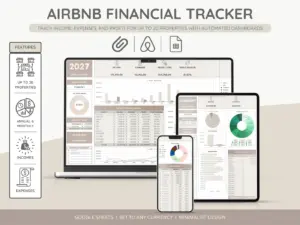
For hosts who would rather start from a finished file, the Airbnb host spreadsheet we keep updated handles the bookkeeping this post walks through.
FAQ
Common questions, answered briefly
What should an Airbnb bookkeeping spreadsheet include?
Is a spreadsheet enough for Airbnb accounting?
How do hosts track Airbnb income and expenses?
Does Airbnb report host income to the IRS?
If yours isn’t above, drop the question in the comments and we’ll fold it in.
People also ask