The call, up front
reMarkable Paper Pure review: is $399 the right ask?
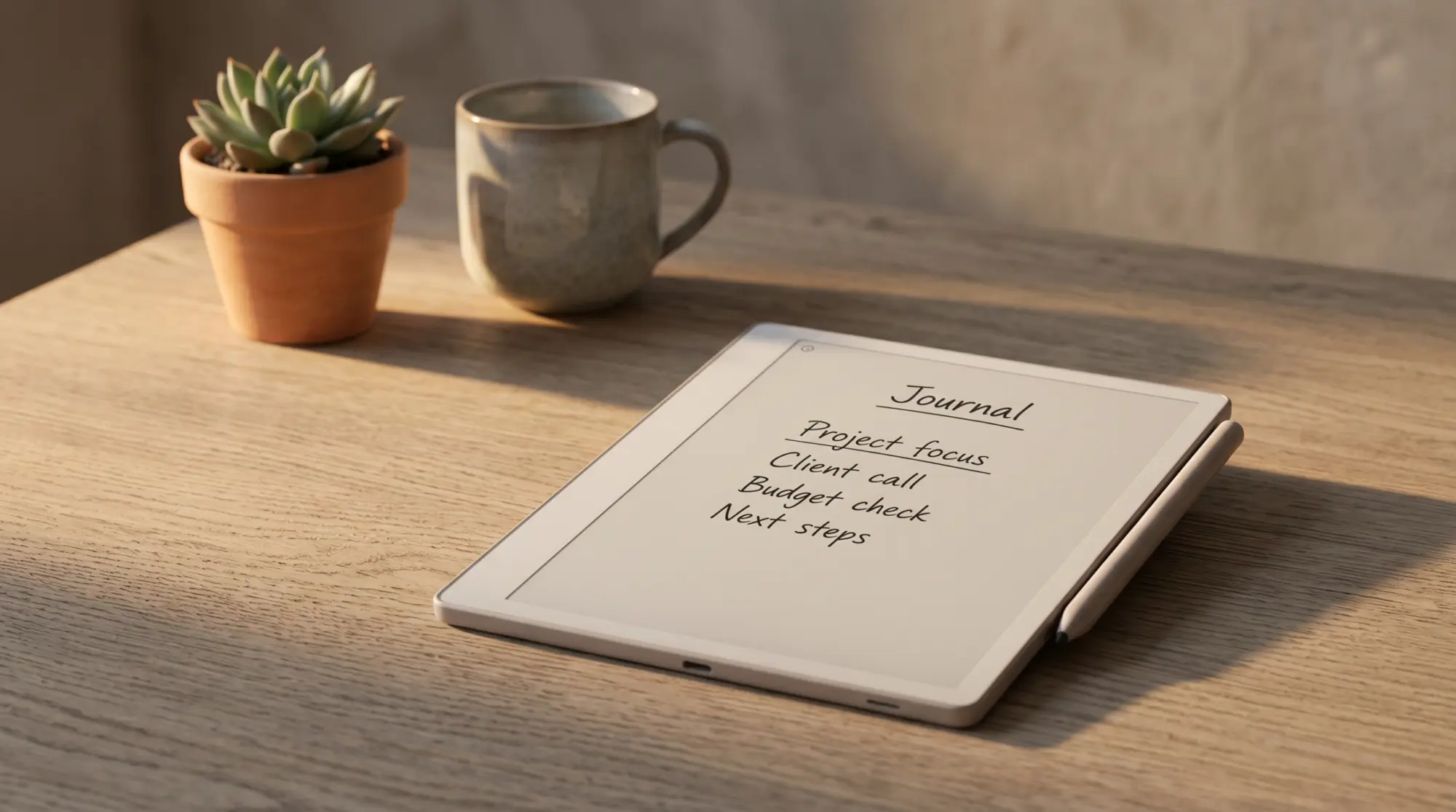
The reMarkable Paper Pure review answer splits cleanly. Yes for the buyer who wanted a reMarkable 2 in 2024 and got talked out of it by the sealed battery or the older panel. No for the buyer who is ready to spend $629 on the Paper Pro for color writing and ~12 ms latency. The Paper Pure is not the line’s flagship and it is not trying to be. It is the mono device that fixes the rM2’s specific gaps at the rM2’s specific price.
Two caveats up front. First, the Paper Pure shipped in June 2026 and nothing below is hands-on. Everything here is read from the spec sheet, from reMarkable’s published numbers, and from the prior performance of the Carta 1300 panel on the devices already shipping with it. Where a field review would change the read, we name that explicitly. Second, the comparison readers care most about is not Paper Pure versus Paper Pro; it is Paper Pure versus a refurbished reMarkable 2, which now starts $50 lower, at $349. We covered that fork in detail at Paper Pure vs reMarkable 2. This review focuses on the device on its own merits.
What changed
What changed from the reMarkable 2
Four deltas, each measurable. None of them is the writing engine. The Paper Pure’s writing surface specs (10.3-inch panel, 21 ms latency, Marker compatibility) match the reMarkable 2’s writing surface specs almost exactly. That is the point: reMarkable did not redesign the part of the device that worked. They redesigned the parts that did not.
| Delta | reMarkable 2 | Paper Pure |
|---|---|---|
| Frontlight | None | None |
| Panel generation | Carta (2019) | Carta 1300 (2025) |
| Battery serviceability | Glued in | User-replaceable 3,820 mAh |
| Chassis | Glued shell | Screws + snaps, 38% recycled |
| Writing latency | ~21 ms | ~21 ms (unchanged) |
| Pen-to-ink | ~1.0 mm | 0.84 mm |
Two things did not change. Writing latency holds at 21 ms; the Paper Pro line at ~12 ms is still the latency leader. Storage holds at 32 GB; if you load a working library of textbooks and PDFs, that is not generous. Both of those calls are honest pricing decisions from reMarkable. The Paper Pure is the entry-level mono device, and giving it Paper Pro internals would have collapsed the price ladder.
The full spec sheet, for the buyer who wants the rest of the numbers in one place:
- Display
- 10.3-inch E Ink Carta 1300, mono, 1404 x 1872 at 227 ppi
- Frontlight
- None. reMarkable lists no reading light on the Paper Pure.
- Processor
- 1.7 GHz dual-core Arm Cortex-A55
- Memory
- 2 GB RAM, 32 GB storage
- Battery
- 3,820 mAh, user-replaceable, ~3 weeks light use
- Writing
- 0.84 mm pen-to-ink, ~21 ms latency, Marker included
- Construction
- 38% recycled materials, screws and snaps, no glue
- Software
- Codex (same as the rest of the reMarkable line)
- Price
- $399 base, $499 bundle with Marker Plus and Sleeve Folio
The specs match the price ladder. $399 puts you on the same panel size as the Paper Pro at one-third less, with the same software and a slower stylus. The $499 bundle adds the Marker Plus and a Sleeve Folio for $100 over the base, against $50 for the Marker Plus upgrade alone and $69 for the folio bought separately, and a $549 bundle swaps in the new leather folio ($129 on its own).
Which of those two sleeves to buy, and when a third-party case is the better buy, is its own question, and our reMarkable Paper Pure case guide answers it.
Panel + pen
How the Paper Pure writes and reads
Carta 1300 is the panel generation that shipped on the 2024 Kindle Scribe and the Boox Go 10.3 (and Go Color 7, in its color sibling). Two years of field use show meaningful contrast gains over the rM2’s older panel and faster refresh rates on writing strokes. Page-turn ghosting is reduced. Long-form reading of PDFs at A4 is noticeably cleaner than on the rM2; small captions and footnote text land cleaner.
The gap the panel does not close is light. There is no frontlight on the Paper Pure, and reMarkable’s own spec page for the device lists none, while the Paper Pro page lists an adjustable reading light twice. That is the single biggest reason to look at a Kindle Scribe instead, because every Scribe except the $429.99 no-light model is front-lit, the older 10.2-inch one at $399.99 included, and reads in a dark room where this does not. Kindle and Kobo have shipped lit monochrome panels for over a decade, so the omission is a choice rather than a cost ceiling, and it is the one specification a buyer at this price is most likely to assume is there.
0.84 mm is reMarkable’s new headline number for the Paper Pure, and it is the closest pen-to-ink distance the company has claimed on any reMarkable device. The number reflects the gap between the surface of the panel cover and the actual e-ink layer where strokes land. Smaller is better for the writing illusion; smaller means less parallax when the pen leaves a line offset from where the eye expects it. For context, the reMarkable 2 ships at around 1.0 mm and the Paper Pro at around 1.2 mm. 0.84 mm is sub-1 mm for the first time on the line. Heavy-pressure writers and small-handwriting users will feel the difference; sketchers and broad-stroke note-takers may not.
Latency is the trade. 21 ms holds from the reMarkable 2. The Paper Pro line at ~12 ms is meaningfully faster, and a writer who has used a Paper Pro will feel the lag when switching to a Paper Pure. The question is whether 21 ms is fast enough to feel paper-like, which is what reMarkable was chasing in the first place. The rM2 spent five years answering that question yes for most writers, and this reMarkable Paper Pure review inherits that answer.
Repairability
Battery, repairability, and the recycled-materials angle
The construction is the under-discussed selling point in launch coverage, and it is the change that ages the best. Every reMarkable before this one is a glued chassis. The Paper Pure is screws and snaps. The battery is genuinely user-replaceable; the chassis comes apart on documented removal steps without breaking clips or panels. reMarkable says 38% of the materials by weight are recycled, which is a first for the line.
The pragmatic angle: e-ink panel batteries lose meaningful capacity at year three to year five under daily use. On a glued device, that often coincides with replacement. On the Paper Pure, year three is a battery swap, not an end-of-life event. The device is built to be the reMarkable a buyer keeps for the full useful life of the e-ink panel, not just the battery.
What we liked
- Screws-and-snaps construction, the first reMarkable a buyer can open without destroying it.
- 0.84 mm pen-to-ink is the closest reMarkable has put the ink to the glass on this line.
- User-replaceable battery and screws-and-snaps build, the first reMarkable a buyer can actually open.
- $399 entry price holds the line at the reMarkable 2’s original price five years on.
What we did not
- Still no frontlight, five years after the rM2 shipped without one. The Kindle Scribe has one at the same price.
- 21 ms latency unchanged from the rM2; the Paper Pro line at ~12 ms remains the latency leader.
- 32 GB storage with no expansion. Tight for textbook-heavy libraries.
- Mono only at this tier. Color writing means stepping up to the Paper Pro at $629 or the Paper Pro Move at $449.
The Paper Pure is most of the device the reMarkable 2 should have been in 2020: modern panel, repairable chassis, same $399 entry price, and still no light to read by.From the verdict
What we cannot test yet
What this review cannot tell you yet
The reMarkable Paper Pure ships in June. As of this writing, no buyer has the device. There are five things a field review will need to confirm, and this post deliberately does not assert on any of them:
- Real-world refresh rate on long PDFs. The Carta 1300 panel reads well on Kindle Scribe, but Paper Pure’s combination of panel and reMarkable’s writing-tuned software has not been measured in the field yet.
- Writing-feel after three weeks. The 0.84 mm number is a spec. Whether the writing surface holds up to three weeks of dense note-taking the way the rM2 has held up is a field question.
- Pen-nib wear curve on the new surface. Different e-ink coatings wear nibs at different rates. The Paper Pure’s Carta 1300 surface profile may behave differently than the rM2’s older Carta.
- Whether the repairable chassis is repairable in practice. Screws and snaps only help if reMarkable actually sells the parts. Battery and panel availability, and what they cost, is the test.
- Real-world battery numbers. “~3 weeks light use” is a vendor claim. Mixed writing-and-reading workloads typically come in below the marketing number.
None of these are likely to be disqualifying. The Paper Pure inherits well-understood hardware lineage from the rM2 and well-understood panel behavior from the Kindle Scribe. But spec consistency is not field validation, and we will update this review when the device is in real users’ hands. Subscribe to the niche newsletter at the bottom of the page if you want a ping when that happens.
Verdict
The reMarkable Paper Pure verdict, pre-shipping
FAQ
Common questions, answered briefly
Is the reMarkable Paper Pure worth waiting for instead of buying a refurbished reMarkable 2?
Does the reMarkable Paper Pure write in color?
How does the Paper Pure battery compare to the reMarkable 2?
Can templates designed for the reMarkable 2 be used on the Paper Pure?
What is the difference between the $399 and $449 Paper Pure SKUs?
If you are weighing it against the bigger sibling, our reMarkable Paper Pure vs Paper Pro comparison runs the two side by side.
If your question is not above, drop it in the comments. We will update this review when the device is in real users’ hands, and the FAQ is the first place we will fold in new questions readers actually ask.
People also ask