The real number
What Airbnb host fees actually include
Ask a new host what Airbnb host fees are and the answer is usually “3%.” That number is real, but it describes one line of a three-line deduction stack. On every booking, the platform applies a guest service fee (charged to the guest, roughly 14% of the booking subtotal), a host service fee (charged to you, either 3% or, on the host-only structure, 15.5% for most hosts), and, in many jurisdictions, an occupancy tax that Airbnb collects and remits on your behalf.
Two details worth pinning down, because they are the ones hosts get wrong. The 3% split-fee rate rises to 4% for listings in Brazil and Mexico. And on the host-only structure Airbnb states that most hosts pay 15.5%, with the rest typically landing between 14% and 16%, or 16% in Brazil and Mexico. If you are searching for why your fee reads 15.5% rather than 3%, that is the answer: you are on host-only, which is mandatory for traditional hospitality listings such as hotels and serviced apartments, and for anyone connected through property management software.
The guest service fee never appears on your payout statement, which is why most hosts ignore it. That is a mistake. The guest fee inflates the price guests actually compare in search, so it shapes your conversion rate even though you never touch the money. A $180 listing competes as a roughly $205 listing once the guest fee lands on top, per Airbnb’s published fee documentation.
This post walks the whole stack: both fee structures, the worked math on a real booking shape, the deductions hosts forget, and what you can honestly do about any of it. If you want to plug in your own numbers as you read, our Airbnb host fee calculator runs the same math interactively.
Two structures
Split fee vs host-only fee, side by side
Airbnb runs two fee structures for hosts, and which one you are on depends mostly on how you list. Hosts who connect through property-management software are generally moved to host-only; most individually managed listings still default to the split. The same one-week booking looks very different on a payout statement under each.
| Split feedefault | Host-only feesoftware-connected | |
|---|---|---|
| Host pays | 3% of subtotal | 15.5% for most hosts |
| Guest pays | ~14% on top of your price | Nothing extra |
| Search price guests see | Your rate + ~14% | Your rate, as listed |
| Platform take of gross | ~15% | ~15% |
| Payout statement reads | Small deduction, feels cheap | Large deduction, feels steep |
Read the bottom two rows together and the structures converge: the platform keeps roughly 15% of gross either way. The difference is who appears to pay it. Split-fee hosts feel cheap fees and show inflated search prices; host-only hosts feel steep fees and show clean search prices. Neither is a discount. They are the same take, routed differently.
The worked math
How much does Airbnb take from host payouts, really
Numbers beat adjectives here, so take a concrete booking: one week at $180 a night with a $90 cleaning fee. The stay subtotal is $1,260, and with cleaning the fee base is $1,350. Here is what each structure withholds.
| Line item | Split fee | Host-only | Notes |
|---|---|---|---|
| Stay subtotal + cleaning | $1,350 | $1,350 | Same on both |
| Guest service fee | ~$189 | $0 | Split: ~14%, paid by guest |
| Host service fee | ~$41 | ~$202 | 3% vs ~14-16% |
| Guest pays, all in | ~$1,539 | $1,350 | Split inflates the sticker |
| Platform take of gross | ~15% | ~15% | Converges either way |
So when someone asks how much does Airbnb take from host revenue, the honest answer is: about $230 of the $1,539 the guest paid under the split, or about $202 of $1,350 under host-only. Roughly 15 cents of every gross dollar, before your own costs (cleaning, supplies, utilities, mortgage) touch the remainder. That distinction between payout and profit is exactly why we built a separate Airbnb profit calculator walkthrough.
Both fee structures converge at roughly fifteen cents of every gross dollar. The difference is who appears to pay it.The worked math
The forgotten lines
The deductions hosts forget to count
Two more lines complicate the clean 15% story. The first is occupancy tax. In many jurisdictions Airbnb collects and remits transient lodging tax automatically; in others, you owe it yourself and the platform never mentions it. Hosts who move between markets, or who started before their city signed a collection agreement, regularly discover the gap at filing time. Check your jurisdiction in your payout settings rather than assuming.
The second is the float between published rates. The guest service fee is not a fixed 14%; Airbnb’s documentation describes a range of roughly 12% to 16% depending on country, stay length, and account specifics. Host-only sits between 14% and 16% on the same logic. If your spreadsheet hard-codes 3% and 14%, your projections will drift a few percent from reality across a full year, which on $50,000 of bookings is real money.
What you can do
Lowering the effective fee, honestly
You cannot negotiate Airbnb host fees, and most “pay less fees” advice online quietly means “leave the platform.” What you can do is lower the effective fee per booked night. Longer stays do this mechanically: a 10% to 15% weekly discount and a 25% to 30% monthly discount pull in bookings that spread the fixed costs (cleaning turnover, check-in time) across more nights, and fewer bookings means fewer fee events relative to revenue. Airbnb’s own hosting resources push the same lever for different reasons.
The other honest lever is pricing against the guest-facing number. If you are on the split fee, your $180 listing is a $205 listing in the guest’s checkout. Price as if the guest fee is part of your sticker, because to the guest, it is. None of these moves push the platform take below roughly 12% to 15% of gross. Anyone promising otherwise is selling something.

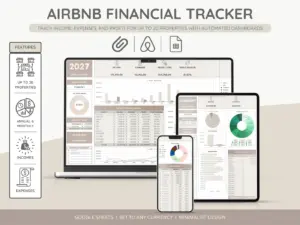

Everything you hand a guest, matched and priced to move together.
Make it routine
Tracking host fees so tax season is boring
Fees you tracked all year are a deduction; fees you reconstruct in April are a headache. The minimum viable system is one row per booking with four columns: gross booking value, host service fee withheld, occupancy tax remitted, and net payout. That is enough to reconcile your 1099 against reality and to spot the months where the fee percentage drifted. Our Airbnb spreadsheet guide covers the full layout, and the host tax spreadsheet walkthrough handles the filing side.
Host fees are the least controllable number in your hosting business, which is exactly why they should be the most boring one in your records. Know your structure, price against the guest-facing number, and reconcile monthly. If your payout statements have surprised you this year, tell us how in the comments; reader fee stories regularly turn into updates to this guide.
FAQ
Common questions, answered briefly
What are Airbnb host fees in 2026?
How much does Airbnb take from host payouts?
Why is my Airbnb host fee 15% instead of 3%?
Can you avoid or reduce Airbnb host fees?
Does Airbnb collect occupancy tax for hosts?
If yours isn’t above, drop the question in the comments and we’ll fold it in.
People also ask