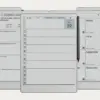
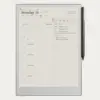
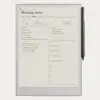
Templacity templates are made to be read on devices designed for focus, so the surrounding website should be the same: readable type, generous contrast, predictable navigation, no surprise pop-ins. This page documents what we test against, where we still have work to do, and how to flag anything that isn’t working for you.
What we test against
Every public page on templacity.com is built against the WCAG 2.2 AA standard. On every theme deploy, we run the same Lighthouse accessibility audit that Google PageSpeed Insights uses, and pages dropping below an internal threshold of 95/100 block the deploy.
In practice that means:
- Type is scaled from a system base, so browser zoom and OS “larger text” settings work without breaking the layout
- Colour contrast meets AA minimums for body text, interface copy, and link states in both light and dark themes
- Every interactive element is reachable by keyboard alone, with tab, shift-tab, enter, space, and arrow keys
- Focus is trapped inside overlays (cart drawer, mobile menu, modals) and restored when they close
- A skip-to-content link is the first focusable element on every page
- Heading order stays sequential so screen readers can navigate by document structure
- Images carry descriptive alt text, except purely decorative ones, which are explicitly marked decorative so screen readers skip them
- Motion is reduced automatically if your OS requests it
- Forms have visible labels, not placeholder text that vanishes on focus, and errors are announced rather than only coloured red
What we know is still imperfect
The honest list:
- A handful of older blog posts (pre-2026 rebuild) still have non-sequential headings or oversized images. We’re working through them as we re-edit the back catalogue.
- Some review-heavy posts embed YouTube or X. Those embeds carry their providers’ accessibility limits, not ours.
- The device-compatibility table is dense on small screens; a stacked version is on the build list.
If you find anything else we missed, please tell us. Details below.
The templates themselves
Templacity templates ship as hyperlinked PDFs. PDFs have their own accessibility characteristics: screen-reader compatibility depends on the reading device, the page structure, and whether the elements are tagged. Our exports include tagged headings and links, but if you need a different format (a high-contrast version, a tagged-PDF with simplified structure, a large-print export), write to us and we’ll prepare one. There’s no extra charge for an accessible alternative.
How to report something
The fastest route is an email to [email protected]. Useful details to include:
- The page URL you were on
- What you were trying to do and where it stopped working
- The browser, screen reader, or assistive setup you were using (keyboard only, NVDA, JAWS, VoiceOver, OS zoom level, and so on)
We reply inside one working day, and we treat accessibility reports as priority work, not feature requests: fix first, polish later.
Last updated May 2026.